
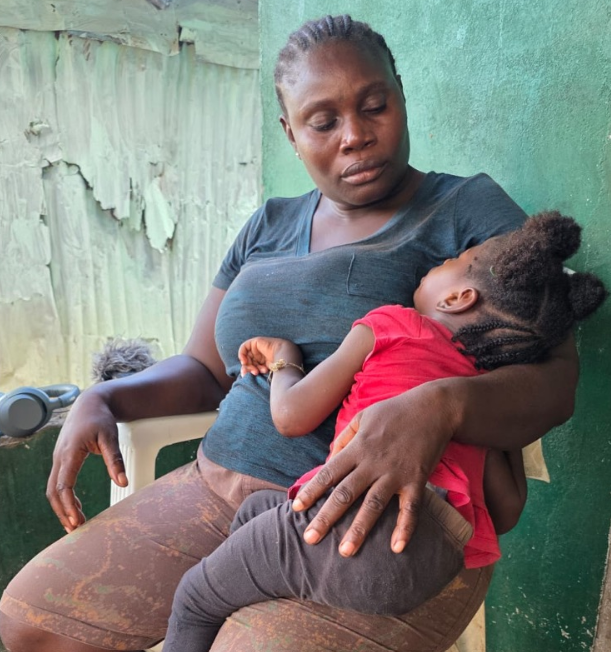
Rachel and her five-year-old daughter sit on their front porch
Summary:
• A family in Monrovia was forced from their home because the landlord believed her five-year-old daughter with cerebral palsy, a disability caused by damage to the developing brain, was cursed.
• Liberia has laws and a government agency to protect people with disabilities, but they do not do outreach campaigns that would have alerted the mother to her rights and provide no services to thousands of families with children with severe disabilities.
• The National Commission on Disabilities says just US$210,000 is allocated to its public sector investment program. The Commission says it needs at least US$1 million to meet demand.
By Tetee Gebro, gender and health correspondent with New Narratives
ELWA, Monrovia — Rachel cried as she packed her family’s meagre belongings. The rain from the sky matched the pain in her heart that early Sunday evening in June 2024. Rachel said her landlord had ordered her and her five children to leave. He called her daughter, who has cerebral palsy, a “dragon” and said children like her should not live in his house.
“It broke my heart and took tears from my eyes,” Rachel said. “Up to now, when I think about it, I can still cry.”
Rachel is one of thousands of parents of children with disabilities struggling to survive in Liberia, with a government that, experts say, has failed them. A previous New Narratives/FrontPage Africa investigation documented other families who said they had no government support, faced extreme discrimination and exclusion from schools.
Liberia has laws, a government disability commission and international commitments to protect people with disabilities. But in practice, the government does nothing. Its National Commission on Disabilities, the government agency tasked with assisting these families, does not know how many children have conditions such as cerebral palsy, a disability caused by damage to the developing brain, and profound autism. It has a small fraction of the funds it needs to meet demand. Most families do not even know a government agency exists.
The gaps come as the Human Rights Measurement Initiative released its latest global human rights data in June. The globally recognized measure assesses countries’ performance on economic, social, civil, and political rights. On “empowerment,” an assessment of how well the government is respecting rights, the country ranked “fair” but people with disabilities were ranked fourth most “at risk” of violations of their rights.
Liberia’s 2022 census found more than half a million people aged five and older – or about 11 percent of the population – had some level of functional disability. While there is no national data, in 2022 Unicef estimated about 1 in 7 children in West Africa had moderate to severe disabilities.
Doctors have expressed heartbreak and frustration at the number of babies they see with cerebral palsy in Liberia. Most cases are preventable and happen when the baby is deprived of oxygen during an emergency birth. Because many women avoid hospital because they do not have the funds to pay for it, and medical staff do not know the signs, there are a higher number of these injuries in Liberia than in countries with better functioning health systems. Rachel said this was exactly the case with her daughter. After a long labor the baby was rushed to hospital but it was too late. (New Narratives withholds the names of children in its reporting to protect them from stigma)
Advocates said that with support services children with severe disabilities and their families can see improvement in their quality of life.
Discrimination and stigma are illegal but there are no protections for families
The discrimination that Rachel and other families have suffered is illegal. Liberia has committed to protecting the rights of people with disabilities. The government established the National Commission on Disabilities under a 2005 law. It has also ratified the United Nations Convention on the Rights of Persons with Disabilities, and the country’s Children’s Law includes protections for children with disabilities.
But in practice laws are not enforced. Mohamed Sackor, program manager of the National Commission on Disabilities said lawyers advised the Commission it cannot prosecute someone solely on the basis of Liberia’s international treaty commitments without the relevant protections being incorporated into national law.
He said the Commission is working on proposed disability legislation that would strengthen protections, including requirements for schools to provide accessibility and accommodation for children with disabilities. That would need to go to the Legislature but lawmakers often need an active lobbying campaign to agree to such laws. No such campaign is happening now.
Meanwhile cases are widespread according to Urias Pour, executive director of Liberia’s Independent National Commission on Human Rights. He said its monitors have documented children with disabilities being called “dragons”, bullied in schools and having their complaints dismissed.
In one case, Pour said, a 12-year-old girl with a speech impairment went to police to report abuse by a relative. Officers gave her a biscuit and sent her home. “No one looked into the matter because they could not hear her,” Pour said.
Bowoulo Taylor Kelley, vice president of the Association of Female Lawyers of Liberia, said responsibility cannot rest with the disability commission alone. She said ministries responsible for education, health, gender and justice need systems and funding that allow people with disabilities to exercise their rights.
“Fund and enforce disability rights as a legal obligation and not as charity,” Kelley said. “Our people are not beggars.”
Families also desperately need services to avoid poverty, illness and death
Rachel’s daughter turned five in August. She cannot walk or speak and depends on her mother for almost everything. But when her four siblings talk and play with her, she laughs.
The child’s father stopped supporting his daughter after members of his family called her a witch. Rachel once took him to police and a relative promised he would provide support, but she has received none. Rachel used to earn money washing other people’s clothes but she can no longer easily leave home because her daughter needs constant care. “I can’t turn my back on my child,” Rachel said.
“I carried her for nine months and I suffered, and I am still suffering for her,” said Rachel. “Sometimes I can lock myself up in the room and cry, cry, cry.”
Rachel said her daughter recently became seriously ill and was taken to hospital because Rachel was not able to feed her. The girl will only eat Cream of Wheat mixed with peanut butter. But a small packet of peanut butter costs L$180. When she could not afford it, Rachel softened rice and tried to feed it to her. Her daughter refused to eat.
Rachel said she pawned the deed to her property to a shopkeeper to get a US$5 pack of diapers after the shopkeeper refused to give them to her on credit. Rachel is now starving herself.
“So for that reason my daughter’s body is dropping and it’s hurting me,” Rachel said. “I can’t see my daughter in that condition where she has not eaten and then I take food to eat.”
She wants help starting a small business she can operate from home. The family lives in a makeshift house, and Rachel said she also needs money to repair its floor. Her other four children are also suffering from the financial challenges brought on by her situation.
Janet, and her five-year-old son, who also has cerebral palsy caused by lack of oxygen during birth
Government doesn’t know how many children need help
Sackor said the lack of data on how many children in Liberia have severe disabilities makes it harder for the Commission to identify people who need help and plan services for them. But even if it had the funds, it could not do much.
The Commission has a budget of US$573,00 of which US$210,000 is allocated for its public sector investment program across the entire country. Sackor said it provides educational and technical-vocational assistance and is currently supporting about 150 people in various ways.
“There is a huge pressure on the Commission currently to accommodate more people,” Sackor said.
Sackor said the Commission needs at least a million a year and is hoping the Boakai administration – that recently trumpeted an increase in revenue to more than $1 billion – will agree to an increase in the Commission’s budget next year.
The Commission is working with international partners to improve screening and data collection, including for people with cerebral palsy and profound autism, a severe developmental condition that usually leaves children without language and with limited control of emotions, and requiring constant care.
But there is no coordination of the services that do exist. JFK Medical Center operates a pediatric neurology clinic that treats children with neurological conditions including cerebral palsy. Sackor told FrontPage Africa/New Narratives it did not know about the clinic but would follow up.
For now, Rachel and thousands of other families like hers are battling to survive day by day, afraid for their children and for themselves.
This story was produced in collaboration with New Narratives as part of the Investigating Liberia project.
See more Liberia News Network stories in Google Search by adding LNN as one of your Preferred Sources.
★ Add LNN as a Preferred Source