
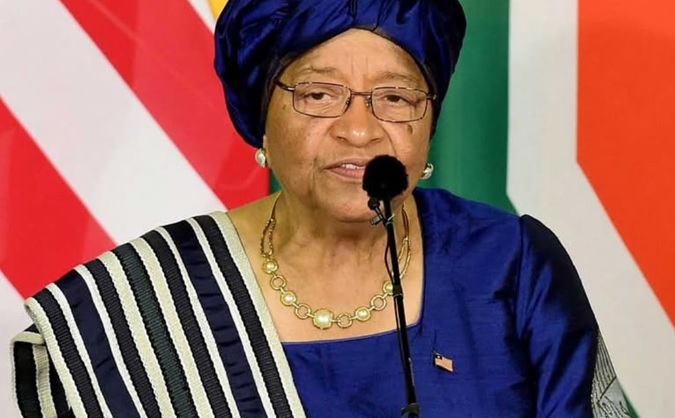
The former president’s sovereignty message raises questions about timing, her own record, and Liberia’s long relationship with Washington
MONROVIA, LIBERIA — When former President Ellen Johnson Sirleaf declared that Liberia must stop following the United States and embrace a new era of African sovereignty and respectability, she raised a question that goes beyond foreign policy: Why is this message coming now, and how does it compare with the policies and diplomatic approach she pursued during her own presidency?
Sirleaf made the remarks on October 6, 2026, following a governance symposium in Monrovia. According to reports published by Liberian media, she told journalists: “We have to stop following the United States of America. Let’s join a new era of sovereignty and respectability that Africa is pushing.” She also argued that Liberia could no longer continue operating with the same structures, policies, attitudes, and mindsets while Africa and the wider world were changing.
The statement has attracted attention because of the speaker herself. Sirleaf, who served as Liberia’s president from 2006 to 2018, was Africa’s first elected female head of state and became internationally recognized for her close engagement with Western governments and development partners.
Her call for a different approach therefore invites a legitimate examination of Liberia’s relationship with Washington, the record of her administration, and whether the country has been too dependent on external partners to determine its development priorities.
The central question is not whether Liberia should have an independent foreign policy. Every sovereign country should. The question is why this message is being emphasized now by a former president whose administration operated within a particularly close relationship with the United States.
A MESSAGE THAT CHALLENGES HER OWN POLITICAL LEGACY
During Sirleaf’s presidency, Liberia worked closely with the United States on postwar reconstruction, economic recovery, governance reforms, security, and public health. The relationship strengthened considerably during her administration, which benefited from substantial American assistance and wider international support.
A 2020 report by the U.S. Congressional Research Service noted that Washington provided significant development assistance during Sirleaf’s tenure. It also documented that her administration secured nearly US$5 billion in external debt relief and attracted major support from international donors.
Those achievements matter. Liberia emerged from years of civil war with damaged infrastructure, weakened institutions, and an economy in need of urgent reconstruction. Close cooperation with international partners helped the country address some of those challenges.
But the same history raises a difficult question: If Liberia needed to develop a more independent national outlook, why did that objective not become a more prominent feature of Sirleaf’s own governing agenda?
Did her administration sufficiently challenge the tendency to look to Washington and other Western capitals for support, policy direction, and international approval? Did Liberia use the assistance it received to build a stronger foundation for self-reliance, or did its dependence on external financing remain a structural weakness?
These questions are fair, although they should not be used to dismiss every achievement of her administration. Liberia’s postwar circumstances were exceptional, and international cooperation was not necessarily evidence of surrendering national sovereignty.
Nevertheless, the former president’s current message invites scrutiny of whether the relationship she helped strengthen also left Liberia with unresolved questions about economic independence and national decision-making.
WHY SPEAK NOW?
The timing is one of the most important aspects of Sirleaf’s statement.
She has been out of office since January 2018. Her call comes at a time when debates about African sovereignty, international partnerships, economic dependence, and the ability of African countries to determine their own futures remain significant.
Her remarks may reflect a genuine reassessment of the international order. The world has changed considerably since she took office in 2006. African countries increasingly discuss diversifying their economic and diplomatic relationships and negotiating international partnerships on terms that better serve their citizens.
There is also a practical argument behind her message: Liberia should not automatically accept an American, European, Chinese, or any other foreign government’s preferred approach simply because that government has greater economic or political influence.
However, the timing invites questions that Sirleaf has not publicly answered in the reports reviewed for this analysis.
What specific American policies does she believe Liberia should stop following?
Is she criticizing Liberia’s historical diplomatic orientation, its economic policies, its reliance on foreign aid, or a broader habit of treating Western approval as a measure of national success?
Has she identified particular agreements, policies, or institutional arrangements that should be reconsidered?
Without such details, her statement remains a broad political principle rather than a concrete policy proposal. The distinction matters because a call for sovereignty is most useful when it explains what a country should change and how those changes would benefit its people.
DID SHE HAVE THE OPPORTUNITY TO MAKE THIS CHANGE AS PRESIDENT?
This is perhaps the most uncomfortable question surrounding the former president’s statement.
Sirleaf occupied the highest political office in Liberia for 12 years. She had the authority to set national priorities, negotiate international agreements, shape foreign policy, and direct the government’s development agenda within the limits of Liberia’s Constitution and institutional arrangements.
Her administration also enjoyed strong relationships with international donors and development partners. That cooperation helped Liberia secure debt relief and resources for reconstruction, but it also makes it reasonable to ask how far her government advanced the goal of economic and policy independence.
Critics may argue that a leader who now urges Liberia to stop following America should explain what she did, or could not do, to change that pattern while in office.
But the issue requires a balanced assessment. Sirleaf inherited a country devastated by war, and rebuilding it required international assistance. Cooperation with the United States did not automatically mean that Liberia was surrendering its sovereignty. Nor does the fact that her administration maintained close ties with Washington prove that she opposed an independent Liberian foreign policy.
The more precise question is whether the country’s relationship with its strongest partners was structured to build lasting domestic capacity and economic resilience.
If Sirleaf now believes Liberia must move beyond an established pattern of dependence, she could strengthen her argument by explaining which lessons she learned during her presidency, what limitations she encountered, and what she would do differently today.
That would turn a provocative statement into a more substantive contribution to the national debate.
COULD THERE BE A POLITICAL MOTIVE?
The question of motive is unavoidable in political analysis, but it must be handled carefully.
Sirleaf remains a prominent former president whose statements can influence public debate. Her call for a change in Liberia’s relationship with America may serve several possible purposes.
First, it may represent a genuine change in her thinking about the international system and the need for African countries to exercise greater control over their development priorities.
Second, it may be an attempt to contribute to a wider African conversation about sovereignty, economic independence, and the limits of relying heavily on foreign assistance.
Third, it may be part of her effort to shape the political and historical interpretation of her own legacy. By emphasizing sovereignty now, she is placing herself within a debate about how Liberia should relate to powerful foreign countries in the future.
But these are possible interpretations, not established facts. The available reports do not demonstrate that she made the statement to advance a hidden political agenda, settle scores with Washington, support a particular Liberian political party, or position herself for a specific future role.
It would therefore be irresponsible to present any such motive as fact without additional evidence.
The more useful test is to examine what follows the statement. Does Sirleaf identify practical reforms? Does she advocate transparent review of foreign agreements? Does she support greater domestic investment, stronger public institutions, local industrial development, and accountability in the management of national resources?
Those actions would help establish whether her message is primarily a call for policy change or a broad statement of political principle.
STOP FOLLOWING AMERICA DOES NOT MEAN BREAKING WITH AMERICA
Liberia’s historical relationship with the United States is unusual and deeply rooted. The two countries have maintained close diplomatic ties for generations, and the United States has played significant roles in Liberia’s postwar recovery and development.
But sovereignty does not require Liberia to reject American cooperation.
A country can maintain strong diplomatic relations with Washington while independently deciding its economic priorities, negotiating its mining and investment agreements, protecting its natural resources, and determining the policies best suited to its people.
The same principle should apply to Liberia’s relationships with China, the European Union, regional African partners, and international financial institutions.
The objective should not be to replace dependence on one foreign power with dependence on another. It should be to develop the national capacity to negotiate with all partners from a position of informed choice and accountability.
That means asking hard questions about foreign investment, public debt, aid conditions, mineral concessions, local employment, technology transfer, and the share of national wealth that remains in Liberia.
It also means holding Liberian officials accountable. Foreign influence cannot be examined in isolation from the decisions of domestic leaders who negotiate agreements, approve policies, and manage public resources.
Sovereignty is not merely a declaration. It must be reflected in the institutions and economic choices of the state.
THE QUESTION OF AFRICA’S “NEW ERA”
Sirleaf’s reference to a new era of sovereignty and respectability reflects an important aspiration: African countries should have a stronger voice in shaping their economic and political futures.
But what does that new era mean for ordinary Liberians?
Will it lead to better roads, improved hospitals, more reliable electricity, stronger schools, greater employment, and a more productive economy? Will it help Liberia negotiate better deals for its iron ore, gold, timber, and other natural resources? Will it reduce the country’s vulnerability to shifts in foreign assistance?
Those are the outcomes by which the argument should be judged.
A country may speak forcefully about independence while remaining economically vulnerable. It may criticize foreign influence while allowing weak institutions, corruption, poor public financial management, or unaccountable concessions to undermine national development.
For Liberia, a credible sovereignty agenda would require more than changing diplomatic language. It would demand stronger public institutions, transparent contracts, a productive domestic economy, better management of natural resources, and political leaders willing to defend national interests even when doing so is difficult.
It would also require a clear explanation of how Liberia can reduce dependency without jeopardizing beneficial partnerships or essential development support.
THE FORMER PRESIDENT OWES THE PUBLIC AN EXPLANATION
Sirleaf’s statement opens an important discussion, but it also places a responsibility on her to clarify the difference between her present position and the approach pursued during her presidency.
What does she believe Liberia should stop following? Which policies should be changed? What lessons from her 12 years in office inform her current position? And how can Liberia pursue greater independence without isolating itself from international cooperation?
These are not questions intended to dismiss her contribution to Liberia’s postwar recovery. They are questions that should be asked of any former head of state who proposes a significant change in national direction.
Her experience gives her a valuable platform from which to explain how foreign partnerships can be made more accountable and beneficial to Liberia. It also gives the public a legitimate basis for comparing her present advice with her past decisions.
Ultimately, Liberia does not need to choose between blindly following America and rejecting America. It needs to decide what serves Liberia.
The former president’s call will carry greater weight if it is accompanied by specific proposals, an honest assessment of the policies pursued during her own administration, and a practical plan for strengthening national independence.
Until then, the question remains: Is Sirleaf offering Liberia a new roadmap for sovereignty, or raising a principle that her own presidency left only partially addressed?
The answer should be found not in speculation about her personal motives, but in the policies she proposes, the record she is willing to examine, and the practical steps she encourages Liberia to take.
See more Liberia News Network stories in Google Search by adding LNN as one of your Preferred Sources.
★ Add LNN as a Preferred Source