
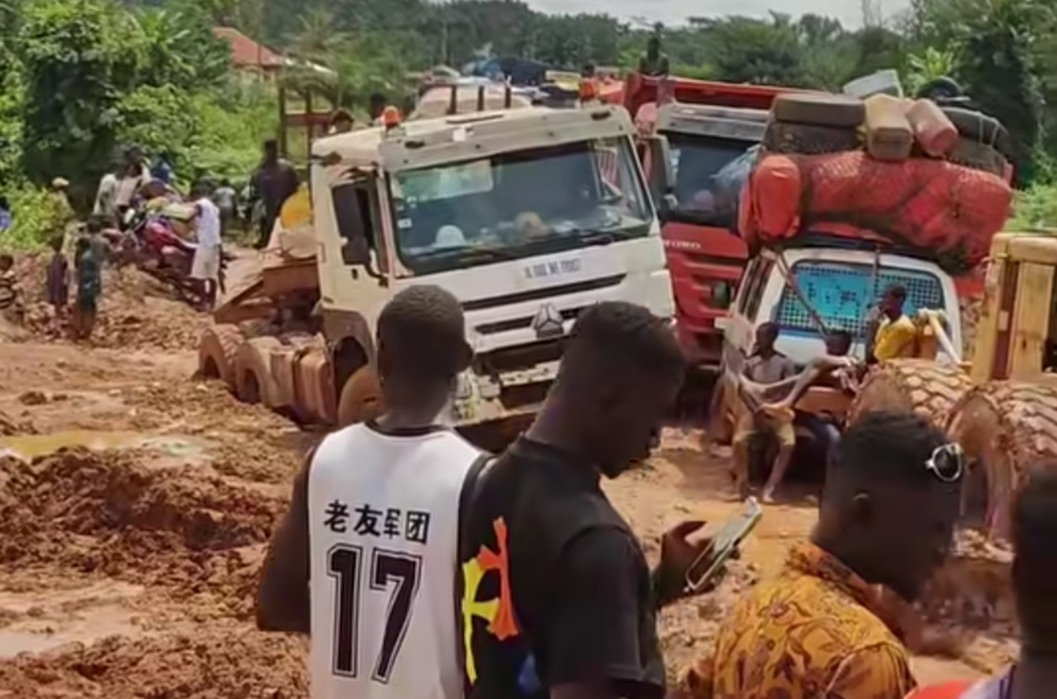
Southeastern Liberia and Lofa County continue to face road challenges, raising questions about the government’s 100-day commitment to keep major highways passable.
\n
MONROVIA, LIBERIA — Where is President Joseph Nyuma Boakai’s promise that no vehicle would get stuck in the mud on Liberia’s major highways during his administration?
That question deserves urgent answers as concerns over road conditions continue to confront travelers in southeastern Liberia and Lofa County, exposing the enormous gap between government commitments and the everyday experiences of citizens struggling to move across the country.
\n
Although southeastern Liberia has attracted considerable public attention over deteriorating roads, the problem is not confined to that region. Lofa County has also experienced serious transportation challenges, demonstrating that Liberia’s road crisis extends beyond a single highway or geographical area.
For ordinary Liberians, the condition of these roads is more than an inconvenience. It affects trade, agriculture, access to healthcare, school attendance, transportation costs, and the ability of rural communities to connect with the rest of the country.
\n
A PRESIDENTIAL PROMISE UNDER SCRUTINY
In his January 29, 2024, Annual Message to the Legislature, President Boakai announced a 100-day deliverable known as “No Car Stuck in the Mud.” The initiative was intended to make major primary road corridors passable, particularly during the rainy season.
\n
The promise raised hopes among citizens who have endured years of difficult journeys on roads connecting counties and rural communities.
But as the administration continues its work, an important question remains: How far has the government gone in fulfilling that commitment, and what happens to communities whose roads remain difficult to navigate?
\n
A pledge to keep major highways passable is a commitment that should be measured against conditions on the ground, not simply through official announcements or the deployment of road machinery.
The government must explain what was accomplished under the original 100-day initiative, which roads received attention, which remain in poor condition, and what resources have been allocated for sustained maintenance.
\n
SOUTHEASTERN LIBERIA: THE STRUGGLE CONTINUES
Road connectivity in southeastern Liberia remains a significant development challenge.
\n
In August 2026, the Daily Monitor reported complaints from commuters traveling toward Grand Gedeh County, who described deteriorated road sections, potholes, mud, lengthy journeys, and difficulties navigating certain stretches. The report said some passengers were forced to leave vehicles or help drivers when vehicles became stuck or struggled to pass.
More recently, the Ministry of Public Works and the African Development Bank conducted an inspection of road corridors under the Mano River Union Road Development and Transport Facilitation Programme.
\n
According to the Ministry of Public Works’ October 14 announcement, the programme covers the Karloken–Fish Town, Fish Town–Kelipo, Kelipo–John David Town, and John David Town–Zwedru corridors.
The inspection assessed ongoing works, contractor performance, and concerns raised by communities affected by the projects.
\n
These interventions demonstrate that road projects are underway. However, inspection missions and construction plans must ultimately translate into reliable transportation for the people who depend on these routes.
The central question is whether the pace of implementation is sufficient to address the daily difficulties faced by residents, traders, drivers, and passengers.
\n
LOFA COUNTY IS ALSO LOOKING FOR ANSWERS
Lofa County presents another important test of the government’s road-development agenda.
\n
In May 2026, President Boakai broke ground for an 86-kilometer asphalt highway connecting Mendikorma in Foya District to Voinjama, the county’s administrative capital. The project is intended to strengthen regional connectivity and promote trade and economic activity.
In July, the President also dedicated the Gbarnga–Salayea road and launched additional road projects in Lofa County, including the Salayea–Konia and Zorzor–Yeala corridors.
\n
These are significant infrastructure developments, but they also highlight the distinction between constructing new roads, rehabilitating damaged sections, and maintaining existing roads so that they remain usable throughout the year.
The government must provide clear updates on the progress of these projects and explain how it intends to address sections that continue to create difficulties for road users.
\n
A groundbreaking ceremony is not a completed highway, just as a road-maintenance announcement is not proof that a road is passable.
Citizens need to see measurable progress, realistic timelines, and consistent maintenance.
\n
THE ECONOMIC COST OF BAD ROADS
Poor road conditions carry consequences far beyond the inconvenience of a difficult journey.
\n
Farmers may struggle to transport produce to markets, while traders face increased transportation costs that can contribute to higher prices for consumers.
Patients may experience delays reaching hospitals, and families in remote communities can find themselves cut off from essential services when roads become difficult to navigate.
\n
Commercial drivers also face higher vehicle-maintenance expenses, possible damage to their vehicles, and fewer opportunities to complete trips.
For a country seeking to expand agricultural production, improve rural livelihoods, and strengthen national integration, unreliable roads undermine these objectives.
\n
The consequences are particularly serious during the rainy season, when deteriorating road surfaces can make already difficult journeys even more challenging.
WHERE IS THE ACCOUNTABILITY?
\n
President Boakai’s road pledge was specific enough to create a public expectation. It was not simply a general promise to improve infrastructure someday; it included a 100-day target focused on keeping major primary corridors passable.
The administration should therefore publish a comprehensive assessment of that initiative.
\n
The Ministry of Public Works should identify the highways covered by the programme, disclose the work completed, explain the condition of the remaining sections, and provide timelines for necessary repairs.
The government should also clarify the funding available for routine road maintenance and explain how it monitors contractors responsible for rehabilitation and construction projects.
\n
Where projects have been delayed, citizens deserve to know why. Where roads have deteriorated after repairs, authorities should explain what corrective action will follow.
These are reasonable demands in a country where taxpayers and development partners commit resources to infrastructure development.
\n
LIBERIANS NEED ROADS THAT WORK, NOT JUST PROMISES
The debate over Liberia’s roads should not become merely a contest between political parties or competing claims about which administration performed better.
\n
The real issue is whether citizens can travel safely and reliably between counties, transport goods without unnecessary delays, and access essential services throughout the year.
President Boakai’s administration has announced and undertaken several road projects. Those efforts deserve to be assessed on their actual progress and results. At the same time, the existence of projects cannot substitute for answers about roads that remain difficult to use.
\n
The President and his public works team must confront the concerns of affected communities with transparent information, practical solutions, and measurable results.
The question remains: If the promise was “No Car Stuck in the Mud,” what has been achieved, what remains unfinished, and when will Liberians see the full benefit of that commitment?
\n
For citizens traveling through southeastern Liberia, Lofa County, and other underserved parts of the country, the answer will not be found in another speech. It will be found on the roads they travel every day.
See more Liberia News Network stories in Google Search by adding LNN as one of your Preferred Sources.
★ Add LNN as a Preferred Source