
By Lincoln G. Peters
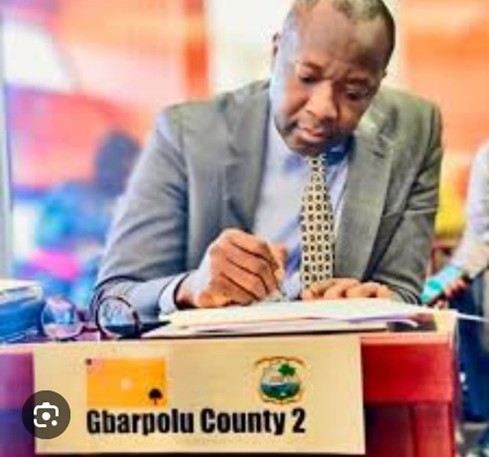
CAPITOL HILL, Monrovia, October 21, 2026: Gbarpolu County Senator and former Finance Minister Amara Mohamed Konneh has questioned why Liberia’s reported US$1 billion revenue collection and growing economy have failed to translate into meaningful improvements in the living conditions of ordinary citizens.
Senator Konneh blamed the situation on persistent inflation, economic growth concentrated in sectors that generate relatively few jobs, and sluggish government spending on essential services, including education, healthcare and infrastructure.
Speaking during Tuesday’s Senate plenary, October 20, Konneh said citizens repeatedly raised concerns about the country’s economic performance during his recent constituency visit to Gbarpolu County.
“The government says the economy is growing and it has collected US$1 billion; why are we still suffering?” Konneh quoted residents as asking.
He acknowledged that the government’s reported economic indicators show improvements, with real Gross Domestic Product (GDP) growth rising from 4 percent in 2024 to 5.1 percent in 2025 and a projected 5.5 percent in 2026.
However, he argued that these improvements have not translated into corresponding economic relief for ordinary Liberians.
“The government is right, and the numbers it has announced are true,” Konneh said, while maintaining that citizens are equally justified in questioning why economic growth has not improved their living standards.
Explaining what he described as the GDP-inflation spread, Konneh said inflation continues to put pressure on household purchasing power despite its gradual decline.
He cited economic growth of 4 percent against inflation of 8.3 percent in 2024, representing a negative spread of 4.3 percentage points.
According to him, the spread narrowed to negative 3.4 percentage points in 2025 and is projected to reach negative 0.4 percentage points in 2026, with GDP growth at 5.5 percent and inflation at 5.9 percent.
“While the spread improved over the last two and a half years, it remained negative throughout,” he explained.
Konneh argued that continued increases in consumer prices, even at a slower rate, are placing pressure on household budgets and limiting the benefits citizens experience from economic growth.
He said the situation helps explain why Liberians continue to complain about economic hardship despite government announcements of improved revenue performance and a national budget of approximately US$1.3 billion.
Growth Concentrated in Mining
The former Finance Minister also expressed concern that Liberia’s economic expansion remains concentrated in the extractive sector, with limited benefits for employment and household incomes.
He disclosed that mining and panning recorded growth of 16.6 percent, accounting for approximately 23.4 percent of GDP.
By contrast, agriculture, which he said supports the livelihoods of about 70 percent of Liberians, experienced slower growth of just 1.3 percent.
“But mining does not employ our people,” Konneh argued, emphasizing the limited employment opportunities associated with the sector’s expansion.
He said economic growth driven largely by mining activities does not necessarily translate into increased employment and income opportunities in surrounding communities.
“So GDP grows in the bush of Grand Cape Mount, but jobs do not grow in its big towns like Robertsport, Kinjor, and other big towns in its neighboring counties of Bomi and Gbarpolu,” he lamented.
Konneh stressed that economic policies must prioritize sectors capable of creating jobs, supporting local businesses and improving household incomes.
Poor Spending on Basic Services
Turning to public investment, Senator Konneh criticized what he described as sluggish implementation of the government’s Public Sector Investment Program (PSIP), particularly in health and education.
He claimed that PSIP execution in the two sectors stands at approximately 4 percent, raising concerns about the government’s ability to translate budgetary allocations into tangible development projects.
According to him, communities such as Gbarma and Vaye Town have schools earmarked for improvements in the national budget, but the necessary funds have not been disbursed.
He argued that delayed project implementation has left communities without improvements in classrooms, healthcare facilities and other essential infrastructure.
Konneh cited continuing difficulties facing health workers and public schools, including the recent teacher go-slow within the Monrovia Consolidated School System (MCSS).
He also pointed to delays in resolving the longstanding concerns of volunteer teachers, although he acknowledged that some progress has been made.
The senator further questioned the pace of road construction and rehabilitation, saying rural communities continue to struggle to transport agricultural produce to markets despite the arrival of government road construction equipment nearly a year ago.
He maintained that these challenges demonstrate the gap between reported economic growth and the actual delivery of public services.
“So people see macro growth on paper and in presidential and cabinet pronouncements by the Executive Branch. Still, the clinics and health workers are struggling; no teachers in classrooms due to pay issues, as we saw recently in the MCSS,” Konneh said.
He called for greater attention to public investment execution, job creation and improvements in basic services to ensure that Liberia’s economic gains produce measurable benefits for ordinary citizens.
His remarks underscore growing concerns about whether increased domestic revenue and economic expansion are translating into better education, healthcare, infrastructure and employment opportunities across the country.
See more Liberia News Network stories in Google Search by adding LNN as one of your Preferred Sources.
★ Add LNN as a Preferred Source