
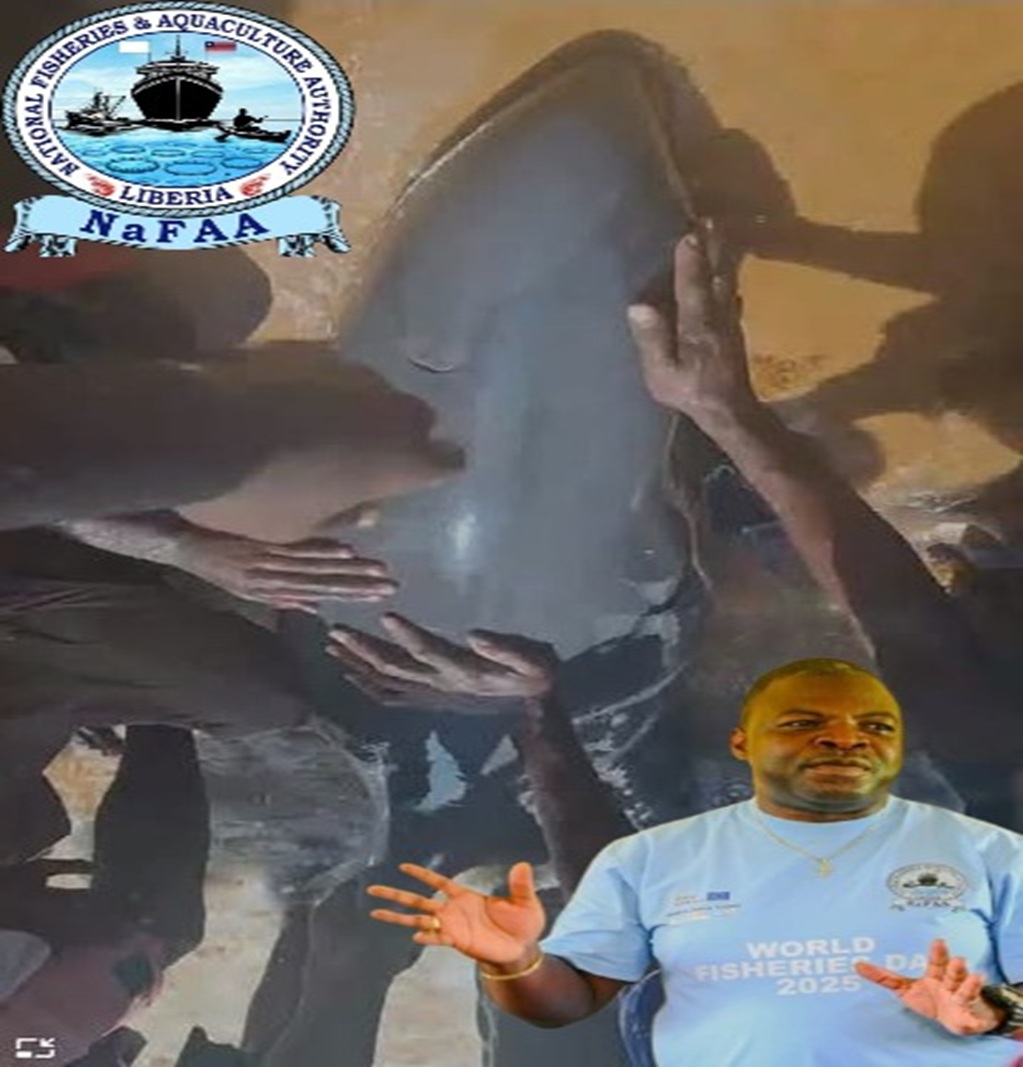
MONROVIA, LIBERIA — A dolphin found along Liberia’s coastline has met a tragic end, as reported by the head of the country’s fisheries authority.
\n
\n
In a Facebook post on Sunday, October 25, Saygbe expressed his sorrow over the incident.
“It’s sad to report that the dolphin discovered on Miami Beach earlier 2day did not survive before our team arrived at the scene. The community helped but later killed and shared it,” he wrote.
\n
This statement raises serious concerns about the circumstances surrounding the dolphin’s death, the community’s actions, and the readiness of coastal residents to handle marine wildlife emergencies.
While the exact details remain unclear, Saygbe’s account suggests a major gap between the discovery of the stranded dolphin and the response from the authorities tasked with its protection.
\n
Questions linger about when the dolphin was first found, its condition at that time, whether it was alive when residents encountered it, and how long it took for NaFAA to be notified.
Saygbe’s post also does not clarify whether the community’s initial efforts were aimed at rescuing the dolphin before it was ultimately killed and shared, or if other factors influenced the outcome.
\n
These questions are crucial, as the distinction between a rescue attempt and the treatment of a deceased animal has significant implications for wildlife conservation, public health, and the investigation into the incident.
This reported dolphin incident follows another marine wildlife occurrence that highlighted similar vulnerabilities in Liberia’s coastal management.
\n
On February 11, 2026, a dead whale was found washed up on Sheri Beach in Monrovia, entangled in a fishing net. By the time authorities arrived, locals had already cut up the carcass and taken pieces away. A report from FrontPage Africa on March 5, in collaboration with New Narratives and republished by AllAfrica, revealed that residents were unsure about whom to contact when they encountered the stranded whale.
The report also raised concerns about the health risks of consuming marine animals when their cause of death and condition are unknown.
\n
This incident sparked calls for better public education and clearer communication between NaFAA and coastal communities.
The recent dolphin incident brings up a similar issue; have many people living along Liberia’s coastline been educated on what to do when they find a stranded whale, dolphin, or other marine animal?
\n
For communities reliant on the sea for food and livelihoods, discovering a large marine animal can seem like a chance to obtain meat.
Howbeit, this immediate reaction can have serious consequences if the animal’s health, cause of death, and potential exposure to contaminants are not understood.
\n
Additionally, the loss of the animal prevents specialists from examining it before it is cut up or removed, which could destroy crucial evidence that might explain the circumstances of its death.
Marine wildlife experts typically advise against handling stranded whales or dolphins, as these animals may be severely ill or injured, and untrained attempts to move them can cause further harm and pose risks to human safety.
\n
The U.S. National Oceanic and Atmospheric Administration’s Fisheries Service emphasizes that stranded marine mammals need to be evaluated by trained responders who can decide on the best course of action.
The agency cautions that handling or moving these animals too soon can disrupt treatment and hinder the collection of important health data.
\n
For Liberia, the message is straightforward; if a dolphin or whale washes up on the shore, locals should maintain a safe distance, avoid unnecessary handling when possible, and promptly notify NaFAA or the relevant authorities.
Residents should not assume that an animal is safe for consumption just because it seems dead or because its meat might be shared among families.
\n
Saygbe’s statement has brought renewed focus on NaFAA’s ability to respond swiftly to marine wildlife emergencies and the resources available to coastal communities.
How was the dolphin initially discovered? Who alerted the authorities, and at what time? Was the animal already dead when found? Did anyone try to rescue it, and did trained responders have enough time to act?
\n
The details surrounding the animal’s death and subsequent sharing also need to be clarified. If it was alive when residents first encountered it, investigators must find out what transpired between its discovery and its death.
If it was already dead, authorities should investigate how and why the carcass was handled and distributed.
\n
These inquiries are essential for a thorough factual investigation, rather than conclusions drawn from a brief social media post.
The NaFAA should also clarify whether it has started documenting the incident, if any remains are available for examination, and what further actions it plans to take to prevent similar occurrences in the future.
\n
The response from the authorities should extend beyond just looking into this one incident.
Implementing a practical public-awareness campaign, providing clear emergency contact details, and fostering stronger connections with beach caretakers, fishermen, and community leaders could ensure that any future stranded animals receive prompt assistance.
\n
The reported death of the dolphin serves as a stark reminder that safeguarding Liberia’s marine resources involves more than just regulations and official statements.
It necessitates public awareness, quick reporting, and collaboration between communities and the agencies responsible for protecting the country’s waters.
\n
Liberia’s coastal environment is vital for livelihoods, fisheries, and food security. Thus, protecting marine wildlife is not just a matter of conservation; it is part of the broader duty to manage the nation’s natural resources wisely.
Currently, the full details surrounding the Miami Beach incident are still unclear.
\n
Saygbe’s post offers the initial account, but further verification is essential to determine the dolphin’s condition when it was found, the timeline of events, and the exact circumstances surrounding its death.
What is evident is that this incident calls for answers—and that communities along Liberia’s coast require practical guidance on how to act when marine wildlife is discovered stranded.
\n
We must ensure that the next encounter does not end with another animal lost before trained responders can arrive.
See more Liberia News Network stories in Google Search by adding LNN as one of your Preferred Sources.
★ Add LNN as a Preferred Source