
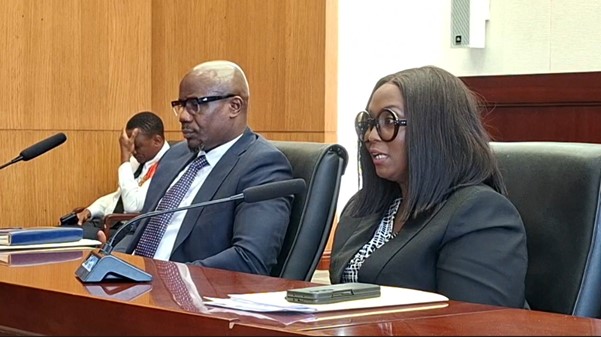
MONROVIA – Justice Minister-designate Cllr. Betty M. Lamin-Blamo has staked her confirmation on a promise Liberia’s justice system has struggled to keep. Prosecutions, she pledged, will follow evidence, not power. Before the Senate Judiciary Committee on Monday, she put a number on the system’s failure. More than two-thirds of the country’s 4,125 inmates, over 2,800, have never been tried. Some have not even been indicted. Her vow that the state will “either prosecute or release” puts the backlog at the center of her tenure. It also tests a ministry carrying the cocaine prosecutions, an exodus of experienced prosecutors and public suspicion of selective justice. Legal pundits say senators must weigh her record against those pressures, as THE ANALYST reports.
\n
Lamin-Blamo, acting minister since September, appeared alongside Solicitor General-designate Cllr. Abraham Boimah Sillah, Sr. before the committee chaired by Senator Augustine Chea of Sinoe County. Chea opened the hearing by calling it “not merely a procedural requirement” but a test of the nominees’ grasp of the legal, institutional and ethical demands of their offices.
\n
The chairman said the committee would probe the nominees’ approach to the prosecution of criminal cases, accountability and transparency, and the protection of human rights. He added that senators would also examine conditions in correctional facilities and detention cells, and the public’s confidence in the justice system.
\n
Evidence, Not Affiliation
\n
Lamin-Blamo acknowledged concerns in the press, at the bar and among ordinary Liberians that the state’s prosecutorial power could be turned on opponents while sparing friends. “A case will be brought because the evidence supports it, and for no other reason,” she declared. “And a case will not be brought, however loud the demand, where the evidence does not support it.”
\n
She stated that the decision to prosecute would rest on the facts and the law, and never on political affiliation, county of origin, wealth or status. “If I am confirmed, I will not be a minister who prosecutes adversaries with zeal and friends with reluctance,” she told senators, pledging to step aside openly wherever she has a conflict of interest.
\n
As a Cabinet member, she said, she would advance the President’s policy agenda and remain accountable to the President, the Legislature and, primarily, the Liberian people. As Attorney General, however, her first loyalty would be to the Constitution and laws of the Republic.
\n
She described a ministry whose reach touches “the market woman in Duala,” the motorcyclist in Ganta and the farmer in Lofa. It prosecutes crimes in the name of the Republic, represents the government in court, and supervises the Liberia National Police (LNP), the Liberia Immigration Service (LIS), the Liberia Drug Enforcement Agency (LDEA), the Liberia National Fire Service (LNFS) and the Bureau of Corrections and Rehabilitation (BCR).
\n
Where the law is applied evenly, she argued, disputes end in courtrooms instead of on the streets. “Where the law bends to power, nothing else that the government does will hold,” she warned.
\n
Where Cases Collapse
\n
Lamin-Blamo identified the gap between police investigators and prosecutors as one of the weakest links in the criminal justice chain. Too many cases collapse, she said, not because the accused is innocent, but because investigations are incomplete, evidence is poorly preserved, or the charge does not fit the facts.
\n
“Victims lose faith, the guilty go free, and the innocent languish in detention,” she lamented. If confirmed, she pledged to continue an assessment of the prosecution department’s capacity and develop a roadmap for its effectiveness.
\n
Cases, she insisted, must be evidence-based and professionally prepared. They must protect the rights of the accused while assuring victims that serious crimes will be prosecuted lawfully.
\n
Untried and Waiting
\n
The nominee reminded senators that Article 21 of the Constitution requires an arrested person to be brought before a court within 48 hours, and that the law presumes every accused person innocent. Yet at the Monrovia Central Prison alone, she disclosed, 1,312 of 1,888 inmates, more than 69 percent, are awaiting trial.
\n
She observed that the burden falls hardest on the poor, who cannot afford a lawyer. The ministry has begun reviewing pre-trial files at the Monrovia Central Prison, and she pledged to extend the review nationwide if confirmed.
\n
“The state will either prosecute or release in accordance with law,” she declared. She said she would work with the judiciary to expand magisterial and special sittings, and with public defenders, the Liberia National Bar Association (LNBA) and legal aid providers so that no one stays jailed for lack of a lawyer.
\n
Departing from her prepared text, she argued that pre-trial detention and prison overcrowding require policy reform. She illustrated the point with armed robbery, a non-bailable offense, noting that more than 200 people charged with the crime are held at the Monrovia Central Prison.
\n
All of them, she explained, await Criminal Court “D” in Montserrado County, which sits four 42-day terms a year, in February, May, August and November. At best, a judge might try five cases a term, or 20 a year, since one complex case can consume two to three weeks.
\n
A defendant who elects a jury trial can tie up the court for an entire term, she added, because only one jury can be empanelled per session. She said more than 300 people charged with statutory rape, also a non-bailable offense, are held at the same prison, awaiting Criminal Court “E.”
\n
She urged the Senate to pass a pending bill extending the terms of court so that courts sit longer and hear more cases. “In order for us to decongest the prison, we have to do a lot with reform of the law,” she stated.
\n
But she cautioned that decongestion cannot mean freeing suspects against whom the state holds evidence. “If people commit crime, we can’t let them go,” she insisted.
\n
Decongestion also demands infrastructure, she said. She pledged full support for a new correctional facility at Cheesemanburg, sought legislative funding for its construction, and promised a nationwide assessment of prison capacity, security and infrastructure, including security cameras, solar power and a standardized architectural design.
\n
Cartels and Stolen Assets
\n
“Illicit drug trafficking is destroying a generation of young Liberians before our eyes,” Lamin-Blamo declared. She vowed to pursue the importers, traders, financiers and protectors of the trade, and to settle for nothing less than dismantling the cartels, alongside rehabilitation for those struggling with addiction.
\n
“Liberia will not be a transit country, a laundering point, or a soft place to do bad business,” she stated. “Our success will be measured not by the number of arrests, but by convictions that survive appeal.”
\n
Her remarks follow months of pressure on the justice and security sector over large cocaine seizures and the prosecution of individuals allegedly linked to a transnational narcotics network. Those cases remain before the courts.
\n
On corruption, which she called a menace, she pledged to work with the Liberia Anti-Corruption Commission (LACC), the General Auditing Commission (GAC) and the Financial Intelligence Agency (FIA). The aim, she explained, is to investigate, charge, carry cases through to judgment and return stolen assets to the Liberian people.
\n
She noted that the ministry would equally prioritize sexual and gender-based violence and trafficking in persons. She also promised a case management system to track every case and every detainee.
\n
A Returning Solicitor General
\n
Lamin-Blamo served a little over four years as Solicitor General under former President Ellen Johnson Sirleaf. She told senators the ministry then hired 29 additional prosecutors to expand access to justice at the magisterial courts, where most ordinary Liberians first meet the judicial system, and deployed nine of them outside Monrovia.
\n
She said close coordination between police and prosecutors during that tenure produced an 85 percent conviction rate. She also cited pathology training in Ghana for three Liberian doctors and her role in initiating the plea-bargaining law.
\n
“I recite this record not for praise, but as the foundation on which I intend to build,” she remarked. She disclosed, however, that many experienced prosecutors have since left the ministry, and asked the Senate for budgetary support to recruit more prosecutors and raise salaries to match the weight and risk of their work.
\n
President Joseph Nyuma Boakai nominated her on September 2 to replace Cllr. N. Oswald Tweh, who has since been named Acting Minister of National Defense. Sillah replaced Cllr. Augustine C. Fayiah as Solicitor General.
\n
A Solemn Duty
\n
Lamin-Blamo thanked President Boakai for the nomination and the Senate for exercising its constitutional duty of advice and consent. She also thanked her husband, Patrick, and their children for again sharing her with the government and people of Liberia, acknowledging that “the terrain this time appears more challenging.”
\n
“Peace is sustained by justice, and justice by institutions the people trust,” she told the committee. She conceded that not every challenge would be resolved overnight, adding that “public confidence is not won by speeches.”
\n
She pledged to serve with integrity, act with independence, honor the Constitution, cooperate with the Senate and keep ordinary Liberians at the center of every decision. “If confirmed, I will regard this office not as a privilege, but as a solemn duty to the Republic,” she concluded.
\n
The committee will send its recommendation to the full Senate, which votes on confirmation.
See more Liberia News Network stories in Google Search by adding LNN as one of your Preferred Sources.
★ Add LNN as a Preferred Source