
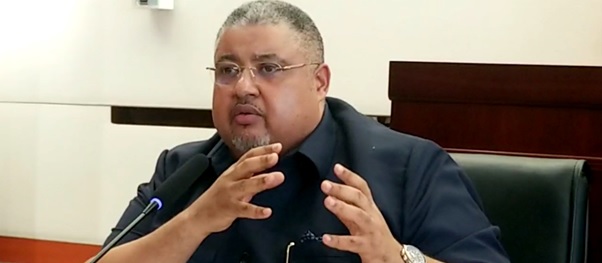
Former Commerce Minister Calls for Local Value Addition, Stronger Liberian Businesses and Greater Benefits from Mining and Energy Investments
MONROVIA, LIBERIA — Former Commerce Minister Amin Modad has challenged Liberia’s economic approach, warning that the country cannot achieve sustainable prosperity by continuously increasing taxes on the same limited pool of citizens and businesses without expanding domestic production and strengthening the private sector.
Reflecting on his recent role moderating a session at the Liberia International Mining and Energy Conference, Modad argued that Liberia has the natural resources, geographical advantage and human capacity to generate significantly more domestic revenue if the government deliberately builds local supply chains and ensures that greater benefits from extractive industries remain within the country.
According to Modad, while the country’s recent US$1 billion domestic revenue milestone is commendable, it should serve as a reminder of Liberia’s much greater economic potential.
He believes Liberia could generate more than US$10 billion in sustainable domestic revenue, but cautioned that the current approach to revenue generation is not sufficient to achieve that ambition.
Modad argued that international mining and energy companies often export raw materials and transfer profits, management fees and other earnings outside the country. He said practices such as debt shifting and interest deductions can further limit the economic benefits retained locally.
He therefore called for policies that create stronger domestic demand for Liberian businesses in transportation, construction, engineering, maintenance, technology and manufacturing.
He also stressed the need to prepare Liberian technicians, engineers, geologists and managers to occupy higher-value positions in the mining and energy industries.
“This is not about shutting out international expertise. It is about building the capacity to compete, replace imports where it makes sense, and keep more value at home,” Modad argued.
QUESTIONS GOVERNMENT’S REVENUE STRATEGY
Modad cautioned that increasing taxes without expanding the productive economy could place additional pressure on citizens and formal businesses.
Using a generator analogy, he said attempting to make a 50KVA generator carry a 100KVA load may work temporarily but will eventually fail.
He maintained that Liberia cannot build a prosperous economy simply by collecting more revenue and increasing public expenditure. Instead, government policy should focus on how public resources are used to expand production, create jobs and strengthen local businesses.
Among the issues he raised were the share of government procurement awarded to qualified Liberian-owned companies, access to affordable financing for local manufacturers, farmers, traders and small businesses, and the extent to which major investments create opportunities for Liberian enterprises.
CALLS FOR GREATER LOCAL PARTICIPATION
Reflecting on his time in government, Modad said he consistently advocated for value addition and greater Liberian participation in the trading of the country’s natural resources.
He also revisited his argument about the “T” in the government’s ARREST development agenda, saying he would have preferred it to represent Trade rather than Tourism.
He explained that tourism itself is a tradable service because international visitors spend money on accommodation, food, transportation and recreation, bringing foreign currency into the domestic economy.
Modad further called for transparent management of natural resources, smarter trade policies, fiscal discipline and stronger coordination among concessionaires, financial institutions, training institutions and the private sector.
He said investment in education, healthcare and living standards must also form part of the country’s economic development strategy.
The former minister indicated that his next discussion will examine the relationship between domestic revenue generation, GDP per capita, sustainable economic growth and the development of a strong domestic private sector, using economic performance across West Africa as a reference point.
His comments have reopened an important national debate: whether Liberia’s natural resource wealth is translating into stronger local businesses, better-paying jobs and lasting economic opportunities for its citizens.
The challenge, as Modad presents it, is not simply how much revenue Liberia collects, but how much wealth the country produces, retains and distributes through a stronger domestic economy.
See more Liberia News Network stories in Google Search by adding LNN as one of your Preferred Sources.
★ Add LNN as a Preferred Source