
Published: November 5, 2026
MONROVIA — The Ministry of Public Works expects to pave more than 700 kilometers of primary roads by 2029, about 44 percent above the government’s target. It says Liberian-owned companies are doing most of the work it pays for directly.
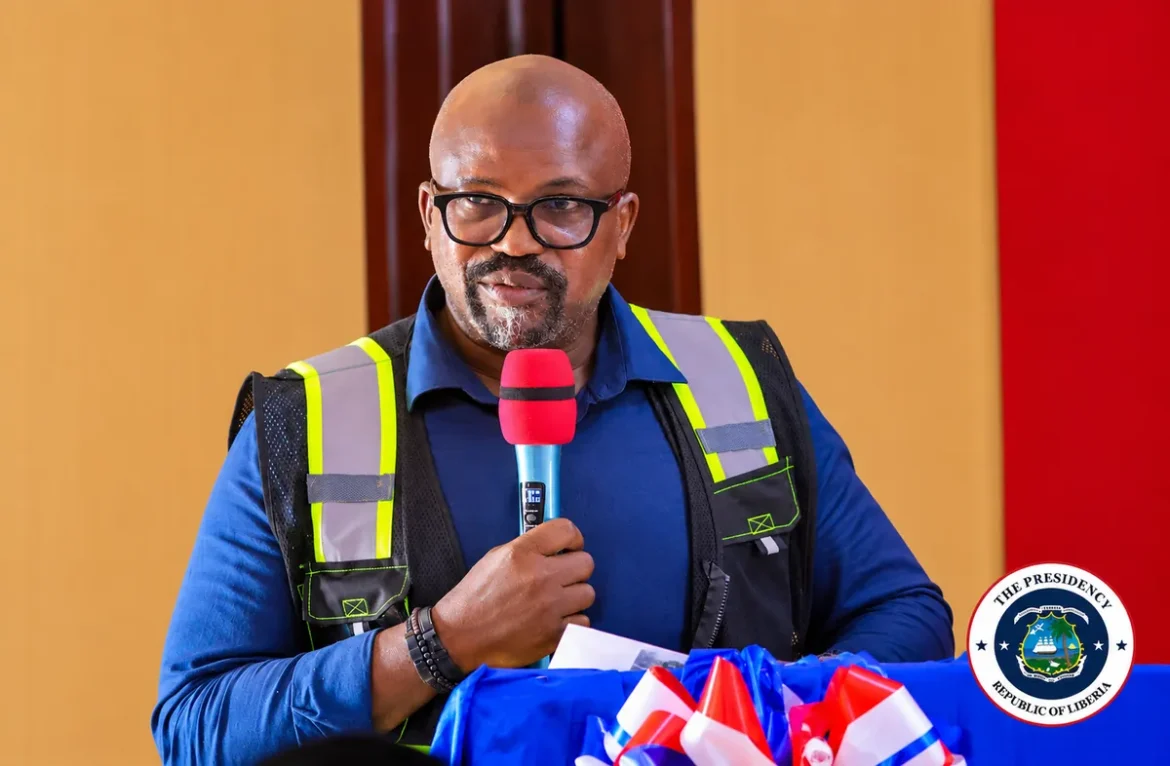
Public Works Minister Roland Layfette Giddings gave the projection Tuesday at the Ministry of Information’s regular press briefing. The ARREST Agenda for Inclusive Development set a 2029 target of 485km of paved primary roads and 125km of urban and community roads. Giddings said the ministry will exceed both, reaching more than 700km of primary roads and more than 150km of urban and community roads, based on works now under way and those starting this dry season.
“These are not promises; they are kilometers of asphalt and concrete that Liberians are driving on today,” Giddings said.
From January 2024 to August 2026, the ministry paved an additional 150km of primary roads and 14km of urban and community roads, he said. Those roads include the Saclepea-Tappita corridor in Nimba County, which the ministry said is now paved end to end. The 700km projection leaves out two planned corridors, the 60.6km Buchanan-Cestos Junction Coastal Corridor and the 238km Liberia Legacy Economic Corridor, so the final figure will be higher, Giddings said.
The ministry’s figures put 22 primary corridors, totaling about 1,191.6km, in the pipeline. Works are under way on 15 corridors covering about 663.5km. Five more, covering about 229.5km, are in procurement or detailed design ahead of civil works in 2027. The remaining two, about 298.6km, are awaiting approval from the boards of the African Development Bank and the World Bank, which the ministry expects in the first quarter of 2027.
This dry season, the ministry plans to finish the 61km Saclepea-Tappita road and the 20km Kelipo-Fish Town road in River Gee County and to begin the final wearing course on the 80km Fish Town-Karloken road. Civil works are also due to start on four corridors totaling about 226.5km: Tappita-Toe’s Town, Toe’s Town-Zwedru, John Davis Town-Putuken-Kelipo and Barclayville-Sass Town.
Giddings said Liberian firms carry most of the government’s own program. Of the 56 contractors on projects under the government’s Public Sector Investment Programme, 46, or 82 percent, are Liberian-owned. Foreign contractors work mainly on projects financed by bilateral and multilateral partners. Those projects are procured under the financiers’ own rules and usually involve large asphalt corridors and major bridges.
A new ministry regulation, 001/MPW/26, reserves all laterite and concrete road construction contracts for Liberian-owned companies, whatever the source of funding. To qualify, a company must have at least 51 percent Liberian equity and 51 percent Liberian management and operational control. The regulation bars foreign participation in these contracts and any subcontracting to foreign firms without approval.
Giddings said every county city streets project, both ongoing and new, is being built by a Liberian-owned company. The program includes 14 ongoing projects in Monrovia and its environs, Kakata, Foya and Buchanan. New projects in 12 counties start this dry season, including Barclayville, Zwedru, Bopolu, Gbarnga, Greenville and Cestos.
Under the regulation, he said, “the wages, the materials, the equipment rental and the profits stay in the Liberian economy.”
Giddings announced four other regulations. The first sets up a system to classify and certify contractors and consultancy firms; it issued 562 certificates to 451 firms between August 2025 and Sept. 14, 2026. The second sets uniform right-of-way widths for roads. The third covers abandoned buildings: an owner who does not submit a remediation plan within 30 days of a notice of abandonment faces a US$500 monthly fine. After six months, the ministry and the Ministry of Justice may move to demolish the building or acquire it compulsorily with fair compensation, subject to due process and judicial review. The fourth sets the requirements for private citizens and organizations that finance and build public projects.
The ministry has also streamlined its internal paperwork, he said. A new standard operating procedure, adopted July 17, covers seven core processes, from small purchases to contractor progress payments, and cuts the approval steps involved from 88 to 57, a 35 percent reduction. Giddings said the change will ease cash-flow pressure on local contractors.
He appealed to the public to respect road rights-of-way and to protect road markers and sidewalks. He urged Liberian contractors to deliver quality work on time and “prove that Liberians can build Liberia.”
See more Liberia News Network stories in Google Search by adding LNN as one of your Preferred Sources.
★ Add LNN as a Preferred Source