
Monrovia — A growing dispute within the University of Liberia Alumni Association (AAUL) has intensified, with concerned alumni challenging Martin Wleh Pennie’s more than five-year tenure as acting president, while Pennie maintains that his continued leadership is supported by the association’s constitution and circumstances that prevented elections.
In a November 4, 2026 position statement, the Concerned Alumni of the University of Liberia accused the association’s leadership of violating constitutional provisions governing elections, tenure and accountability.
Pennie, who assumed acting leadership following the death of then-President James S. Davis in January 2021, is being challenged over his continued stay in office without a fresh electoral mandate.
However, in a nine-count response to FrontPage Africa, Pennie defended the National Executive Committee’s (NEC) decisions, arguing that the constitution allows the vice president to serve as acting president until a successor is elected.
He attributed the electoral delay to poor meeting attendance, failure to achieve quorum and inadequate financial contributions from members. He maintained that the December 4–5, 2026 Annual General Assembly (AGA) and elections were constitutionally declared.
Dispute Over Pennie’s Tenure
At the center of the disagreement is Article VIII of the AAUL Constitution, which provides for a two-year tenure for elected officers, with eligibility for one additional term.
The concerned alumni said the last officers, including Davis and Pennie, were elected in 2019, meaning their mandate expired in 2021. They argued that subsequent elections should have been held in 2023 and 2025, making 2027 the next regular election year.
Although acknowledging Pennie’s right to assume acting leadership following Davis’s death on January 3, 2021, the group cited Article V, Section II, arguing that the arrangement was intended to last only until a new president was elected.
“An acting arrangement is a bridge to legitimate leadership, not a substitute for it,” the group argued.
Pennie, however, offered a different interpretation of the provision, which states that the vice president shall serve as acting president in the event of the president’s sickness, absence, resignation, removal, death or other inability to serve until a new president is elected.
He said the framers included the provision to prevent a leadership vacuum and ensure institutional continuity, particularly when poor membership participation makes elections difficult.
Pennie said the NEC repeatedly attempted to mobilize members for meetings and AGAs but encountered poor attendance and a lack of quorum. He added that meetings that achieved quorum resulted in members mandating the leadership to continue managing the association until broader participation could be secured.
He said attendance records and meeting minutes were available to support the NEC’s position.
Poor Attendance or Leadership Failure?
The concerned alumni rejected the argument that poor attendance and COVID-19 justified the prolonged failure to conduct elections.
They noted that Liberia’s State of Emergency, declared in April 2020, ended on July 21, 2020, months before Davis’s death and the 2021 election cycle.
The group demanded meeting notices, minutes and attendance records to demonstrate that the leadership made genuine efforts to convene constitutionally required meetings.
Pennie countered that members also have constitutional responsibilities, including attending meetings and paying dues.
Citing Article XII, he said members are required to pay dues determined by the AGA, with the constitution specifying a minimum monthly contribution of L$100.
He argued that inconsistent dues payments and the absence of members from meetings had weakened the association’s ability to function effectively.
University President’s Intervention
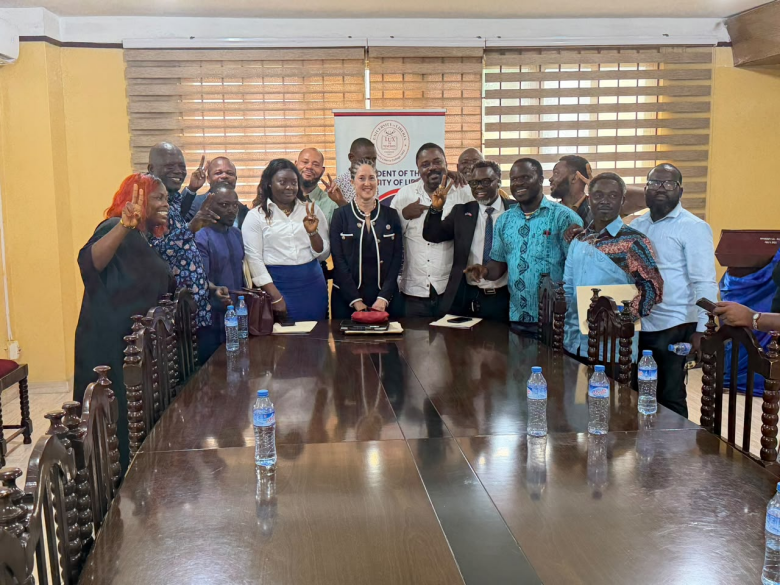
The disagreement intensified following a stakeholder meeting convened by University of Liberia President Dr. Layli Maparyan on October 20, 2026.
According to the concerned alumni, Maparyan proposed an independent body to oversee the elections and invited stakeholders to recommend credible individuals for the Election Commission.
The group said Pennie rejected the proposal and subsequently reported Maparyan to the University’s Board of Trustees.
Pennie argued that the Office of Alumni Affairs has no constitutional authority to convene assemblies, appoint an Election Commission, audit the association or take custody of its assets.
He maintained that the AAUL is an independent membership organization governed by its constitution, which vests authority in the NEC and identifies the AGA as its highest decision-making organ.
Pennie said the NEC attended the October 20 meeting out of respect for the University administration but insisted that the University’s involvement must remain within the limits established by the constitution.
He also questioned why the concerned alumni submitted their complaints to the Office of Alumni Affairs rather than directly to the NEC.
He invited the signatories to submit their names, dues status and grievances to the NEC for consideration at the December AGA.
Pennie Defends December Elections
The concerned alumni questioned the December election schedule, arguing that the association’s ordinary two-year electoral cycle points to 2027.
They also argued that Article VIII requires the election venue and timetable to be announced three months before the election month. They noted that the AGA resolution was issued on September 27, while the election timetable was released on October 20.
They similarly questioned the timing of the Election Commission’s establishment.
Pennie maintained that the NEC properly declared the elections under the constitution, which provides for a five-member ad hoc Election Commission appointed by the president with the Executive Committee’s consent.
He said the NEC would consent only to commissioners who are not candidates for any position and maintained that the commission is required to invite observers, including representatives of the Advisory Council, the National Elections Commission and civil society institutions.
Financial Accountability and Eligibility Concerns
The concerned alumni also demanded financial statements, budgets and an independent audit of the association’s accounts.
Pennie rejected suggestions of financial mismanagement, saying the NEC had operated under different budgeting frameworks despite difficulties securing quorum and consistent dues payments.
He cited constitutional safeguards requiring joint signatures for bank withdrawals, prior NEC approval for expenditures exceeding US$1,000 and semi-annual financial reporting.
Although he said the constitution does not expressly provide for an external audit, Pennie stated that the NEC has no objection to one.
He said financial reports would be presented at the December AGA, allowing the assembly to decide whether to appoint an independent auditor.
The group also questioned the eligibility of the Secretary General, citing a constitutional restriction preventing university employees who are alumni from contesting the offices of president and secretary general.
Pennie said the allegation was unsupported by evidence and that no formal complaint had previously been submitted to the NEC. He added that the matter could be placed on the December AGA agenda for consideration under the appropriate constitutional procedures.
Questions Over Election Commission’s Independence
The concerned alumni also raised concerns about the perceived impartiality of the current Election Commission, citing alleged personal and social relationships between its chairperson and Pennie, including their reported association with a social club known as “The Shrine” on the Capitol Hill Campus.
The group acknowledged that such relationships do not establish wrongdoing but argued that the appearance of independence is important in a contested election.
It called for the commission’s reconstitution through stakeholder consultations, involvement of the Advisory Council and observation by the National Elections Commission.
Pennie maintained that the commission should be constituted according to the AAUL Constitution. However, he requested that the University administration nominate two observers to work alongside the Election Committee to ensure a credible, free, fair and transparent process.
He also cited constitutional provisions allowing at least 75 dues-paying members to request an extraordinary AGA and encouraged the concerned alumni to use established procedures to submit their grievances.
A Test of Institutional Governance
The dispute places the AAUL before a critical test of institutional governance, with both sides invoking the same constitution to defend their positions.
While the concerned alumni argue that the prolonged acting presidency undermines electoral provisions, Pennie maintains that the succession clause and repeated failures to achieve quorum justify the NEC’s actions.
Both sides say they support credible elections but remain divided over the legitimacy of the current leadership and the appropriate arrangements for overseeing the process.
The December 4–5 AGA is expected to provide an opportunity to address the outstanding constitutional and governance concerns.
For the concerned alumni, the objective is to restore constitutional governance and public confidence. For Pennie and the NEC, the priority is to proceed with the scheduled assembly and elections under the association’s existing constitutional framework.
See more Liberia News Network stories in Google Search by adding LNN as one of your Preferred Sources.
★ Add LNN as a Preferred Source