
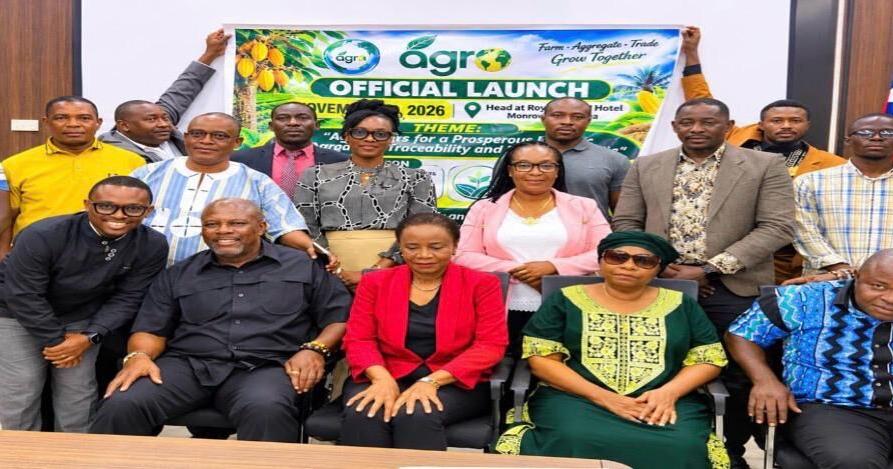
Liberian agritech company AgroWorld has launched a digital farm mapping and traceability platform designed to help smallholder farmers comply with the European Union Deforestation Regulation (EUDR), strengthen agricultural supply chains, and gain access to premium international markets.
The platform was officially unveiled Thursday, November 12, 2026, at the Royal Grand Hotel in Sinkor, Monrovia, under the theme, “Bridging the Digital Divide in Liberian Agriculture: EUDR Compliance, Traceability and Smallholder Inclusion.”
The initiative is intended to strengthen farm-level traceability, improve commodity aggregation and processing, expand access to agricultural financing, and connect Liberian producers with international buyers, particularly in the European Union (EU).
Delivering the keynote address, AgroWorld Chief Executive Officer Dan Torkamawon Saryee described the initiative as an important opportunity to strengthen farming communities, improve agricultural productivity, and make Liberian commodities more competitive in international markets.
Welcoming farmers, exporters, development partners, and other stakeholders, Saryee emphasized that meeting international trade and environmental standards would require collective commitment and coordinated action among government institutions, private-sector actors, farmers, and development partners.
He warned that Liberia faces significant challenges in farm registration, geolocation, and agricultural traceability ahead of the December 30, 2026, EUDR compliance deadline.
According to him, failure to establish the necessary systems could jeopardize farmers’ livelihoods, disrupt agricultural exports, and threaten Liberia’s access to the European market.
Saryee explained that the AgroWorld application would establish digital links between agricultural commodities and their producers, strengthen data protection, and create opportunities for farmers to access financial services through partnerships with commercial banks and mobile network operators.
He also disclosed plans to establish agricultural aggregation hubs in Lofa, Bomi, Bong, and Grand Gedeh counties to improve commodity collection, processing, quality control, and value addition.
Providing the industry context during the opening session, Farmers Union Network President and AgroWorld Board Chair Josephine George Francis warned that Liberia faces significant challenges in meeting the requirements of the EU Deforestation Regulation, particularly in farm registration, geolocation, and traceability.
She cautioned that without effective systems to identify and digitally map agricultural farms, smallholder producers of cocoa, coffee, and other commodities supplied to European markets could risk losing their international buyers.
Francis observed that many farmers remain unfamiliar with the documentation and compliance requirements under the regulation, while Liberia has limited technical and institutional capacity to identify, register, and digitally map smallholder farms nationwide.
She therefore called for a nationwide awareness campaign and stronger collaboration among government institutions, private-sector organizations, agricultural cooperatives, farmers’ groups, and development partners to prepare the sector for the new requirements.
Citing Liberia’s agricultural export performance, Francis disclosed that the country exported more than 37,000 metric tons of agricultural commodities in 2025, emphasizing the importance of protecting and expanding the market opportunities represented by the sector.
She called for urgent investment in farm mapping, farmer registration, laboratory testing, and technical capacity-building to strengthen the country’s agricultural production and export systems.
Francis stressed that because agriculture remains a major source of livelihoods for many Liberians, compliance with international environmental and trade standards extends beyond export requirements to the broader national economy and the welfare of rural communities.
Providing a technical overview of the platform, AgroWorld Technical Support Officer Sherman Seeque explained that field agents would visit farming communities to register producers, verify their identities, obtain their informed consent, and use Global Positioning System (GPS) technology to digitally record farm boundaries.
He said participating farmers would be required to provide identification, evidence of cooperative membership, and documentation demonstrating land ownership or authorized land use.
According to Seeque, field agents would explain the registration process and its objectives in local languages before collecting farmers’ information. Consent would be documented through signatures or thumbprints before personal and farm-level data were recorded.
The information collected would include farmers’ identities, counties, districts, communities, cultivated crops, and geographical farm locations.
A key feature of the platform is its offline functionality, which allows field agents to register farmers and collect geographical information in remote communities where internet connectivity is limited or unavailable.
Seeque further explained that collected records would be stored using encryption technology and shared only with authorized buyers, regulatory institutions, and certification bodies for compliance verification and agricultural trade purposes.
Beyond traceability, the platform is expected to provide registered farmers with digital farm identification, facilitate payments through mobile money and bank transfers, and improve access to agricultural inputs and climate-smart farming support.
These services are intended to help smallholder farmers become more visible within formal agricultural supply chains while strengthening their capacity to meet international market requirements.
Speaking on behalf of the Chair of the House Committee on Agriculture, Fisheries and Forestry, Peleg G. Nickerson described digital farm mapping and traceability as an important step toward modernizing Liberia’s agricultural sector.
He said the initiative could connect farmers to new domestic and international markets while improving transparency, accountability, and efficiency across agricultural supply chains.
Nickerson emphasized that the introduction of agricultural technology must not marginalize smallholder farmers but instead empower them, protect their interests, increase productivity, and ensure they receive greater economic benefits from their labour.
He urged AgroWorld to strengthen collaboration with government institutions, private-sector organizations, development partners, and local communities to ensure the platform delivers tangible benefits to farmers.
He also called for a broader transformation of Liberia’s agricultural sector, emphasizing the need to move beyond subsistence production toward a more productive, competitive, commercially oriented, and technology-driven agricultural economy.
AgroWorld, a subsidiary of Creative Investment Group Africa LLC (CIGA), operates a business-to-business agricultural platform that provides services in commodity aggregation, agricultural input distribution, processing, trade, and financial intermediation.
As part of its expansion strategy, the company plans to establish agricultural aggregation hubs in Lofa, Bomi, Bong, and Grand Gedeh counties, while using Montserrado County as a support base for operations serving Grand Bassa and River Cess counties.
The proposed hubs are intended to strengthen agricultural collection and processing systems, improve commodity quality, facilitate value addition, and bring essential agricultural services closer to smallholder farming communities.
The company expects the facilities to improve the connection between rural producers, commodity aggregators, processors, exporters, and international buyers.
The platform’s launch comes as Liberia intensifies efforts to strengthen agricultural production, farm registration, and traceability systems to protect access to international markets for key commodities, including cocoa, coffee, oil palm, and rubber.
See more Liberia News Network stories in Google Search by adding LNN as one of your Preferred Sources.
★ Add LNN as a Preferred Source