
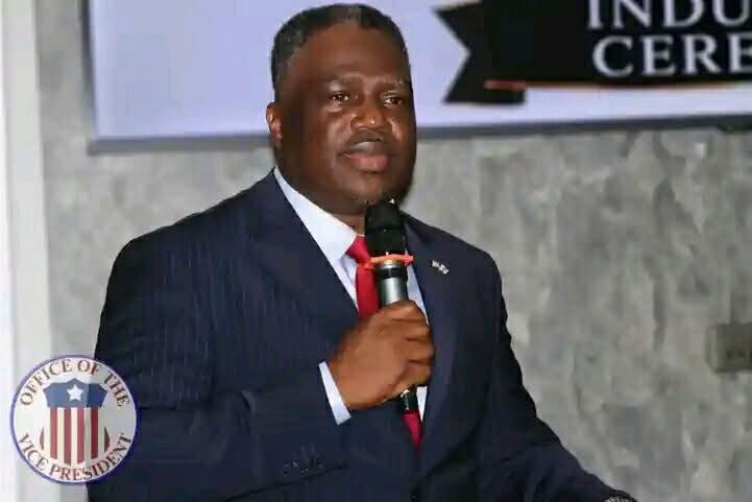
MONROVIA – The Congress for Democratic Change (CDC) has accused Vice President Jeremiah Kpan Koung of allegedly financing a faction within the Movement for Economic Empowerment (MOVEE) to remove its Political Leader, former Foreign Minister Ambassador Dee-Maxwell Saah Kemayah Sr., escalating political tensions within the opposition and raising questions about alleged government interference in opposition party affairs.
In a statement released Saturday, November 21, in Monrovia, the CDC alleged that US$50,000 was provided to members of MOVEE’s executive structure to facilitate Kemayah’s suspension and ultimately push him out of the party’s leadership.
The opposition party described the alleged financial inducement as part of what it characterized as a broader strategy by the Unity Party-led government to weaken opposition institutions through internal divisions and political manipulation.
The allegations, which have not been independently substantiated, come amid growing tensions within MOVEE, where Kemayah faces internal disciplinary action as he challenges his criminal conviction.
The CDC portrayed the suspension as politically motivated, alleging that those behind the move acted in Vice President Koung’s interest after receiving financial inducements.
However, the party did not identify the alleged beneficiaries or provide documentary evidence, transaction records, or other independent proof to support its US$50,000 claim.
The US$50,000 Allegation
At the center of the controversy is MOVEE’s decision to suspend Kemayah, a former senior government official and prominent opposition figure who has maintained political ties with former President George Manneh Weah.
The CDC alleged that the suspension was not merely an internal disciplinary matter but an orchestrated effort to undermine Kemayah’s political influence and weaken his relationship with the former president.
According to the party, Vice President Koung is uncomfortable with the political alliance between Kemayah and Weah and is allegedly using financial inducements to influence the internal affairs of opposition parties.
The CDC also rejected allegations that Kemayah converted a MOVEE campaign vehicle to his personal use, insisting that the vehicle had been returned to the CDC in accordance with an agreement governing the 2023 electoral campaign.
“The vehicle in question was properly returned to the CDC under the campaign agreement, the agreement was fulfilled, full stop,” the statement declared.
The party further maintained that it currently has possession of the vehicle and its title documents, which it argued contradicts allegations being advanced by some MOVEE members against Kemayah.
However, the CDC did not attach a copy of the alleged campaign agreement or supporting vehicle documentation to substantiate its explanation.
Questions therefore remain about the specific terms of the agreement, when the vehicle was returned, and whether documentary evidence exists to establish the transfer.
Kemayah’s Legal Troubles and Party Suspension
The political dispute is unfolding against the backdrop of Kemayah’s legal troubles following his conviction in a criminal case, which the CDC characterized as politically motivated.
The party said Kemayah is challenging the conviction while simultaneously facing suspension from MOVEE, describing the developments as an attempt to weaken his political standing through both judicial and internal party processes.
However, the CDC’s characterization of the conviction and its allegations of political orchestration remain claims by the opposition party and have not been independently established.
The latest controversy also raises questions about MOVEE’s internal governance, particularly the authority of its executive committee to suspend its political leader and the procedures followed in reaching that decision.
It remains unclear what specific constitutional provisions MOVEE’s executive committee relied upon, whether Kemayah was afforded an opportunity to respond to the allegations against him, and whether an appeal mechanism has been activated.
These questions carry implications for internal party democracy, political representation, and the broader opposition landscape as political maneuvering ahead of the 2029 elections intensifies.
Broader Opposition Political Tensions
Beyond MOVEE, the CDC accused Vice President Koung of pursuing what it described as a wider campaign to influence the leadership structures of opposition parties.
The party cited alleged interference within the National Patriotic Party (NPP), claiming that US$175,000 in state resources was provided to sponsor the party’s convention scheduled for December 11–12 in Grand Bassa County.
According to the CDC, the alleged objective is to facilitate the emergence of Senator James Biney as the party’s Political Leader.
The opposition party also alleged that Vice President Koung offered US$30,000 to induce some of its executive members in Nimba County to resign.
The CDC characterized the alleged activities as a strategy of political infiltration and hostile takeovers, claiming that the government is seeking to weaken opposition leadership ahead of the next electoral cycle.
If substantiated, the allegations could raise serious questions about the use of public resources, political patronage, and the independence of opposition parties.
However, the CDC did not provide financial records, identify the alleged beneficiaries, or present independent evidence to substantiate the claims involving the NPP and its own county executives.
VP’s Office Previously Denied NPP Interference
While the Office of the Vice President has not responded to the latest allegations involving the alleged US$50,000 payment to influence MOVEE’s internal affairs, it previously rejected similar accusations concerning the National Patriotic Party.
In October, the office dismissed claims that Vice President Koung was maneuvering to take control of the NPP or financing efforts to remove former Vice President Jewel Howard Taylor as the party’s Political Leader.
Taylor, who is facing prosecution on allegations of drug trafficking and money laundering, remains the NPP’s Political Leader. She is currently under house arrest as the legal proceedings continue.
In a written response to an inquiry from FrontPage Africa dated October 20, 2026, the Vice President’s Office said Koung had no interest in the internal politics of the NPP or any other political party.
The response, signed by the Vice President’s Chief of Staff, Prince Menkalo Gbieu, described the allegations as false and deliberately misleading.
“At no point has the Honorable Vice President sought to interfere in the internal affairs of the NPP or any political party. The allegation is not only false, it is deliberately misleading and designed to create unnecessary tension in our body politics,” Gbieu stated.
The office maintained that Koung was not interested in controlling political institutions or creating controversy, but was focused on supporting President Joseph Nyuma Boakai in implementing the government’s ARREST Agenda.
“His sole focus remains clear: to stand firmly beside President Joseph Nyuma Boakai and ensure that the ARREST Agenda delivers real results — roads, jobs, education, healthcare, and opportunity to every Liberian,” the statement said.
Gbieu further emphasized that the Vice President would continue engaging Liberians across political, ethnic, and regional lines to preserve national peace and create an enabling environment for development.
“He will continue to work with all well-meaning Liberians, irrespective of parties, tribe or region, to maintain the peace we enjoy and to create the stable environment Liberia needs for development and progress,” he added.
The October response, however, addressed the allegations of interference in the NPP and did not specifically address the latest claims involving MOVEE or the alleged US$50,000 inducement.
Questions for the Vice President and MOVEE
The latest accusations place renewed attention on the relationship between the executive branch and the internal affairs of political parties, particularly whether public officials are using financial influence to shape opposition leadership.
The central issue remains whether there is credible evidence that money was offered to influence MOVEE’s disciplinary decision against Kemayah.
The CDC’s statement did not provide transaction records, names of alleged beneficiaries, dates of payment, or other independently verifiable evidence to support the US$50,000 allegation.
Although the Vice President’s Office has previously denied allegations of interference in the NPP, it has yet to publicly respond to the latest accusations involving MOVEE.
What began as an internal leadership dispute within MOVEE has now evolved into a wider political confrontation, with the CDC accusing the country’s second-highest elected official of using financial influence to reshape opposition politics.
Whether the allegations can be backed by verifiable evidence or are part of the intensifying political contest ahead of 2029 remains an open question.
See more Liberia News Network stories in Google Search by adding LNN as one of your Preferred Sources.
★ Add LNN as a Preferred Source