
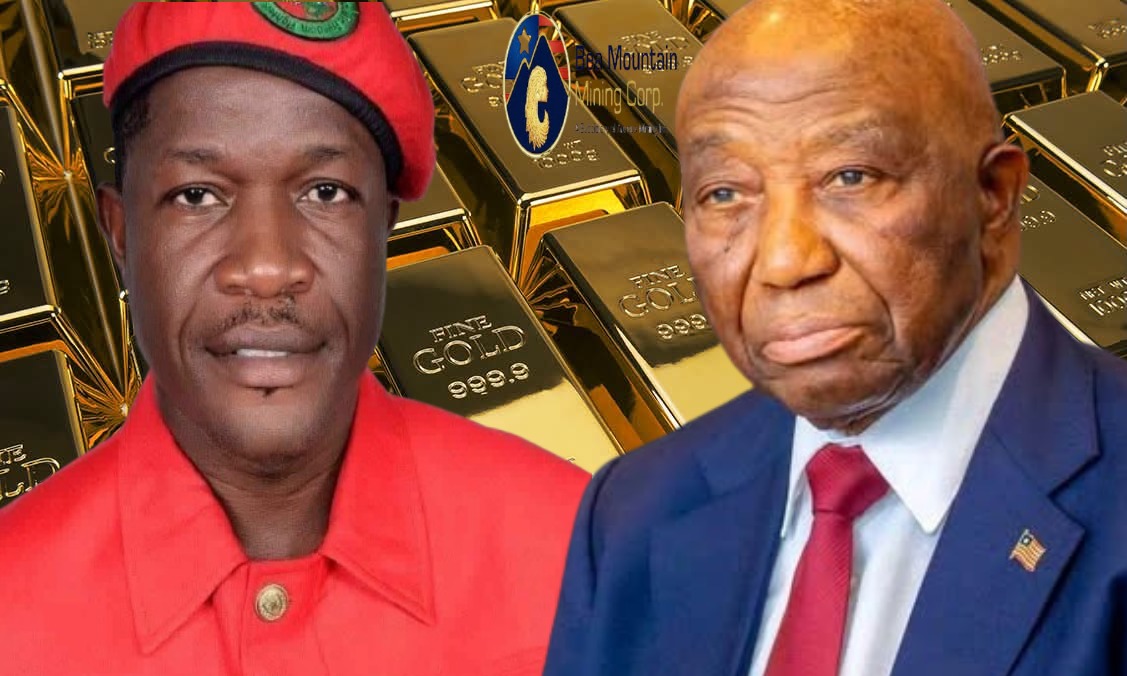
MONROVIA, LIBERIA — Days after leaving his government post at the Freeport of Monrovia, Emmanuel C.D. Gonquoi, leader of the Economic Freedom Fighters of Liberia (EFFL), has sharpened his criticism of the Boakai administration.
He has raised renewed concerns about a proposed US$5.7 billion development arrangement with Bea Mountain Mining Company, which he says could carry serious risks.
In a recent forceful statement, Gonquoi called on President Joseph Boakai to reject the proposed deal or substantially revise it.
He cautioned that beneath its appealing pledges to improve electricity and road infrastructure is a financing structure that could deprive Liberia of meaningful control over resources earmarked for national development.
While recognizing the government’s goal of tackling the country’s persistent energy and infrastructure problems, Gonquoi said his initial backing for the proposal shifted after he reviewed elements of its financing plan.
“The smoke in this deal is huge, and Bea Mountain is the only winner and not Liberia at the end,” he declared.
His remarks add to growing national debate over the proposed development package, focusing attention on who would ultimately control the funds, how they would be used, and whether Liberia would receive an equitable return.
Gonquoi said the government deserves recognition for seeking solutions beyond immediate national challenges, but argued that its chosen approach could put the country’s economic interests and sovereignty at serious risk.
He also challenged the administration’s approach to international financing, noting the Boakai government’s ongoing efforts to obtain support through a Millennium Challenge Corporation (MCC) Compact, with funding already allocated to the energy sector.
For the EFFL man, advancing the Bea Mountain arrangement without carefully weighing Liberia’s existing international financing opportunities could be a strategic miscalculation, especially as the country navigates an increasingly complex geopolitical environment.
He indicated that he is not keen on Foreign Aid, but that he is mindful of the complications and uncertainty associated with geopolitics, urging the government to avoid decisions that could undermine Liberia’s long-term national interests.
His most serious concern, however, is the proposed financial structure, which he believes grants Bea Mountain excessive control over funds intended for major national development projects.
“Bea Mountain can’t give us money as a country and control that same money for projects,” Gonquoi argued.
He characterized the arrangement as one that could make the mining company the primary beneficiary while leaving Liberia to bear the deal’s wider consequences.
In a forceful language reflecting his opposition, the EFFL leader accused the government of risking what he called “daylight corporate robbery” in the name of national development.
“Bea Mountain shouldn’t be allowed to take away our sovereignty and dignity under the guise of development,” he warned.
Rather than merely opposing the government’s development goals, Gonquoi put forward an alternative financing plan, arguing that Liberia could secure significantly less expensive and more transparent funding without giving up control of its development priorities.
He urged the government to seek long-term project financing from international financial institutions, with the exception of the International Monetary Fund (IMF).
Under his proposal, the funds would be paid directly to the Government of Liberia through the Central Bank of Liberia. Taxes generated by Bea Mountain could be pledged as collateral or used to repay the financing, enabling the government to raise funds while retaining control of national project implementation.
Gonquoi further asserted that, with adequate institutional backing, he could mobilize US$3 billion for Liberia within four months.
“Give me four months with all the institutional support, and I will mobilize $3 billion for Liberia,” he challenged.
He also recommended pursuing concessional financing from China, with Bea Mountain revenues again serving as a repayment guarantee through an escrow account.
According to Gonquoi, the arrangement could give Liberia access to lower-interest financing and enable projects to be completed at reduced cost.
He identified four priority areas that, in his view, could reshape Liberia’s development under the proposed US$3 billion financing arrangement, including energy, which entails building a 700-megawatt facility combining hydroelectric and heavy fuel oil (HFO) generation to expand electricity supply more quickly; and healthcare, involving constructing a new John F. Kennedy Medical Center and three fully equipped regional hospitals to ease the burden on the country’s main referral hospital.
The other priorities are education, which will take the construction of 40 standard high schools across Liberia, with housing for teachers; and road infrastructure, involving constructing roads linking all 15 counties to improve transportation, commerce, and national integration.
However, he acknowledged that the projects would require comprehensive feasibility studies to establish their actual costs and identify the technical and financial requirements for implementation.
Gonquoi added that this initial assessment would support transparency, prevent waste, and help the government determine whether the projects could be delivered within the proposed US$3 billion financing limit.
He argued that this alternative would enable Liberia to pursue several national development projects at lower cost while avoiding what he described as questionable financial arrangements associated with the Bea Mountain proposal.
Gonquoi’s latest intervention comes at a politically pivotal time, following his resignation from his government post at the Free Port of Monrovia.
His increasingly forceful criticism of the administration has prompted questions about his changing political stance and whether he intends to become a more prominent opponent of government policies.
Although he commended President Boakai and his cabinet for pursuing long-term solutions to Liberia’s infrastructure challenges, his central point was clear: development goals cannot excuse financing arrangements that may compromise national sovereignty and public accountability.
For the EFFL leader, the question is not whether Liberia needs improved roads, dependable electricity, modern hospitals, and better educational facilities. It is whether the country can meet these needs without relinquishing control over its resources and development priorities.
“Trust me, I like the dream itself, but the path to implementation is horrible,” he stated.
He concluded with an emphatic call for the government to abandon the deal’s current structure, signing off with his familiar political declaration: “Our feet shall take us there.”
Gonquoi’s allegations and proposed financing options, however, have not yet been independently verified.
But for now, Gonquoi has posed a difficult question to the Boakai administration: Can Liberia fund its long-awaited development without granting a private mining company control over resources and decisions that should remain firmly in the hands of the state?
See more Liberia News Network stories in Google Search by adding LNN as one of your Preferred Sources.
★ Add LNN as a Preferred Source