
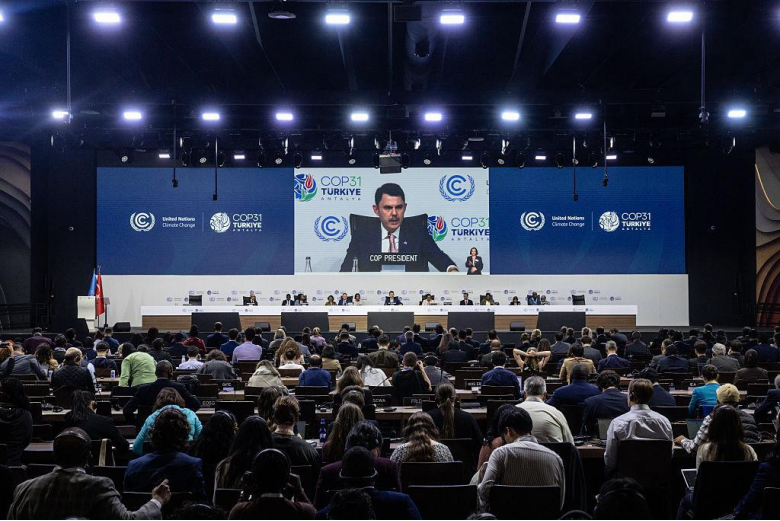
Countries adopted decisions on adaptation and just transition in Antalya, but failed to agree on the conference’s overarching political outcome. Photo: UNFCCC
Summary
- COP31 ended without agreement on the proposed Antalya Pact after disagreements over fossil fuels, climate finance and the direction of global climate action.
- Governments adopted decisions on adaptation and just transition, but failed to agree on the Mitigation Work Programme and several other proposals.
- Developing countries left Antalya without a clear pathway for delivering adaptation finance, while attention turns to Ethiopia’s hosting of COP32 in 2027.
The United Nations climate conference in Antalya, Türkiye, ended on Sunday without agreement on its proposed overarching political deal, after nearly two extra days of negotiations exposed deep divisions over fossil fuels, climate finance and how governments should respond to rising global temperatures.
“I am deeply disappointed that COP31 has ended without consensus on an overarching outcome,” United Nations Secretary-General António Guterres said in a statement following the conference.
“There may be no consensus in the negotiating room. There is no ambiguity in the science.”
The failure to adopt the proposed Antalya Pact left the conference without a common political statement addressing some of the most contested questions in climate action. But it did not mean all negotiations failed. Governments adopted separate decisions on issues including the Global Goal on Adaptation and the Just Transition Work Programme, while other proposals, including the Mitigation Work Programme, did not secure agreement.
The proposed Antalya Pact consisted of two Presidency-led decisions, one under the United Nations climate convention and another under the Paris Agreement. Together, they were intended to provide an overarching political response to the climate crisis and set direction for the next phase of international climate action.
But countries could not agree on the language. A central dispute was whether the decisions should explicitly address the transition away from fossil fuels, the main source of greenhouse gas emissions. Countries also disagreed over the strength of the language on climate action and whether the proposed text adequately addressed the financing needs of developing countries.
The breakdown is not without precedent. At COP6 in The Hague, Netherlands, in November 2000, negotiations also collapsed after countries failed to resolve disputes over emissions reductions, carbon sinks, compliance and financial support for developing nations. Conference president Jan Pronk suspended the talks without an agreement. Negotiations resumed in Bonn the following year, where countries eventually reached a compromise.
The disputes were different, but both conferences exposed the difficulty of reaching consensus when countries have competing priorities over climate action, financing and responsibility.
At COP31, the European Union found itself at the center of a dispute over the conference’s political outcome, this time insisting that any agreement must explicitly address fossil fuels. Speaking on behalf of the bloc, Ireland’s environment minister, Darragh O’Brien, said: “We will not endorse a cover decision or an Antalya pact that does not even mention fossil fuels, which is the key driver of climate change.”
The EU’s position, however, drew criticism from climate campaigners who accused the bloc of applying pressure on fossil-fuel language while resisting financing commitments needed by developing countries. Mohamed Adow, director of Power Shift Africa, said the EU could not distance itself from the outcome of negotiations in which it had also played a role.
“Europe’s hypocrisy is staggering. Its governments demand fossil fuel roadmaps from others while expanding fossil fuels themselves and blocking the finance poorer countries need to make the transition,” Adow said in a response to the EU’s rejection of the final text.
Russia, meanwhile, opposed language on fossil fuels, warning that reducing supply faster than demand could cause price shocks and energy shortages. Saudi Arabia argued that all proposed solutions should remain available. The disagreement left governments unable to reach the consensus required to adopt the two decisions.
The dispute was not simply about whether fossil fuels should be mentioned. It was also about whether the conference would reaffirm commitments made at previous summits or weaken them through a new political text. More than 130 countries had called for stronger action on transitioning away from fossil fuels, following the commitment reached at COP28 in Dubai. The proposed Antalya Pact did not include that language, prompting objections from countries that said the text fell short of what science and previous agreements required.
Vanuatu’s delegation said the proposed decision was silent on “fossil fuels, the principal driver of the climate crisis.” It also warned: “Consensus must never come at the expense of our people’s survival, sovereignty and future generations.”
The conference nevertheless produced decisions in areas where governments were able to reach agreement. One of the most significant was the Global Goal on Adaptation, which seeks to measure whether countries are becoming better able to cope with the effects of climate change.
At COP30 in Brazil, countries agreed on 59 indicators intended to help track adaptation progress. But questions remained over how the indicators would be measured and whether countries had the technical capacity to use them. At COP31, governments agreed to establish a technical task force of national experts to refine the indicators and develop guidance for their use by October 2027.
The agreement is a step towards making adaptation progress more measurable, but it does not itself provide the money countries need to implement projects. That distinction is important for countries such as Liberia, where coastal erosion, flooding, extreme heat and pressure on agriculture require investments in infrastructure, public services and community protection.
An aerial view of flooding in Liberia after heavy rains left communities affected and families in need of food and other essential supplies. Photo:Mamadou Jallow/WFP.
Another decision was reached on the Just Transition Work Programme, which was extended for three years. The program provides a space for countries to discuss how the shift to lower-emission economies can protect workers, communities and people whose livelihoods depend on industries affected by climate policies.
However, governments did not settle the operational arrangements for the Just Transition Mechanism agreed at COP30. Disagreements over its governance and institutional arrangements meant those decisions were postponed until COP32 in 2027. The extension keeps discussions going, but countries have yet to agree on how the mechanism will provide practical support.
Other negotiations ended less successfully. Governments failed to reach agreement on the Mitigation Work Programme, which was due for renewal. The program provides a forum for countries to discuss ways to reduce greenhouse gas emissions. Russia and Saudi Arabia objected to the draft decision, leaving the program without an agreed continuation at COP31.
Draft decisions on response measures and the Global Environment Facility also failed to secure adoption. The closing-day negotiations report documented the rejection of these draft decisions, leaving several issues unresolved as countries prepare for the next round of negotiations.
Climate finance remained one of the most difficult issues, particularly for developing countries that need funding to prepare for climate impacts they have contributed relatively little to causing.
At COP30, countries had agreed to efforts to triple adaptation finance by 2035. But developing countries came to Antalya seeking clarity on how that increase would be measured and delivered, including a baseline for calculating progress, predictable funding and stronger accountability from developed countries.
The African Group of Negotiators had also pressed for finance that is concessional and grant-based, rather than loans that add to the debt burdens of countries already struggling to fund basic services.
“Ambition needs to be supported by ambitious levels of finance,” Debra-Lee Swanepoel, the African Group’s finance thematic lead, said during a November 19 briefing on the group’s priorities.
The proposed Antalya Pact included language on accelerating adaptation finance and addressing barriers such as high borrowing costs, limited fiscal space and unsustainable debt. But because the overarching decisions were not adopted, those proposals did not become agreed outcomes. The conference did not resolve developing countries’ demand for a clear pathway to deliver the adaptation-finance commitment.
The Climate Action Network, a global coalition of climate organizations, criticized the outcome, accusing wealthy countries of blocking measures intended to strengthen support for vulnerable nations.
“Simply recalling the COP30 commitment to triple adaptation finance means nothing without a baseline or delivery plan. It remains an empty promise,” said Pooja Dave, the network’s adaptation lead.
The network cited annual adaptation needs of $305 billion by 2035, rising to $420 billion when adjusted for inflation, and said the Adaptation Fund had raised barely $50 million against a $300 million annual target. In its statement on COP31, the network said wealthy countries had obstructed measures that could have strengthened finance and accountability for climate action in developing countries.
Mohammed Kamal of the Global Alliance for Incinerator Alternatives, in an earlier interview, said the finance problem begins with the scale of the commitment itself. He argued that the $300 billion annual goal agreed at COP29 in Baku was far below the $1.3 trillion sought by African and other developing countries.
“Some African negotiators decided back then that it’s better to take something instead of nothing. And that’s quite problematic,” Kamal said.
He said the problem was not only the size of the target, but also how much of the money committed actually reaches projects and whether countries receive grants or loans. For countries such as Liberia, he argued, borrowing to protect forests, coastal communities and other resources can create repayment obligations for projects that do not generate income.
Kamal also questioned whether African countries were using their collective influence strongly enough in the negotiations. Although the continent has a common negotiating position through the African Group, he said governments needed stronger political coordination and should be more direct in challenging countries that fail to deliver promised support.
He offered a deliberately provocative example: African leaders could consider refusing to attend one future climate summit if their demands continued to be ignored.
“Imagine a COP where all 54 say we’re not joining the next COP. How would that be?” he said.
Kamal acknowledged that such a move would require political decisions beyond the conference itself, potentially through the African Union. His broader argument was that African governments should not continue attending the annual meetings without using their collective political weight to demand stronger outcomes.
The disappointment over the failed political deal was also expressed by Guterres, who called on developed countries to turn their adaptation-finance promises into concrete commitments.
“Put dates and dollars behind that pledge now. Lives depend on it,” he said, referring to the commitment to increase adaptation finance.
Simon Stiell, the United Nations climate change executive secretary, also acknowledged the failure to agree on the two Presidency-led decisions. But he cautioned against treating the entire conference as a failure.
“I share the deep disappointment of many: COP31 has been unable to agree on issues related to both Presidencies’ led decisions,” Stiell said in his closing remarks.
“At this COP, key negotiating decisions have been made including on a Just Transition. Fairness and inclusion in the climate fight is absolutely essential.”
He said the climate process needed to learn from the deadlock, adding that “consensus works best from the ground up,” with full transparency and time to listen to all views. He also pointed to progress outside the formal negotiations, including initiatives on electrification and resilience.
The conference ended after almost two days beyond its scheduled Friday closing, leaving governments with adopted decisions on adaptation and just transition, but unresolved disputes over fossil fuels, mitigation and the finance needed to implement climate commitments.
Attention now turns to Ethiopia, which will host COP32 in Addis Ababa in 2027. The country will inherit unresolved disputes over fossil fuels, climate finance and the implementation of commitments made at previous conferences.
Speaking at the closing plenary, Ethiopia’s Minister of Finance and Cop32 Chief Negotiator, Fitsum Assefa said the next summit would be an opportunity to rebuild cooperation despite the divisions exposed in Antalya.
“Today the world has been reminded that multilateralism requires determination,” she said.
“We are in difficult times but that difficulty is why COP matters most … The United Nations Framework Convention on Climate Change remains the place where every country has a voice and where we come together to confront that challenge.”
She promised that Addis Ababa would be a “COP of hope,” adding: “Hope that despite our differences we can still come together and have the most ambitious decision.”
This story was produced as part of the COP31 Climate Change Media Partnership, a journalism fellowship organized by Internews’ Earth Journalism Network, Informed Earth and the Stanley Center for Peace and Security.
See more Liberia News Network stories in Google Search by adding LNN as one of your Preferred Sources.
★ Add LNN as a Preferred Source