
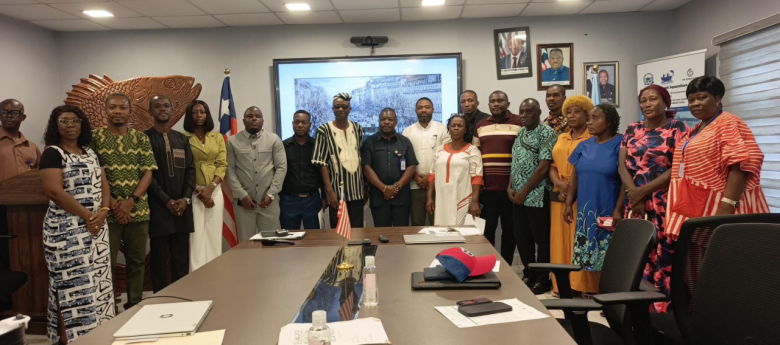
Photo: Officials of NaFAA and implementing partners pose for a group photograph following the launch of the Liberian Women’s Sustainable Fisheries and Livelihoods Incubator.
Bushrod Island, Monrovia-The Government of Liberia has opened a US$680,000 grant facility for women-owned and women-led fisheries businesses across the country’s nine coastal counties, offering financial support ranging from US$5,000 to US$20,000 to help entrepreneurs expand their businesses and improve their livelihoods.
The initiative, known as the Liberian Women’s Sustainable Fisheries and Livelihoods Incubator (LWSFILI), was officially launched Wednesday, November 11, 2026, by the National Fisheries and Aquaculture Authority (NaFAA) in Monrovia. The application period runs from November 11 to November 25, 2026.
The 17-month programme is being implemented by NaFAA in partnership with the iCampus Liberia Consortium, with support from the OPEC Fund for International Development. It forms part of the broader Liberia Integrated Fisheries Sector Strengthening Project (LIFSSP).
Applications opened on November 11 and will close on November 25, 2026. The programme is expected to support approximately 6,200 women-led entrepreneurs and enterprises involved in fishing, fish processing, trading and other related activities.
In his brief remarks at the launch at NaFAA’s headquarters, Director General J. Cyrus Saygbe Sr. said the initiative was designed to address the financial challenges that prevent many women in the fisheries sector from growing their businesses.
He explained that many women work hard to sell fish but cannot expand because they lack the money to purchase sufficient quantities, improve packaging or introduce new products to meet customer demand.
Saygbe illustrated the situation with the story of a woman who regularly sold fish at the market and had established loyal customers but could not increase her business because of limited capital.
“At the end of each day, she went home having worked very hard, but her business remained at the same level. Two years, three years, four years, no growth, no progress,” he said.
“That woman represents thousands of our hardworking women and young women entrepreneurs across Liberia’s fisheries and aquaculture value chain. And that is why we are here today,” he added.
According to Saygbe, the government has listened to the concerns of women fishmongers and entrepreneurs and is responding through the new grant and business-support programme.
“The government of Liberia has heard your cry. And through the Liberian Women’s Sustainable Fisheries and Livelihoods Incubator Program, we are taking practical steps to respond to these concerns,” he said.
He explained that the programme would provide more than financial assistance. Beneficiaries would also receive business training, technical support, help with financial management, business planning, market access and business registration.
“This initiative is designed to do more than distribute money. It is about building businesses, unlocking opportunities, and creating a new generation of Liberian entrepreneurs,” Saygbe stated.
He encouraged women to submit innovative business proposals that could improve fish processing, packaging, storage and marketing instead of relying only on traditional fish-selling activities.
“We are not simply looking to finance the same traditional businesses we have always known. We are looking for innovation,” he said.
He identified fish oil production, fish powder, fish-based products, improved packaging, digital marketing, modern storage facilities and better transportation systems as areas that could create new business opportunities.
“We want to move simply from selling fish to building business around fish,” he added.
Saygbe said the government wants women to move from small-scale businesses into larger and more profitable enterprises that can create jobs and supply supermarkets, hotels, restaurants and other markets.
He, however, warned that beneficiaries must use the grants for the purposes stated in their approved business proposals.
“We will monitor you. We will track you. And if you use the grant funds for things that are not applicable, we will prosecute you,” he warned.
In a special remarks, Director of Research and Statistics and Project Manager of LIFSSP at NaFAA, Austin Saye said the initiative would provide women with greater opportunities to participate in the fisheries sector and improve their economic conditions.
“Today is more than the launch of a program, it is the launch of opportunity and inclusion and transformation for women across Liberia’s fisheries sector,” Saye said.
He disclosed that approximately 6,200 women-led entrepreneurs and enterprises were expected to benefit from the programme through business expansion, increased production, employment opportunities and improved household incomes.
Saye said the US$680,000 grant facility would help beneficiaries purchase equipment, improve fish-processing methods, establish storage facilities and strengthen transportation and other business operations.
He also said the programme recognizes that many women operate successful businesses without formal registration or extensive financial records.
“Potential should never be limited by paperwork,” he emphasized, explaining that the programme would consider business viability, commitment and potential impact in providing women with opportunities to access support.
Providing overview about the application process, Team Lead and Project Lead of the iCampus Liberia Consortium, Luther D. Jeke said applications were open to eligible women-owned and women-led enterprises operating in Bomi, Grand Cape Mount, Montserrado, Margibi, Grand Bassa, River Cess, Sinoe, Grand Kru and Maryland.
He said applicants must have operated their businesses for at least six months.
To qualify as a women-led enterprise, a business must have at least 51 percent women ownership, with women occupying at least 50 percent of management positions.
Jeke explained that applicants could request funding under three categories: Band A, ranging from US$5,000 to US$8,999; Band B, from US$9,000 to US$14,999; and Band C, from US$15,000 to US$20,000.
He said documentation requirements would depend on the amount requested and could include identification documents, evidence of business operations, sales records, financial projections, business plans and proof of matching contributions.
He encouraged interested women to obtain the official application form, carefully follow the instructions and submit their completed applications before the November 25 deadline.
Jeke also assured applicants that the selection process would be transparent and fair. He explained that field officers would assist applicants in completing and submitting forms but would not have the authority to reject or rank applications.
“Every completed form must be accepted and forwarded,” he said.
He added that NaFAA’s LIFSSP Project Implementation Unit would be responsible for determining eligibility, reviewing applications, conducting due diligence and selecting beneficiaries.
Also speaking at the launch, Assistant Commerce Minister for Small Business Administration Jekeh Forkoa Koiyan, representing Commerce Minister Stephen Maka-Yekerson, endorsed the initiative and described it as an important opportunity to strengthen women’s businesses and promote economic growth.
“For us at the Ministry of Commerce and Industry, empowering women economically goes beyond providing opportunity to participate in business. It means creating pathway for women to build sustainable enterprise, improve their competitiveness, access market, strengthen their business capacity, and contribute meaningfully to the national economic growth,” Koiyan said.
He encouraged eligible women-owned businesses, fisheries cooperatives and other enterprises to take advantage of the opportunity.
Koiyan urged NaFAA and its partners to ensure that the application and selection processes remained transparent, inclusive and based on merit.
He reaffirmed the Ministry of Commerce and Industry’s commitment to working with government institutions, development partners and the private sector to strengthen small businesses and promote women’s participation in Liberia’s economy.
The programme is expected to strengthen women’s participation in the fisheries sector, improve fish processing and marketing, create employment and increase income opportunities in coastal communities.
NaFAA has also established a call centre to provide information and respond to questions from prospective applicants. Interested women can call 6232 free of charge using any mobile network.
See more Liberia News Network stories in Google Search by adding LNN as one of your Preferred Sources.
★ Add LNN as a Preferred Source