
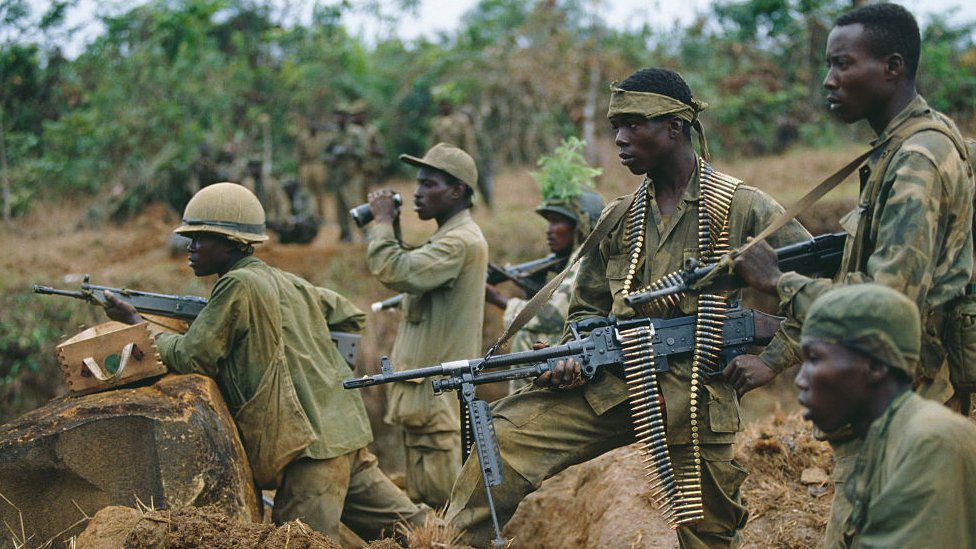
MONROVIA — Human Rights Watch and six other human rights organizations have urged Liberian senators to drop a provision in the Senate’s war crimes court bill that would give the country’s Supreme Court the final word on the court’s verdicts. They warned that it could compromise the independence of a tribunal survivors have awaited for more than two decades.
In a joint statement submitted Wednesday to a public hearing of the Senate Judiciary Committee, the groups said lawmakers “should revisit this arrangement, which could affect the Court’s independence, impartiality and effectiveness or appearance thereof.” They cited “longstanding and well-documented challenges facing the domestic justice system, including in relation to its capacity and independence.”
The statement comments on the Senate’s November 2026 harmonized bill, “An Act to Establish a Special War Crimes Court for Liberia.” It was signed by The Advocates for Human Rights, the Center for Justice and Accountability, the Civil Society Human Rights Advocacy Platform, Civitas Maxima, the Global Justice and Research Project, the Global Justice Center and Human Rights Watch.
The groups backed the bill’s core design, a hybrid court of international and Liberian judges and staff applying both international and Liberian law. They urged the Legislature to move it without delay so the court can be established by November 2027, in line with the Executive’s stated timeline.
“Our call is simple: let us maintain this momentum,” the statement said. “Liberia now has a real chance to secure accountability for grave crimes committed during the country’s civil wars.”
The groups said the court should keep a majority of international judges. They urged lawmakers to consult experts who helped set up comparable courts, including the Special Criminal Court of the Central African Republic, the Extraordinary African Chambers in Senegal and the Special Tribunal for The Gambia.
They also raised concerns about how far back the court’s reach would extend. The Senate bill sets the start of the court’s temporal jurisdiction at 1979, a decade before the civil war broke out in December 1989, and a period that takes in the April 1979 rice riots and the 1980 military coup. The groups said a starting date “more closely linked to the outbreak of the armed conflict in 1989 would be more feasible for the Court to manage.”
On child soldiers, the groups said the bill appears to allow the prosecution of people who were between 15 and 18 when the alleged crimes were committed. They urged lawmakers to clearly exclude anyone under 18 at the time of an alleged offense, in line with international standards.
They questioned whether the court needs jurisdiction over genocide, noting that Liberia’s Truth and Reconciliation Commission found that genocide was not committed during the civil wars.
The groups welcomed the bill’s coverage of conflict-related sexual and gender-based crimes, including rape, sexual slavery, forced marriage and reproductive violence. They objected, however, to its definition of gender as “the two sexes, male and female, within the context of Liberian society.” Citing the International Criminal Court prosecutor’s 2023 policy on gender-based crimes, they recommended dropping the definition altogether, as international treaties do with comparable terms such as race.
The statement praised several provisions:
- Official position and superior orders are no defense.
- Amnesties are limited.
- Protections against double jeopardy do not apply where earlier proceedings were meant to shield suspects.
- Fair trial guarantees are strong.
- Judges must have at least 10 years of relevant experience.
The groups called for clearer rules on who counts as a victim, how victims take part in proceedings and how reparations would be paid. They suggested a separate body, like the International Criminal Court’s Trust Fund for Victims, handle reparations.
They also questioned the inclusion in the statute of the Independent Investigative Unit for Liberia, saying it is a separate institution that should be governed by its own legal framework. They urged lawmakers to confirm the United Nations’ participation in the court, which the bill envisions, before the statute is adopted.
The statement credited the Truth and Reconciliation Commission, whose final report recommended a war crimes court, and drafts by the Liberian National Bar Association, the Office for the Establishment of War and Economic Crimes Court for Liberia and civil society groups. It said trials of Liberian war crimes cases in France and Switzerland “have shown that these crimes can be prosecuted, and survivors rightly expect to see justice delivered at home.”
The groups tied the bill’s timing to Liberia’s presidency of the U.N. Security Council, which begins in December. “Advancing the harmonized bill at this moment would demonstrate Liberia’s leadership on justice and accountability,” they said.
They asked the full Senate, the relevant House committees and the joint Legislature to hold further hearings with victims’ representatives, legal experts and civil society before the bill becomes law.
See more Liberia News Network stories in Google Search by adding LNN as one of your Preferred Sources.
★ Add LNN as a Preferred Source