
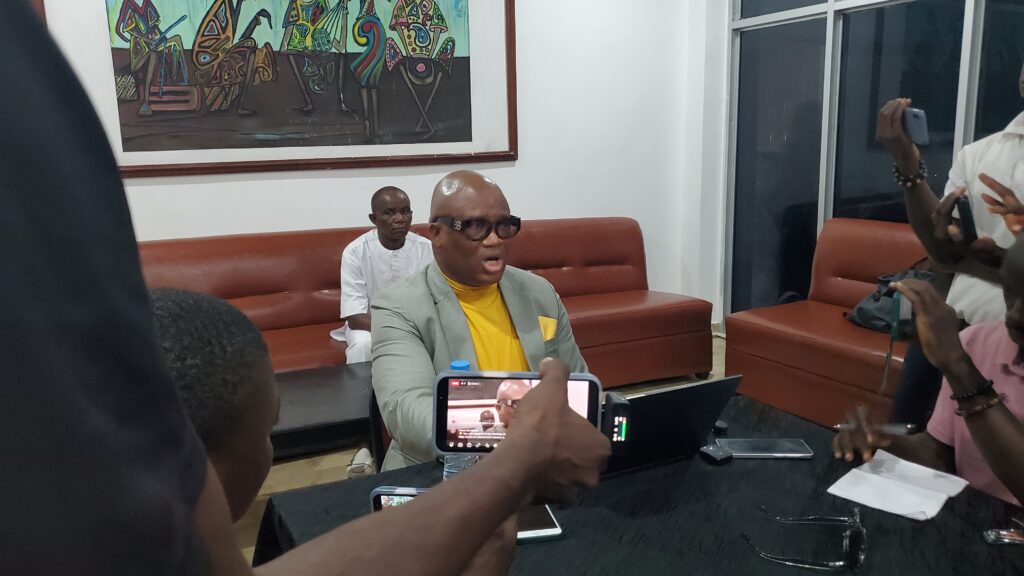
MONROVIA — Opposition Movement for Progressive Change (MPC) Political Leader Simeon Freeman has mounted a strong challenge against President Joseph Nyuma Boakai’s US$5.7 billion Master Infrastructure Development Agreement (MIDA) with Bea Mountain Mining Corporation (BMMC), warning that the arrangement could expose Liberia to decades of financial obligations while placing substantial portions of the country’s anticipated mineral revenues under the control of the mining company.
Freeman, speaking at a press conference held Friday, November 27, at the Sinkor Palace, described the agreement as a potential financial trap for Liberia, arguing that its financing structure, repayment arrangements, interest provisions and anticipated revenue commitments raise serious questions about the country’s ability to sustain the arrangement without compromising future government revenues.
The opposition leader’s criticism comes two days after President Boakai signed the agreement with Bea Mountain on Wednesday, November 25, an arrangement presented as a major infrastructure investment initiative intended to support road construction, energy development and other national infrastructure priorities.
However, Freeman questioned whether the US$5.7 billion headline figure represents money that will be immediately available to Liberia, maintaining that the agreement is structured around anticipated government revenues and project financing rather than a straightforward cash loan or an arrangement in which the country’s gold reserves are directly pledged as repayment.
He argued that the distinction is fundamental because, according to his interpretation of the agreement, the financing arrangement would allow Bea Mountain to use future revenues associated with its mining operations, including royalties, corporate income taxes and other payments, to finance infrastructure projects over an extended period.
Freeman maintained that this structure could prevent the Liberian government from receiving substantial revenues that would otherwise be available for the national budget, thereby reducing the country’s fiscal flexibility and limiting its ability to independently determine how mineral proceeds should be allocated.
“This agreement is a death trap. It is no good for our country,” Freeman declared, insisting that Liberians must carefully examine the contractual provisions instead of judging the arrangement solely by its US$5.7 billion valuation.
One of the principal concerns raised by the MPC leader relates to Liberia’s existing public debt position and the country’s statutory debt ceiling. He referenced the Public Financial Management and Procurement laws, alongside the medium-term debt management framework covering 2026 to 2028, arguing that Liberia must remain within a debt-to-GDP threshold of 60 percent.
According to Freeman, Liberia’s outstanding domestic and external debt stood at approximately US$2.8 billion as of the 2025-2026 period, representing about 55 percent of the country’s gross domestic product based on a GDP estimate of US$5.1 billion.
Using those figures, he argued that Liberia has limited borrowing space remaining under the 60 percent threshold and that the proposed financing arrangement could create additional fiscal exposure if its obligations are treated as public debt or contingent liabilities.
His position raises questions about how the MIDA will be classified within Liberia’s public debt framework, whether the government has conducted a comprehensive debt sustainability assessment and how the agreement’s long-term commitments will be reflected in the country’s fiscal accounts.
Freeman also challenged the proposed interest structure, identifying the Secured Overnight Financing Rate (SOFR) as the benchmark upon which the financing arrangement’s interest would be calculated.
He said the agreement reportedly incorporates SOFR plus an additional two percentage points, estimating that the applicable interest rate could currently fall within the range of approximately 6.5 to 6.7 percent, although the rate would fluctuate as the benchmark changes.
Using an illustrative financing scenario, Freeman argued that borrowing US$500 million could generate approximately US$30 million in interest over one year if the applicable rate remained around six percent.
He further warned that unpaid obligations could be rolled over, exposing the government to additional interest accumulation and potentially increasing the cost of the financing over time.
The MPC leader estimated that interest payments associated with the entire US$5.7 billion arrangement could reach approximately US$2 billion or more over an extended period, although the actual amount would depend on disbursement schedules, outstanding balances, repayment arrangements and movements in the applicable interest benchmark.
Freeman also questioned the duration within which the proposed infrastructure financing would actually be delivered, suggesting that the agreement’s implementation provisions could spread project financing across several years rather than making the entire US$5.7 billion immediately available.
He pointed to provisions he said identify a 60-megawatt biomass power plant and other initial projects for implementation within 24 months, while the remaining infrastructure financing would depend substantially on future revenues and project arrangements.
According to him, such a structure could leave Liberia committed to a long-term financial arrangement without receiving the full value of the announced investment at the outset.
Beyond the interest rate and debt implications, Freeman alleged that the agreement would grant Bea Mountain substantial tax and payment concessions, including exemptions or relief relating to work permits, residency permits, income taxes and social security contributions for foreign contractors brought into Liberia to execute infrastructure projects.
He argued that these provisions could reduce employment opportunities and the economic benefits that Liberian workers and businesses should receive from a major national infrastructure programme.
Using the example of local road construction activities, Freeman maintained that infrastructure investments of this magnitude should create employment for Liberian engineers, construction workers, truck operators, technicians and other professionals rather than allowing foreign contractors to dominate the implementation process.
He further warned that allowing the mining company to influence the use of anticipated mineral revenues could weaken the government’s bargaining position and create a situation in which Liberia would have limited control over how much revenue it receives and when those resources become available.
The opposition leader also raised concerns about Liberia’s credibility with traditional international lending institutions, arguing that a financing arrangement built around future mineral revenues could affect the country’s ability to independently negotiate other development financing opportunities.
He questioned why Liberia would enter into a long-term arrangement with a mining company that already benefits from the country’s mineral resources when, in his view, the government could generate additional revenue through improved mining taxation, royalty adjustments and stronger enforcement of existing contractual obligations.
Freeman cited the 2023 modification of the Bea Mountain mining agreement, following earlier agreements in 2001 and 2013, as another area requiring public examination.
He argued that the existing arrangement has not provided Liberia with sufficient economic returns and that the government should first address the country’s revenue-sharing position before committing additional anticipated mineral revenues to infrastructure financing.
His criticism also extended to the broader management of public infrastructure investments, with particular reference to electricity generation.
Freeman compared Liberia’s expenditure of approximately US$260 million to upgrade the Mount Coffee Hydropower Plant with Guinea’s reported expenditure of a similar amount to construct the 120-megawatt Souapiti Hydropower Project.
He argued that the comparison demonstrates the need for greater efficiency, transparency and value for money in the management of major infrastructure investments, particularly when public resources and long-term financial commitments are involved.
Freeman maintained that Liberia must avoid entering into agreements whose financial implications could extend beyond the tenure of the officials negotiating them, warning that future administrations and generations of Liberians could inherit obligations they had no role in creating.
In outlining possible responses, he disclosed that political parties were considering a series of actions against the agreement, including legal proceedings and mass public demonstrations aimed at challenging its implementation.
He insisted that the opposition would not remain silent over what he considers an arrangement that could compromise the country’s economic future.
The MPC leader’s position places the MIDA at the center of an emerging national debate over the relationship between infrastructure financing, mineral extraction, public debt management and the protection of government revenues.
While the Boakai administration has signed the agreement as a major infrastructure initiative, the concerns raised by Freeman point to the need for the complete contractual document, its financing model, interest calculations, tax provisions, revenue allocation arrangements and implementation schedule to be made accessible for independent examination.
For Liberia, the central issue is not simply the amount announced under the agreement but whether the country will receive infrastructure investments commensurate with the value of the revenues and economic concessions committed over the life of the arrangement.
The government will need to address these questions with clear financial disclosures, particularly concerning the amount of financing guaranteed, the timing of disbursements, the total repayment obligations, the treatment of future mineral revenues and the legal safeguards protecting Liberia’s fiscal interests.
See more Liberia News Network stories in Google Search by adding LNN as one of your Preferred Sources.
★ Add LNN as a Preferred Source