
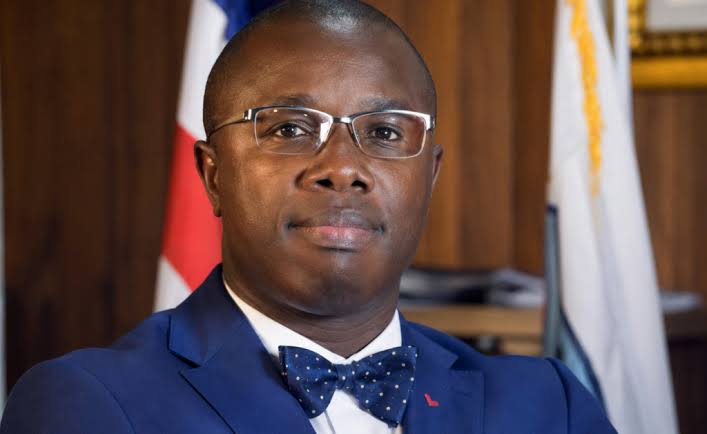
Published: November 29, 2026
MONROVIA — Jefferson Tamba Koijee came home Sunday promising to deliver the Boakai administration to its “political cemetery.” In less than two weeks he will run the congress that decides how the Congress for Democratic Change intends to get it there.
“This regime is operating on what we refer to as borrowed time,” Koijee said. “In the not-too-distant future, the regime will be taken to its political cemetery.”
The rhetoric is familiar. The job waiting for him is what gives it weight. The former Monrovia mayor kept his post as CDC secretary-general through nearly two years of graduate study in Israel. He now chairs the party’s seven-member Convention Committee, which is organizing the Extraordinary Congress set for Dec. 11-13 at Smell No Taste in Margibi County. The congress is expected to address leadership vacancies, internal democracy, membership, representation and electoral preparations, and it could rewrite the party’s constitution, manifesto and policies.
That puts one of the CDC’s most effective organizers at the center of its rebuilding after nearly three years away from frontline politics, and it gives both sides of Liberia’s political divide reason to recalculate. Within the opposition, he could shift the balance of influence inside the CDC and harden its position in talks with other parties. For the ruling Unity Party, he is one of the main organizers of a movement that came within 20,567 votes of keeping the presidency in 2023.
Koijee set out his priorities in institutional terms.
“I’m an institutionalist. We have work to do. We return to our convention. We’re going to put the party together,” he said.
The Mobilizer Is Back
Koijee’s influence has never rested mainly on elected office. It rests on organization. He rose through the CDC’s youth structures and was already an influential organizer when then-President George Weah appointed him mayor in 2018. The Senate confirmed him in February that year, and reporting at the time described him as the youngest person to hold the office.
The CDC’s path to power ran through its ability to turn Weah’s popularity among young and economically marginalized Liberians into an organized movement, and Koijee helped keep that machine running. His time abroad was not a retreat from politics. He stayed publicly engaged and kept his party post. What he lacked was a physical presence in the communities and county structures where he built his influence.
His first remarks suggested he knows where to start.
“What is central to us is to ensure that the Liberian people can find courage in themselves,” he said.
The line was aimed as much at a deflated party base as at the government. But speeches will not rebuild the machine. That takes reviving county structures, reactivating dormant networks, recruiting new supporters and turning public dissatisfaction into turnout.
A Convention With Stakes
The first test is inside his own party. Acting Chairman Janga Kowo and former minister Nathaniel McGill are among the figures in the emerging leadership contest, with rival camps weighing who is best placed to prepare the CDC for 2029. Weah has not publicly endorsed anyone.
Koijee’s role puts him close to the rules of that contest, although separate committees will oversee the elections and the constitutional review. A senior CDC official in Montserrado County has already questioned whether he should oversee convention preparations if he intends to run for an executive post, arguing that it could compromise perceptions of neutrality.
On Sunday, Koijee neither claimed a post nor ruled one out.
“The only decision I’ve made is to ensure that Mr. Weah becomes the next president of the country,” he said.
He added, “Who runs on the party ticket is an institutional decision.”
For now the two statements sit together comfortably. One reaffirms his loyalty to Weah and casts him as the organizer of the former president’s comeback. The other defers to the party’s processes. They could pull apart if rival ambitions surface. His open commitment to Weah may reassure supporters who see the former president as indispensable, and it may unsettle those who want a more open debate about who leads the party next.
A transparent convention with credible rules and a result the losing factions accept would strengthen both Koijee and the CDC. A disputed one would deepen divisions the party can least afford.
The Credential and the Coalition Table
Koijee also returns with a credential that widens his profile beyond the street organizer. At Reichman University in Herzliya, he completed a master’s program in government specializing in counterterrorism and intelligence. His writing from Israel focused on coalition formation, parliamentary bargaining and proportional representation. Israel’s fragmented parliament, where parties routinely trade concessions to form governments, is a working lesson in sharing power among rivals, even if Liberia’s presidential system works differently.
Koijee says he also met Israeli President Isaac Herzog, in the presence of Moti Ajami, deputy mayor of Rishon LeZion. Herzog’s office has not publicly confirmed the meeting. For a politician whose reputation came from grassroots activism, the degree and the reported access help project a broader identity. The test is whether they have added strategic depth to his organizing.
That depth matters because of where the opposition now stands. Opposition leaders have met at a series of roundtables this year, producing a joint communique in September that identified Weah as the CDC’s political leader. Behind those talks lies a harder question: which party has the organization, the votes and the credibility to anchor a coalition against the Unity Party?
A revitalized CDC would argue that it does, and Koijee’s stated goal of returning Weah to the presidency signals the position he is likely to press. For prospective partners, a stronger CDC makes a united opposition more competitive. It also makes the CDC less willing to compromise over the presidential ticket and the division of influence. Opposition figures with presidential ambitions of their own may find themselves negotiating with a CDC confident it can contest power on its own terms. Koijee’s skill as a negotiator may matter as much as his reputation as a mobilizer.
Why the Unity Party Should Pay Attention
For the ruling establishment, the arithmetic is the warning. President Joseph Nyuma Boakai won the Nov. 14, 2023, runoff with 814,481 votes, or 50.64%, to Weah’s 793,914, or 49.36%. The CDC lost after six years in government, but it was not dismantled. A 20,567-vote margin means modest shifts in turnout or allegiance could reverse the result. Young voters and grassroots party supporters are the groups that move margins like that, and they are where Koijee has spent his career.
His remarks Sunday previewed an aggressive campaign.
“This country has been besieged. The country has been destroyed by a gang of people,” he said. The reported excerpts of his remarks offered no evidence for the claim.
He will have grievances to work with. The CDC’s Congo Town headquarters was demolished in 2025 after a court ruling in a private land dispute, and the episode still rankles supporters, some of whom call it political persecution. An experienced organizer can turn grievances like that into rallies, community meetings, membership drives and county-level activity. The danger for the Unity Party is not louder criticism. It is a better-organized opposition able to tie public dissatisfaction to a credible alternative.
The Weight He Carries
Koijee also returns with a serious liability. On Dec. 8, 2023, the U.S. Treasury Department designated him under its Global Magnitsky sanctions program, citing alleged corruption and serious human rights abuse, including alleged control of paramilitary-style groups associated with the CDC. Koijee has rejected the allegations. The designation is an administrative action by the U.S. government, not a criminal conviction in a Liberian court, but it remains a political and reputational burden that his opponents will invoke. His supporters will point to his degree as evidence that he has grown.
Which account takes hold will depend less on either side’s messaging than on how Koijee conducts himself now that he is home. It will also depend on whether the forcefulness his base wants back means turnout and discipline rather than intimidation.
The First Verdict Comes in Margibi
For all the attention on his degree, his reported meeting abroad and his attacks on the government, the first real measure of Koijee’s return will come at the Extraordinary Congress. A credible convention would signal that the former ruling party has moved past its defeat and is rebuilding into a disciplined opposition able to contest power in 2029. A convention marred by factional fights, procedural disputes or personal ambition would show that the CDC’s most pressing opponent, for now, is itself.
See more Liberia News Network stories in Google Search by adding LNN as one of your Preferred Sources.
★ Add LNN as a Preferred Source