
Published: November 29, 2026
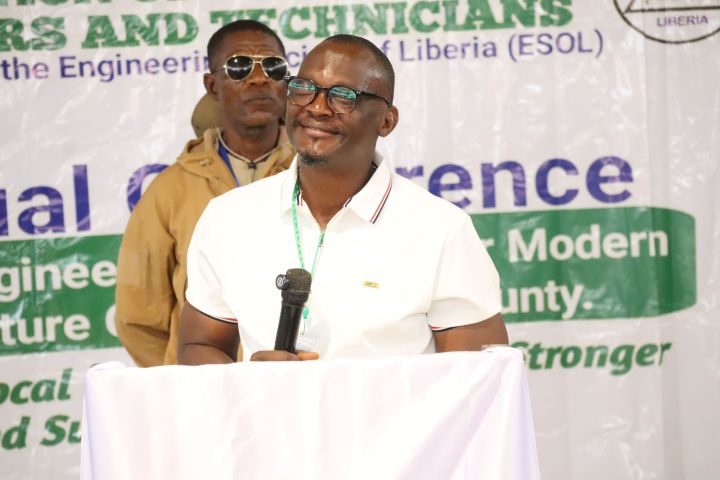
VOINJAMA, Lofa County – Lofa County Senator Momo Tarnuekollie Cyrus has challenged citizens, public officials and professionals to move beyond discussions about the county’s development and take concrete responsibility for its progress, urging greater investment in human capital, infrastructure and collective action.
Cyrus also awarded a US$100,000 construction contract to the Association of Lofa County Engineers and Technicians (ALCET) to construct a building on his farm and donated 50 bags of cement toward the construction of the association’s headquarters in Voinjama.
The senator made the commitments while delivering the keynote address at ALCET’s first annual conference in Voinjama. The association is a professional wing of the Engineering Society of Liberia (ESOL).
The conference, held under the theme, “Harnessing Lofa Human Resource Potential to Drive Collective Development in Lofa,” brought together engineers, technicians and other stakeholders to discuss how professional expertise can accelerate the county’s development.
Cyrus challenged citizens to reflect on their individual responsibilities, asking: “What are we contributing to the development of my county?”
He argued that Lofa’s greatest resource lies not merely in its fertile land, rivers, forests and mineral deposits, but in the knowledge, skills and capabilities of its people.
The senator cautioned against excessive dependence on external partners, emphasizing that the county must develop its own capacity to identify challenges, design solutions and sustain development initiatives.
“Partners have a place in our progress, and we welcome them. But a county that waits for others to supply every answer will move only as fast as others choose,” Cyrus said.
He disclosed that he had provided more than L$1 million in scholarship support to Lofa citizens pursuing studies at various institutions across Liberia, describing education as a critical investment in the county’s future workforce and leadership.
Cyrus also stressed the relationship between human capital and infrastructure development, noting that poor roads prevent farmers from accessing markets, delay patients seeking medical attention and undermine access to education.
“Infrastructure serves human potential, and human skill sustains infrastructure,” he declared.
The lawmaker called for greater inclusion of women and young people in development initiatives, urging established professionals to provide mentorship and practical opportunities for the next generation.
He challenged ALCET to identify critical infrastructure needs, develop practical proposals, uphold professional standards and demand accountability for substandard projects.
Cyrus also encouraged the association to connect professionals in Liberia with those in the diaspora to reduce dependence on external technical expertise.
“The pothole does not ask for your party card. The failed water pump does not ask your faith,” he said, urging citizens to set aside political, religious and social differences in pursuit of development.
He clarified that the broader development priorities outlined in his address were not new funding announcements but a call for stakeholders to establish measurable targets, assume responsibility and deliver tangible results.
Meanwhile, Deputy Minister for Technical Services at the Ministry of Public Works, Prince D. Tamba, challenged engineers and technicians to translate their professional knowledge into practical solutions to Lofa’s infrastructure challenges.
Tamba, a founding member of ALCET and native of Lofa, said the association was established in November 2024 to provide an organized platform through which the county’s technical professionals could contribute to its development.
He urged the association to preserve its nonpolitical and nonprofit character while promoting professional competence, mentorship and public service.
The deputy minister also advocated greater recognition of technical and vocational education, arguing that national development cannot depend exclusively on university graduates.
“Not everybody wants to go to university,” Tamba said.
Citing figures from a national road assessment, Tamba disclosed that Lofa accounts for approximately 1,662 kilometers of Liberia’s road network, representing nearly 12 percent of the national total.
He said the county’s reputation as Liberia’s agricultural breadbasket must be supported by reliable roads connecting farming communities to markets, schools, health facilities and businesses.
Tamba reported progress on an 81-kilometer road project in the county, while financing commitments, design reviews and procurement processes were being pursued for other road corridors. He said procurement activities for some projects are expected to advance during the first quarter of 2027.
He also highlighted a road concession arrangement that provides for 25 years of maintenance responsibility, intended to ensure the sustainability of the infrastructure beyond its initial construction.
The deputy minister urged communities to cooperate with contractors and cautioned against neglecting smaller roads connecting rural towns and villages.
He further encouraged young people pursuing engineering and technical studies to take their education seriously, stressing the need for Lofa to develop professionals capable of constructing, supervising and maintaining its infrastructure.
Tamba commended ALCET’s leadership and members for their voluntary contributions and encouraged engineers in other counties to establish similar professional associations.
He also paid tribute to the late Engineer Jacob Paya for his contributions during the association’s formative period, proposing the establishment of a mentorship initiative and intellectual series in his honor.
See more Liberia News Network stories in Google Search by adding LNN as one of your Preferred Sources.
★ Add LNN as a Preferred Source