
Published: November 29, 2026
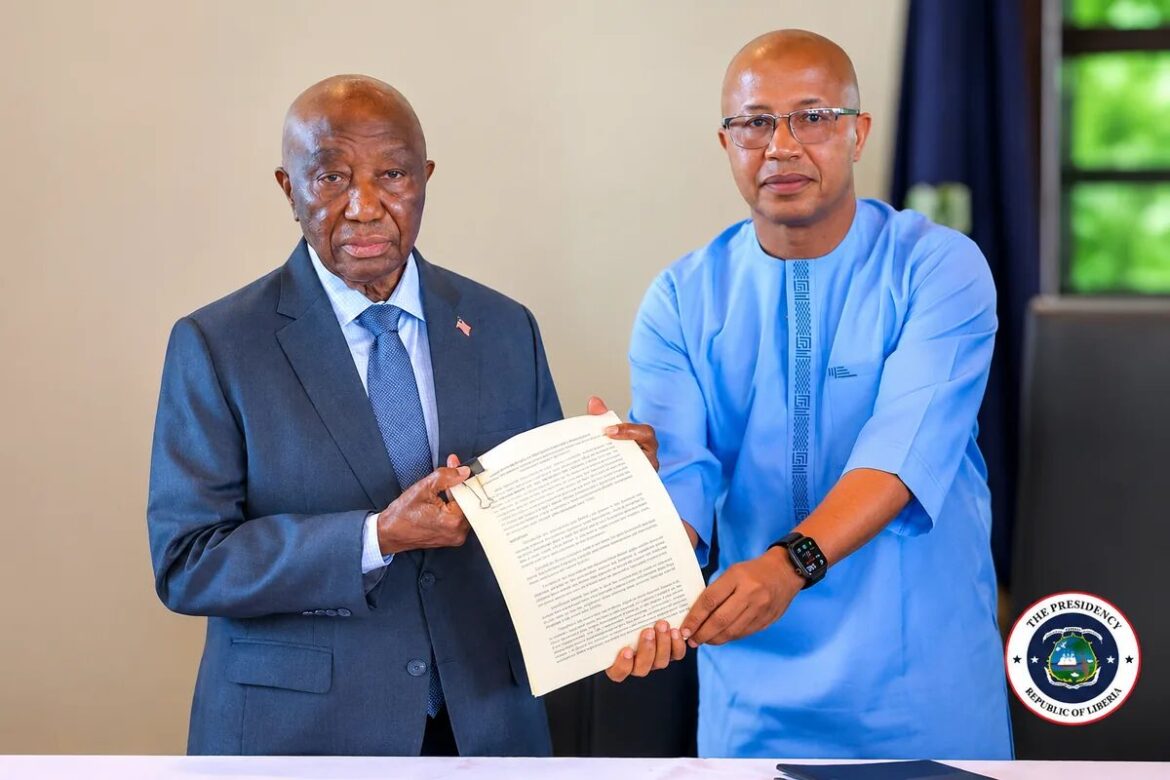
Over the past few days, the signing of the latest US$5.7 billion agreement between the Government of Liberia and Bea Mountain Mining Corporation, and its transmission to the National Legislature (the Senate and the House of Representatives), have generated considerable excitement, debate and political commentary.
Some have welcomed it as a major investment opportunity. Others have questioned its financial implications and the country’s long-term interests. Both discussions are important. However, I believe there is a more fundamental question we should be asking as Liberians:
After decades of granting concessions to companies exploiting our natural resources, where is the comprehensive account of what these companies have actually delivered to the Liberian people?
Let us put politics aside for a moment.
Let us also go beyond the 1926s and 1946s, the historical dates and concession arrangements that economists and other development experts understandably refer to when discussing Liberia’s economic history.
I want us to look at the bigger picture of national development and accountability.
Let me use one country in East Africa as a point of personal reflection: Ethiopia. I first travelled to Ethiopia by air in 2001 on a work duty, I was just a data analyst in the Ministry of Health and Social Welfare, marking my first experience travelling by aircraft outside Liberia. My first experience outside Liberia, however, was in 1993, when I fled the rebels and crossed into neighboring Côte d’Ivoire in Tabou in search of safety. When I first visited Ethiopia in 2001, what I encountered was, from my personal observation, a country facing considerable infrastructure and development challenges, poverty, etc.
Today, I spend considerable time in Addis Ababa because of assignment as a Director at the Africa Centres for Disease Control and Prevention, Africa CDC. This morning, I flew from Addis Ababa to Juba on Ethiopian Airlines, and I could not help reflecting on how dramatically the city has changed over the years.
The transformation is visible. New roads, impressive bridges, modern buildings and skyscrapers, expanding infrastructure and major investments in electricity and urban development have changed the city’s landscape. Addis Ababa at night presents a remarkable picture of modern urban development.
I am not presenting Ethiopia as a perfect country, nor am I suggesting that its development experience can simply be replicated in Liberia. Every country has its own economic, political and historical circumstances.
But as someone who has witnessed both periods, I cannot help asking a question: What has happened in Liberia over these same decades, and why are we still struggling to provide so many basic necessities for our people? This is not a competition between Liberia and Ethiopia. Ethiopia is experiencing renewed internal civil conflicts and overlapping regional tension with Eritrea. It is an invitation for national reflection.
Let us concentrate on contemporary history, from Presidents Charles Taylor to Gyude Bryant, Ellen Johnson Sirleaf, George Weah and now Joseph Nyuma Boakai, Liberia has experienced different administrations, political promises, development agendas and approaches to managing our natural resources.
Each administration has had its own challenges, achievements, controversies and responsibilities.
We have seen successive governments criticize the concession agreements of their predecessors. We have heard allegations of corruption, mismanagement, questionable negotiations and unfavourable contractual arrangements. We have also witnessed new administrations announce investment agreements and present them as evidence of economic progress.
Yet, after nearly three decades of these political transitions, Liberia continues to struggle with some of the most basic requirements of national development. Our roads remain inadequate. Electricity remains inaccessible or unaffordable for many communities. Healthcare facilities struggle without resources. Our education system requires sustained investment. Food insecurity, lack of clean and potable water, employment and other basic necessities remain major concerns.
This raises a question that should concern every Liberian, irrespective of political affiliation:
What measurable benefits have the concessions granted to companies over the years brought to our country?
Let me make one clarification. I am not an economist, though, I took sufficient credit hours in my corporation law, commercial law and legal accounting classes to read and understand these dynamics. I am not attempting to conduct an econometric analysis of Liberia’s concession agreements, investment returns, fiscal policies or national economic performance. I am a lawyer and a public health expert. I will leave the technical economic assessments, financial modelling and econometric analysis to economists and other qualified experts.
My concern, however, is from a governance, public accountability and development perspective. Ultimately, economic policies and investment agreements must translate into improved living conditions for the people they are intended to serve.
I am not particularly interested in the political scoreboard of which president signed the most agreements or which administration negotiated the best-looking investment package.
I am more interested in what happened after those agreements were signed.
- What did the companies promise?
- How much did they actually invest?
- How many Liberians did they employ, particularly in skilled, unskilled and managerial positions?
- What taxes, royalties and other revenues did they pay?
- Which roads, bridges, schools, health facilities, electricity projects and other promised infrastructure did they complete?
- What benefits reached the communities whose land and natural resources were given for commercial exploitation?
- When companies failed to honor their commitments, what action did the Government of Liberia take? I remember participating in the drafting process of legislation that created the commercial court as a member of the Bar Association of Liberia. How many companies have been taken before that court for wrongdoing?
I stand to be corrected, but I have not seen a comprehensive, publicly accessible national reporting system that consistently provides Liberians with quarterly and annual accounts of the performance of major concessionaires against their contractual obligations.
We cannot continue celebrating the signing of agreements without establishing a transparent mechanism to monitor their implementation. Nor should concession agreements become political instruments that one administration uses to discredit another while the companies benefiting from those agreements escape sustained public scrutiny.
My Proposal: Establish a National Concession Performance and Accountability Report
I propose that the Government of Liberia, working through the National Bureau of Concessions and the National Investment Commission, establish a mandatory National Concession Performance and Accountability Report.
The National Bureau of Concessions should serve as the principal technical and monitoring institution, working in coordination with the National Investment Commission, relevant sector ministries, the Liberia Revenue Authority, the General Auditing Commission and other oversight institutions.
This report should be published annually, presented to the Legislature and made accessible to the public.
It should provide a clear account of every major concession agreement, regardless of the administration under which it was signed.
At a minimum, it should document:
- Contractual commitments: What each company agreed to invest, construct, pay and deliver.
- Actual performance: What has been completed against what was promised, supported by independent verification.
- Government revenue: Taxes, royalties, fees, signature bonuses and other payments received by the Government of Liberia.
- Employment and local participation: The number of Liberians employed, their positions, training opportunities and local business participation.
- Infrastructure delivery: Roads, bridges, electricity, schools, health facilities, ports and other projects promised and completed.
- Community benefits: The actual social and economic benefits received by communities affected by concession operations.
- Environmental and social obligations: Compliance with environmental standards, land-use requirements, resettlement commitments and community protections.
- Outstanding obligations and enforcement: What remains undelivered, why it remains outstanding and what corrective or legal action government has taken.
I would also encourage quarterly monitoring updates, with a comprehensive annual report submitted to the Legislature.
This should not become another government document that is prepared, launched and forgotten. It should become a permanent national accountability instrument.
The Legislature should use it to conduct oversight hearings. Civil society organizations and the media should be able to examine its findings. Communities should know what companies operating on their land have promised them. Investors should understand that Liberia expects contractual commitments to be respected.
As we approach another election cycle, I believe this conversation is particularly important. We cannot continue changing governments, changing political narratives and changing the people responsible for managing our resources without establishing institutions that preserve national accountability. If the ruling party wins another term, this accountability mechanism should continue. If another party takes over, it should continue all the same. Our natural resources outlive presidents, political parties and administrations. Therefore, the accountability system governing their exploitation must also outlive political transitions.
I am not opposed to foreign investment. Liberia needs serious investors, capital, technology, employment and infrastructure development. But investment announcements should never be confused with development outcomes. A multibillion-dollar agreement is not, by itself, evidence of national prosperity. The real measure is what is invested, what is delivered, what government receives and how the lives of ordinary Liberians improve. We should be asking not simply how many agreements have been signed, but how many commitments have been fulfilled.
Liberia does not only need more concession agreements. It needs a stronger institutional system to ensure that every concession agreement delivers on its promises. The resources belong to the Liberian people. The responsibility to protect the national interest belongs to the Government. And the obligation to account for the benefits must extend to every company that receives the privilege of exploiting those resources.
This is bigger than Boakai. It is bigger than Weah, Sirleaf, Bryant or Taylor and the next President of Liberia. It is about the country we are leaving for the next generation.
I welcome a constructive national discussion on this proposal.
The question is no longer simply who signed the deal. The question is: Who is monitoring the deal, who is enforcing it, and where is the public accountability?
Tolbert Nyenswah, Ph.D., is a lawyer and public health expert and a director at the Africa Centres for Disease Control and Prevention. The views expressed are his own.
See more Liberia News Network stories in Google Search by adding LNN as one of your Preferred Sources.
★ Add LNN as a Preferred Source