
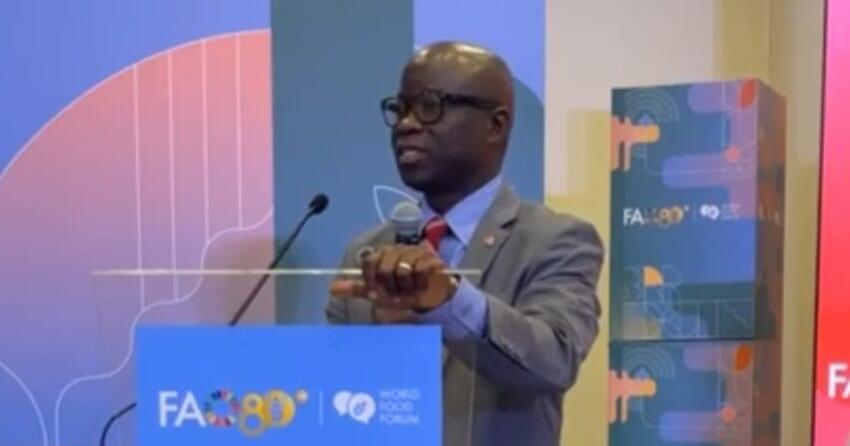
Liberia’s Minister of Agriculture, Dr. J. Alexander Nuetah, has unveiled a US$370 million agricultural investment portfolio at the Food and Agriculture Organization (FAO) Hand-in-Hand Investment Forum in Rome, rallying international investors, development finance institutions, and agribusiness leaders to boost domestic food production.
Minister Nuetah, accompanied by a high-level Liberian delegation, is attending the 2026 World Food Forum being held October 8-16 at FAO headquarters under the theme, “Innovate Today. Nourish Tomorrow.” The forum brings together government leaders, investors, and development partners to advance agricultural investment, innovation, and global food security.
Presenting on Wednesday, October 14, under the theme “Liberia: From Import Dependence to Food Self-Sufficiency,” Minister Nuetah outlined four priority investment areas: US$243 million for rice, US$70 million for cocoa, US$32 million for cassava, and US$25 million for maize.
“Liberia should not remain a country with abundant agricultural potential that depends heavily on imported food. We must turn our land and natural agricultural endowment into food, wealth, employment, and prosperity,” Minister Nuetah declared.
Rice accounts for the largest share of the portfolio, reflecting the Government’s determination to reduce import dependence. Domestic production currently meets only 35 to 40 percent of national demand, while rice imports exceeded US$75 million in the first half of 2026 alone.
With more than 600,000 hectares of potentially irrigable land, the Minister highlighted opportunities for investment in irrigation, mechanized production, modern milling facilities, and market development.
“Our ambition is not simply to grow more rice. It is to build a competitive domestic industry that serves not just Liberian consumers but continental Africa and the rest of the world,” he emphasized.
Minister Nuetah also outlined opportunities in cassava processing for industrial starch and animal feed, cocoa production and value addition, and maize cultivation to support Liberia’s poultry and livestock industries.
The four investment opportunities are projected to directly benefit about 23,900 people and indirectly benefit 119,700 more, creating jobs, expanding markets, and improving livelihoods — particularly for smallholder farmers, women, and youth.
With agriculture contributing approximately 29 to 34 percent of Liberia’s GDP and employing more than 60 percent of the workforce, Minister Nuetah stressed that private investment is critical to unlocking the sector’s largely untapped potential.
He assured prospective investors of the Government’s commitment to facilitating investment through One-Stop-Shop services, investment incentives, agro-industrial processing zones, and duty-free provisions for eligible agricultural machinery and inputs.
“Capital does not move on ambition alone. Investors need credible information, sound project preparation, clear implementation arrangements, and a supportive policy environment. The Government of Liberia is committed to providing these,” he said.
Concluding his presentation, Minister Nuetah invited international investors, financial institutions, and development partners to engage directly with the Liberian delegation to transform the proposals into concrete investments.
“Let us move from agricultural potential to productive investment. From import dependence to food self-sufficiency. And from underused resources to a prosperous, resilient, and inclusive agricultural economy,” he urged.
He thanked the FAO for providing a platform to connect Liberia’s agricultural priorities with international financing, expertise, and commercial partnerships.
In a related engagement earlier in the day, Minister Nuetah participated in a high-level panel titled “From Bean to Bar: Ensuring Chocolate’s Value Reaches Cocoa Farmers,” alongside senior representatives of the Democratic Republic of Congo, the European Investment Bank, the African Development Bank, and global chocolate manufacturer Ferrero.
The discussion examined how cocoa-producing countries can secure greater benefits from the global chocolate industry through improved farmer incomes, stronger market access, sustainable production, and increased investment in processing and value addition.
For Liberia, the engagement highlighted the country’s growing potential as an emerging cocoa producer in West Africa and the importance of attracting private investment in processing, aggregation, storage, and marketing.
The discussion also reinforced Liberia’s US$70 million cocoa investment proposal, which seeks to expand production, promote value addition, and improve market opportunities for more than 40,000 smallholder cocoa farmers.
See more Liberia News Network stories in Google Search by adding LNN as one of your Preferred Sources.
★ Add LNN as a Preferred Source