Published: August 22, 2026
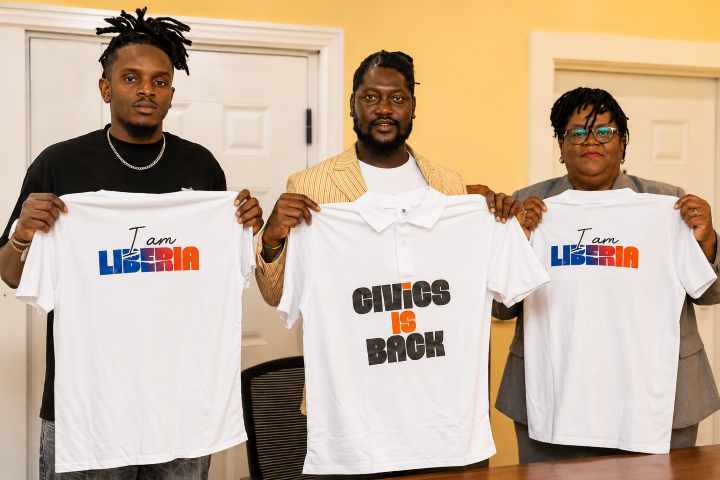
MONROVIA — Liberian musicians Barsee and Com Cruz have been signed as Civic Champions to help take civic education beyond the classroom and connect with young Liberians as the Ministry of Education and Wahala Publishing House Ltd. move to restore civics as a core subject in schools after more than three decades.
The initiative, spearheaded by Wahala Publishing House in collaboration with the Ministry of Education, seeks to strengthen civic knowledge, responsible citizenship, national values and cultural appreciation among Liberian children, particularly from early childhood through Grade 6.
At a ceremony marking the signing of the two musicians, Cllr. Medina A. Wesseh, chairperson of the board of directors of Wahala Publishing House, said the initiative represents more than the return of a school subject. She said it is intended to help rebuild civic consciousness and values among a generation of Liberians.
Under the initiative, civic education is being restored as a core and compulsory subject, supported by newly developed textbooks and learning materials designed to teach children about their rights and responsibilities, communities, culture and the values that shape Liberian society.
Wesseh said the new curriculum differs significantly from the civics materials studied by previous generations, with educators, researchers and teachers contributing to its development.
Rather than focusing largely on conventional civic concepts, she said, the materials place greater emphasis on Liberia’s communities, cultural diversity, national identity, values and everyday social interactions.
The curriculum is designed to help children better understand the districts and communities in which they live, while exposing them to the diverse traditions and cultures found across the country.
Wesseh said the return of civic education also provides an opportunity to confront what she described as an erosion of important societal values, including respect for elders, appreciation for education, responsibility to family and community, and love for country.
National symbols, including the Liberian national anthem and national pledge, also feature prominently in the initiative.
Organizers are producing civic education jingles as part of the campaign, with plans to translate them into Liberia’s major indigenous languages to extend the message beyond classrooms and reach communities across the country.
It is within that broader public awareness campaign that Barsee and Com Cruz are expected to play a major role.
As Civic Champions, the musicians are expected to use their music, influence and public platforms to make civic education messages more appealing and relatable to children and young people.
Their initial engagement is expected to run for one year, with organizers hoping their involvement will help transform civic education from material taught only in classrooms into messages young Liberians can encounter through music and popular culture.
The renewed civic education drive is also dedicated to the legacy of Dr. Amos Claudius Sawyer, the former interim president, professor and statesman who played a leading role in the development of the new Liberian Civics Curriculum and Textbooks.
According to the dedication contained in the new civic education materials, Sawyer envisioned a Liberia in which citizens understand and exercise their civil liberties, including their rights to freedom, participation, knowledge and equality.
The dedication credits him with working to ensure that Liberian children could have access to civic education and describes the restoration of civics as the realization of a vision he pursued for years.
It also recognizes Sawyer’s commitment to ensuring that children could learn, grow and become better citizens and leaders through civic education.
The materials recall the words of Sawyer’s wife, Mrs. Thelma E. Duncan Sawyer, who summarized one of his central aspirations: “All he wanted was to get the books into the hands of children.”
Wahala Publishing House says the new materials are intended to carry that vision forward by putting civic knowledge directly into the hands of Liberian students.
Beyond teaching rights and responsibilities, the curriculum incorporates Liberia’s cultural heritage and traditions.
Wesseh said culture should not be understood only through traditional dances but also through how Liberians live, interact with one another, welcome visitors, conduct ceremonies, prepare food and transfer traditions from one generation to another.
She said exposing children to those aspects of Liberian life through civic education could strengthen their appreciation of their identity while helping them understand the diversity of the country.
The strong cultural component could also open the program to collaboration with other government institutions, including the Liberia National Tourism Authority.
Wesseh said Wahala Publishing House intends to formalize a relationship with the tourism authority and has already engaged its director-general about possible areas of collaboration.
Organizers are also considering how the civic education materials can eventually become more accessible through digital platforms.
Wahala Publishing House has previously explored digitizing educational materials, including discussions around making textbooks and other learning resources available through tablets and similar technologies.
Wesseh, however, acknowledged that limited electricity and access to technology, particularly in rural communities, remain significant challenges that must be considered as Liberia expands digital learning.
The return of civic education comes more than three decades after the subject largely disappeared from Liberia’s school system, a period that included years of conflict and significant social and political change.
With the new curriculum, textbooks and Civic Champions, organizers hope the initiative will help produce a generation that not only understands its rights but also recognizes its responsibilities to communities and country.
For Barsee and Com Cruz, the assignment now places their influence behind that effort — using music and their connection with young people to help bring civic education from the pages of textbooks into everyday Liberian life.
See more Liberia News Network stories in Google Search by adding LNN as one of your Preferred Sources.
★ Add LNN as a Preferred Source