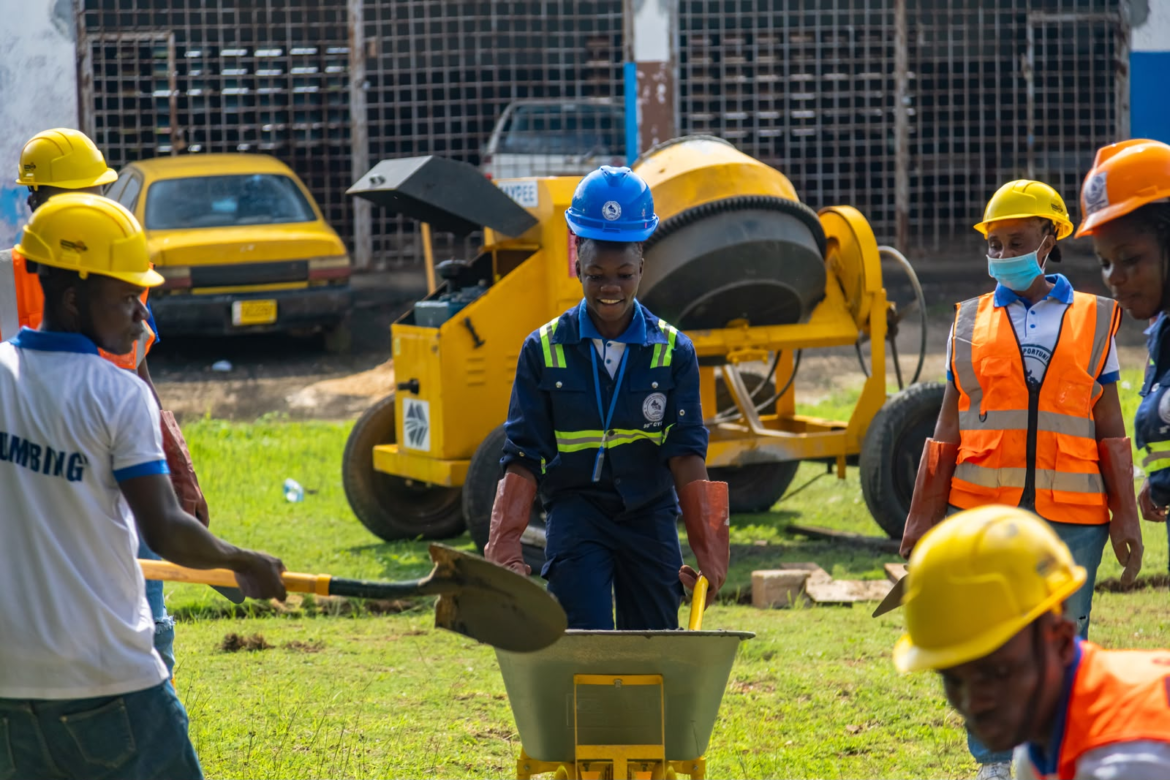
Monrovia – For years, Liberia’s technical and vocational education and training (TVET) challenge extends beyond classrooms. The harder question is what happens when young people leave. The Strengthening Integration through Vocational Education (STRIVE) project addresses whether training translates into jobs, apprenticeships, viable businesses or modern equipment skills.
Funded by the Agence Française de Développement (AFD) with €10 million and implemented by the European Institute for Cooperation and Development (IECD), STRIVE was designed to strengthen vocational training, improve employability and connect training with labor-market needs. IECD says it responded partly to a fragmented system with different curricula and certification approaches.
Liberia’s Ministry of Finance and Development Planning Dashboard lists STRIVE through December 2026, with objectives including stronger TVET institutions, employability, curricula, equipment and training conditions.
At Booker Washington Institute (BWI) in Kakata, Margibi County, George K. Fredericks, Associate Coordinator of the Medical Science Department, including Hospitality, said STRIVE has changed teaching.
“STRIVE is a project that came in various dimensions,” Fredericks said. “We did training of trainers, which was centered on the curriculum. They taught us and trained us about the new curriculum that will be used by all TVET institutions around the Republic of Liberia.”
He said the standardized curriculum ends separate approaches.
“It is making a significant difference,” Fredericks said. “The institution all around Liberia, especially the TVET institutions, was working without a standardized curriculum, which created a lot of problems because thetrainers were training according to what he or she knows.”
“This time, because of the new curriculum and a new pedagogy of teaching, it is student centered based,” he said, adding that approximately 80 percent of training is hands-on.
The shift is visible in hospitality, where Fredericks recalled students using charcoal pots and manual ovens although hotels used modern gas and electric equipment.
“Some years back, what we were using was the traditional means of cooking, using cook pots with charcoal, manual ovens with wood or with charcoal, till IECD provided new equipment which change the old means to the new and industry means of cooking” he said. “And when you go to the industry, those leading hotels, you don’t find those traditional things there.”
“With this new equipment, once the students leave from BWI or other TVET institutions and they go out there in the job market, they are already aware,” Fredericks said. “They already know how to operate a machine as compared to before.”
IECD says STRIVE project strengthens centers, modernizes frameworks, provides equipment and aligns training with labor needs. It initially targeted 9 nine centers and 2,000 young people. IECD due to Liberia’s needs assessment identified Electricity, hospitality, Masonry and agriculture as supported areas.
At Firestone Liberia, Electrical Services Manager Alpha M. Jallo said the company’s IECD partnership dates to 2023 and includes curriculum development, internships and industrial visits.
Jallo said insufficient industrial exposure is a major weakness among young workers.
“From our experience with students who have had from various institutions, not only locally, but from universities and vocational schools, the gap is mainly students not being given enough time of internship programs for industrial areas,” Jallo said.
“It is important that institutions, like the industrial area, be part of the curriculum development programs, because they are dealing with the actual things on the ground,” he said.
“We pinpoint these kinds of students and then try to incorporate them into our workforce, meaning getting them into our employment programs,” he said.
Firestone recently hosted approximately 30 students from IECD-supported institutions at its production lines and power-generation facilities for a company visit.
“We bring them into our facilities, carry them to our production line, our power generation units, for the students to see what we do on the ground, what the workforce does,” he said.
“With the STRIVE program, a lot of students have been participating in our on-the-job training,” Jallo said. “We have employed several of them into our workforce.”
In April 2026, 40 TVET staff graduated from STRIVE-supported training at BWI, while newly equipped masonry and hospitality workshops were handed over. It also supported renovation and equipping of BWI, Monrovia Vocational Training Center (MVTC), Maryann Cheeseman Vocational School, LOIC Monrovia and LOIC Buchanan, plus curriculum development and internships.
Fredericks said employers must view internships as learning opportunities rather than paid positions.
“Most of the industries know fully well that these schools’ students are fully trained. So going there for job training, most of them, their notion is, when the students come for job training, we have to pay them,” he said.
“The major problem will be how to engage these industries to make sure that these students can be absorbed, but it’s not money. It’s the learning aspect of the students.”
He said BWI graduates are finding opportunities in hospitals and hotels in Monrovia, Gbarnga, Ganta and Sanniquellie, while some establish businesses, though entrepreneurship remains constrained by finance.
“I would also like if the STRIVE program can include the instructors to visit major industrial areas to expose them more,” he said.
“We need more awareness,” he said. “Once you do the awareness, most of our students will be absorbed.”
“A project should not go far from being over. We still need the support because it’s almost like you go and build a three-story house and you never think about maintenance,” Fredericks said.
The broader objective is a bridge between what Liberia teaches and what its economy needs. For AFD, STRIVE responds to youth employment through vocational training; for IECD, the focus includes TVET stakeholders, employability and economic opportunities.
The transformation may depend on training centers, government, development partners and employers ensuring skills remain relevant after graduation.
In that sense, the training center is no longer the destination. It is the starting point.
See more Liberia News Network stories in Google Search by adding LNN as one of your Preferred Sources.
★ Add LNN as a Preferred Source