
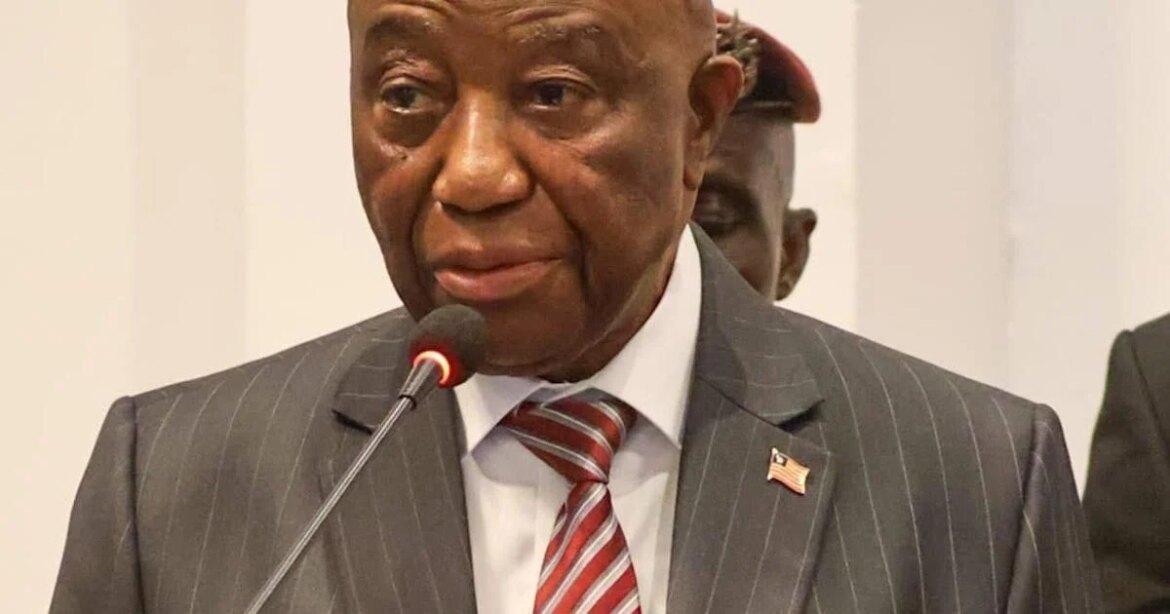
President Joseph Nyuma Boakai has formally acknowledged the resignation of Davidetta Browne Lansanah as Chairperson of the National Elections Commission (NEC), marking the end of a consequential and often turbulent tenure at the helm of Liberia’s electoral body.
In her communication to the President, Browne Lansanah said her decision followed consultations with her family and a desire to take time off after more than twelve years of service to the Commission—first as Commissioner and later as Chairperson.
She expressed gratitude for the opportunity to serve the Republic and satisfaction in helping ensure a smooth institutional transition. According to her, the resignation took effect on March 15, 2026.
President Boakai, in response, praised her for what he described as “dedicated and exemplary service,” noting that her leadership significantly contributed to strengthening Liberia’s electoral framework.
He emphasized that her tenure helped enhance the credibility, stability, and institutional integrity of Liberia’s democratic processes.
While accepting her resignation, the President requested that Browne Lansanah continue to oversee and coordinate the affairs of the NEC through March 31, 2026, to allow for a smooth transition.
He also confirmed that, in line with constitutional and statutory provisions, he will initiate the process of nominating her successor.
Browne Lansanah’s tenure will be most remembered for her leadership during the 2023 Liberian general elections — widely seen as one of the most critical democratic tests in the country’s post-war history.
The election saw then-incumbent George Weah face off against opposition challenger Boakai in a tightly contested runoff that placed immense pressure on Liberia’s electoral institutions.
Under her leadership, the NEC managed a complex process involving millions of voters, thousands of polling stations, and heightened political tensions.
International observers, including the European Union, ECOWAS, and the African Union, reported improvements in logistics, transparency, and stakeholder engagement compared to previous elections.
When the NEC declared Boakai the winner, Liberia achieved its first peaceful democratic transfer of power between two democratically elected presidents since the end of the civil war — an outcome many analysts credit to the Commission’s steady handling of the process.
“The credibility of the 2023 elections owed a great deal to the commission’s ability to remain firm under pressure,” a governance analyst noted. “The NEC leadership had to manage competing political narratives while ensuring the process remained transparent.”
Browne Lansanah herself consistently underscored neutrality during the elections. “Our duty is not to favor any political party,” she said at the time. “Our responsibility is to protect the will of the Liberian people.”
Despite that success, her tenure was also marked by internal disputes that raised concerns about governance within the NEC.
Tensions reportedly escalated following the elections, particularly between the chairperson and segments of the Commission’s workforce.
Some employees accused the leadership of administrative overreach and unilateral decision-making. The situation reached a peak between late 2024 and early 2025 when Browne Lansanah authorized the dismissal of 25 employees without the approval of the Board of Commissioners — an action critics argued violated institutional procedures.
The crisis led to protests, internal paralysis, and a temporary halt in the Commission’s operations, drawing national attention and concern. In January 2025, President Boakai took the extraordinary step of suspending Browne Lansanah for five weeks pending an investigation into the administrative decisions.
Government officials cited issues including the alleged unauthorized dismissals, decisions made without board approval, and the operational shutdown of the NEC.
The move sparked national debate over the balance between executive oversight and the independence of electoral institutions. Following negotiations and internal adjustments — including the reversal of the disputed dismissals — Browne Lansanah was reinstated in February 2025.
However, observers say the episode left lingering institutional tensions. Notwithstanding the controversy, Browne Lansanah’s tenure also delivered notable reforms aimed at strengthening Liberia’s electoral system.
Under her leadership, the NEC modernized aspects of voter registration, improved engagement with political parties and civil society, strengthened electoral dispute resolution mechanisms, and expanded voter education programs.
Her administration also prioritized transparency and collaboration with international partners such as the United Nations Development Programme, which has long supported electoral reforms in Liberia.
“Madam Browne Lansanah played a pivotal role in professionalizing the NEC,” an international election observer said in 2023. “The institution is stronger today than it was a decade ago.”
While Browne Lansanah cited personal reasons for her resignation, analysts suggest multiple underlying factors may have influenced the timing of her departure.
These include the lingering effects of the 2025 administrative crisis, increasing political pressure surrounding electoral reforms, and the demands of managing a high-stakes electoral environment.
“Running an electoral commission in a highly polarized environment is extraordinarily demanding,” a senior government official said. “After the storms she weathered, stepping down may have been the most strategic personal decision.”
Her departure comes at a pivotal time for the NEC, which is currently undergoing infrastructure upgrades and preparing for future electoral processes, including midterm senatorial elections expected within the next 18 months.
The Commission is also laying the groundwork for the 2029 general and presidential elections — contests that will again test Liberia’s democratic institutions.
Under Liberian law, President Boakai will nominate a replacement to complete the remainder of the chairperson’s term, subject to confirmation by the Liberian Senate.
“The next NEC chair will shape the credibility of the 2029 elections,” a democracy advocate noted. “The appointment must inspire confidence across political parties.”
