
MONROVIA – Strong environmental institutions are increasingly becoming indispensable to sustainable development, particularly for resource-rich countries balancing economic growth with ecological protection. Liberia’s acquisition of a permanent headquarters for the Environmental Protection Agency (EPA) and the commissioning of a sophisticated Elemental Analyzer represent more than infrastructure investments. Together, they signal an effort to strengthen scientific regulation, improve environmental monitoring, reduce dependence on foreign laboratories, and build institutional permanence within public administration. President Joseph Nyuma Boakai’s dedication of the new facility, sources say, also reinforces a broader government policy of converting recurring rental expenditures into public assets while equipping national institutions with the tools necessary to support evidence-based policymaking and environmental stewardship. THE ANALYST’s Anthony Q. Jiffan, Jr’s reports.
President Joseph Nyuma Boakai, Sr. has reaffirmed his administration’s commitment to environmental protection and sustainable development, declaring that responsible stewardship of Liberia’s natural resources remains fundamental to the country’s long-term prosperity and inclusive economic growth.
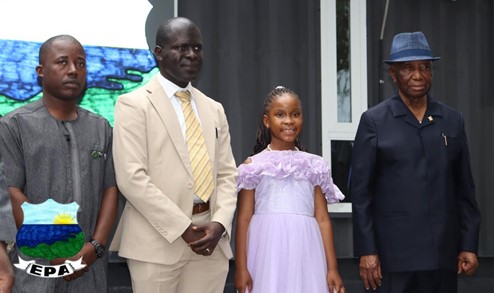
Speaking Thursday during the official dedication of the newly acquired headquarters of the Environmental Protection Agency (EPA) and the commissioning of a state-of-the-art Elemental Analyzer, President Boakai described the twin milestones as major achievements that will strengthen environmental governance, scientific research, and public health through stronger institutions and improved technical capacity.
The President emphasized that the occasion represented far more than the opening of a government facility. Instead, he said, it symbolized a renewed national commitment to ensuring that economic development proceeds without compromising Liberia’s forests, wetlands, rivers, coastlines, and other invaluable natural resources.
“The Environmental Protection Agency has a vital responsibility in the forward march of this nation,” President Boakai declared. “Liberia needs investment and development, but development must be properly regulated to protect communities, prevent pollution, and preserve our forests, wetlands, rivers, coastlines, and other natural resources for present and future generations.”
Permanent National Asset
President Boakai observed that completion of the EPA headquarters demonstrates what public institutions can accomplish through accountable leadership, prudent financial management, and strategic partnerships.
He disclosed that the Government of Liberia acquired the 1.8-acre property for approximately US$800,000, inclusive of taxes and associated fees, at a price substantially below its assessed market value. According to him, the acquisition permanently ends years of rental obligations while providing the EPA with a modern institutional home equipped with offices, conference facilities, laboratories, and workspaces capable of supporting its expanding national mandate.
The President described the purchase as an example of responsible fiscal management because recurring rental expenditures have now been transformed into a permanent public asset that will continue serving future generations.
He commended EPA Executive Director Dr. Emmanuel K. Urey Yarkpawolo and the Agency’s management team for successfully leading the acquisition process, noting that critical public institutions deserve permanent facilities commensurate with their national responsibilities.
Modern Laboratory Capability
A major highlight of the ceremony was the commissioning of a sophisticated Elemental Analyzer valued at approximately €100,000 and donated by the International Atomic Energy Agency (IAEA) after Liberia emerged successful through a competitive regional selection process.
President Boakai explained that the advanced laboratory equipment will significantly expand Liberia’s scientific capabilities by enabling the EPA to conduct comprehensive analyses of soil, water, sediments, plants, and numerous environmental samples within the country.
According to the President, the analyzer will strengthen the work of environmental regulators, researchers, universities, farmers, and public health professionals by improving assessments relating to soil fertility, water quality, pollution levels, mangrove ecosystems, coastal resources, and the environmental impacts of development projects.
For many years, he noted, Liberia’s environmental research and regulatory activities were constrained by limited laboratory capacity and the costly necessity of sending environmental samples abroad for scientific analysis.
The President said the new equipment will substantially reduce those limitations by shortening testing periods, protecting scientific data, strengthening national ownership of environmental information, supporting evidence-based policymaking, and creating new opportunities for training Liberian scientists and university students.
International Partnerships Recognized
President Boakai applauded the International Atomic Energy Agency and other development partners for their continued investment in Liberia’s environmental sector.
He also recognized the EPA’s collaborative research with the University of Liberia and Manchester Metropolitan University, particularly studies examining Liberia’s mangrove ecosystems and their capacity to store organic carbon.
According to the President, such partnerships demonstrate the importance of collaboration among government institutions, academia, researchers, and international organizations in advancing scientific knowledge and environmental protection.
He urged EPA management and staff to properly maintain both the headquarters and laboratory equipment in accordance with internationally accepted standards.
“The laboratory must serve enforcement, research, education, innovation, and sound policymaking,” the President emphasized.
Environmental Protection, Development Linked
Reaffirming his administration’s commitment to the ARREST Agenda for Inclusive Development, President Boakai stressed that environmental protection and economic development should not be viewed as competing objectives.
“Environmental protection is not an obstacle to development,” he declared. “It is the foundation and guardrail for development, ensuring that it is responsible, inclusive, resilient, and lasting.”
The President expressed confidence that the permanent headquarters and upgraded laboratory would significantly strengthen environmental governance, promote scientific innovation, improve public health protection, and contribute to building a cleaner, safer, and more prosperous Liberia.
EPA Highlights Transformation
Earlier, EPA Executive Director Dr. Emmanuel K. Urey Yarkpawolo described the acquisition of the permanent headquarters and commissioning of the Elemental Analyzer as transformative milestones for environmental governance, scientific research, and public service delivery.
According to him, the EPA previously operated for more than sixteen years from two deteriorating rented buildings while paying approximately US$72,000 annually without acquiring ownership. As the Agency’s mandate expanded, those facilities became increasingly inadequate, prompting relocation to a larger building in Mamba Point at an annual rental cost of US$85,000.
Yarkpawolo disclosed that the property was eventually purchased for approximately US$800,000, including taxes and associated fees, substantially below its lowest professional appraisal of about US$1.3 million.
He described the acquisition as a financially prudent decision that converted recurring operational expenses into a lasting public investment.
The Executive Director praised EPA staff for making personal sacrifices to support the purchase, noting that employees voluntarily accepted reduced out-of-town allowances to help finance the acquisition.
According to him, the new headquarters contains approximately 80 offices, three conference rooms, four reception areas, 24 bathrooms, a Geographic Information System laboratory, library, warehouse, parking facilities, staff workspaces, generator house, and secured perimeter.
He further highlighted extensive modernization of the EPA laboratory, including specialized sections for Radiation Safety, Water Quality and Marine Studies, and Instrumental Analysis. The upgraded laboratory, he said, will significantly improve the Agency’s ability to conduct scientific testing, investigate pollution, enforce environmental regulations, and generate credible research supporting national policymaking.
Regional Recognition
Yarkpawolo disclosed that only one Elemental Analyzer was allocated to West Africa under the IAEA regional programme and that Liberia secured the equipment after submitting what evaluators considered the strongest technical proposal based on preparedness and anticipated national impact.
He said the analyzer will advance research relating to soil fertility, agriculture, climate change, mangrove ecosystems, organic carbon, and environmental contamination while creating invaluable scientific opportunities for universities and young Liberian researchers.
The EPA Executive Director further announced that negotiations are nearing completion to acquire land in Grand Cape Mount, Grand Bassa, Sinoe, and Maryland Counties for environmental learning centers intended to expand environmental education, monitoring, and public access to EPA services.
He also highlighted ongoing renewable energy initiatives, including the commissioning of a National Climate Change Laboratory powered by a 32-kilowatt solar energy system and installation of an additional 28-kilowatt solar facility at the Ministry of Mines and Energy.
