
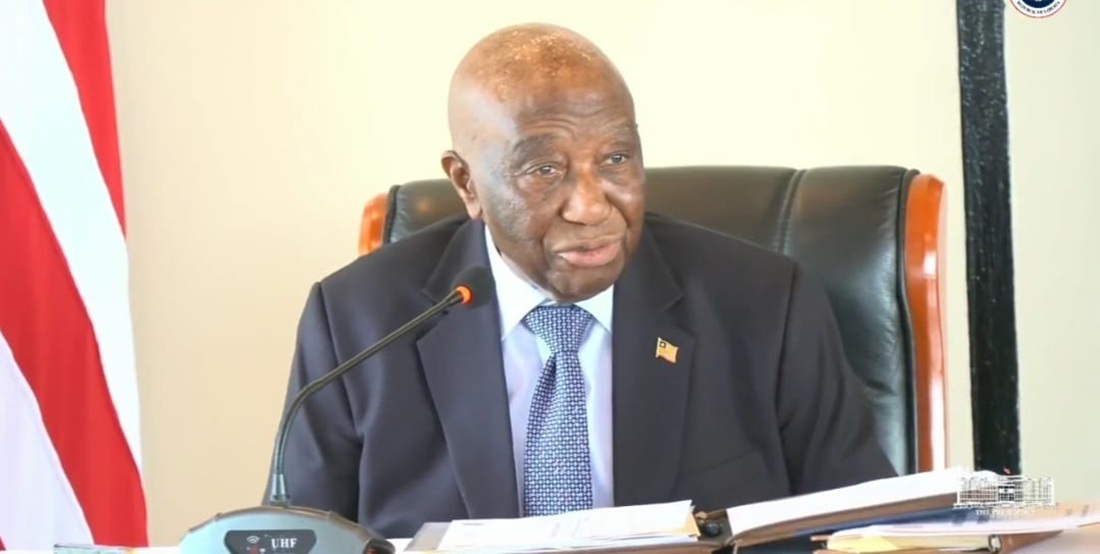
MONROVIA, LIBERIA – President Joseph Nyuma Boakai has issued a stern warning to members of his Cabinet and other government appointees, declaring that officials who fail to perform their duties risk losing their positions as his Administration enters the final three years of its six-year term.
\n
The President delivered the warning on Friday, October 23, 2026, during the opening session of the twenty-fifth Cabinet Meeting, held under the theme “Performance and Delivery.” He challenged ministers and other public officials to demonstrate tangible results, improve service delivery, and ensure that government positions are occupied by individuals committed to advancing national development.
Boakai’s remarks reflected growing pressure on his Administration to translate its development agenda into measurable improvements in the lives of ordinary Liberians. With three years remaining in his term, the President emphasized that public service must be evaluated through actual performance rather than the mere occupation of official positions.
\n
“Make people work and if they don’t work, replace them,” the President charged, making clear that continued employment in government should depend on an official’s willingness and ability to fulfill assigned responsibilities.
He rejected what he described as a culture of complacency among government appointees and support staff across ministries and agencies, cautioning that public offices must not become comfortable positions for individuals who contribute little to the country’s development.
\n
The Liberian leader stressed that his Administration was neither a friendship club nor a family club, reinforcing his position that personal relationships should not shield officials from accountability for poor performance.
“This is a country where I know some people even pray that you don’t call them, that you don’t remember them. They just want to be there. But that’s not work,” Boakai said.
\n
His statement placed renewed emphasis on the responsibility of ministers and heads of government institutions to ensure that their deputies, assistants, and other appointed personnel perform their duties. He warned that officials entrusted with supervisory responsibilities should not allow colleagues to remain in positions without making meaningful contributions.
The President’s warning also highlighted the importance of regular reporting, with Boakai insisting that government performance must be measured through clear information about the volume, speed, and quality of work being completed.
\n
“We have to take account of what we do, how fast we do it, and how well we do it. Because if we don’t know what you’re doing, we don’t know how to grade you,” he noted.
The remarks suggest that the Administration intends to place greater emphasis on performance monitoring as it evaluates the implementation of its development priorities. However, the practical impact of the President’s warning will depend on how consistently performance standards are established, applied, and enforced across government institutions.
\n
The Cabinet meeting addressed several measures intended to strengthen the government’s ability to monitor implementation, identify service-delivery gaps, and improve coordination among ministries and agencies.
Among the key issues discussed was a proposal presented by the President’s Delivery Unit and the Cabinet Office to accelerate government performance and service delivery as the Administration enters its midterm.
\n
The Cabinet also considered the establishment of standing committees to examine technical policy proposals from different sectors before presenting recommendations to the full Cabinet for endorsement. The proposed committees are intended to improve coordination, strengthen policy review, and support more effective implementation of government decisions.
Boakai further called on ministers and officials responsible for awarding and supervising government contracts to ensure that contractors complete projects within agreed timelines and deliver work that meets acceptable quality standards.
\n
“The Liberian people deserve the best and should not be made to compromise on quality,” the President said.
He cited ongoing renovation work at the University of Liberia as an example of the need to pursue higher standards in public projects, emphasizing that the government must pay attention not only to whether projects are completed but also to the quality of the finished work.
\n
The President’s position places responsibility on both government officials and contractors to demonstrate that public resources are being used to produce tangible benefits. Effective supervision, timely implementation, and adherence to quality standards will therefore remain important considerations in assessing the performance of institutions responsible for public projects.
Beyond personnel performance and project supervision, the Cabinet endorsed measures aimed at strengthening accountability, improving revenue generation, and increasing the efficiency of public service delivery.
\n
The meeting also considered an interim jobs strategy intended to create more than 1,000 jobs across sectors including agriculture and public works within 15 months. The strategy is expected to serve as a foundation for a comprehensive five-year national jobs strategy.
Another proposal from the Liberia Revenue Authority seeks to strengthen revenue generation by using technology to improve the registration and tracking of cell phones entering the country.
\n
These initiatives form part of the Administration’s broader effort to improve government functioning as it moves through the middle stage of its term.
Nevertheless, the President’s warning raises an important question about how the government will translate its stated commitment to accountability into measurable outcomes. Replacing underperforming officials may demonstrate political resolve, but sustained improvements will also require clearly defined responsibilities, consistent performance reviews, transparent decision-making, and consequences for failure to meet established targets.
\n
For ordinary Liberians, the central measure of the Administration’s performance will be whether its policies and public investments lead to better services, more employment opportunities, improved infrastructure, and more effective use of public resources.
As Boakai calls on his appointees to work harder and deliver results, attention will increasingly turn to whether the warning produces meaningful changes in government operations and whether underperformance is addressed consistently across ministries and agencies.
\n
The President has made his position clear. The challenge now is to ensure that the demand for performance is reflected in the everyday experience of the Liberian people.
See more Liberia News Network stories in Google Search by adding LNN as one of your Preferred Sources.
★ Add LNN as a Preferred Source