
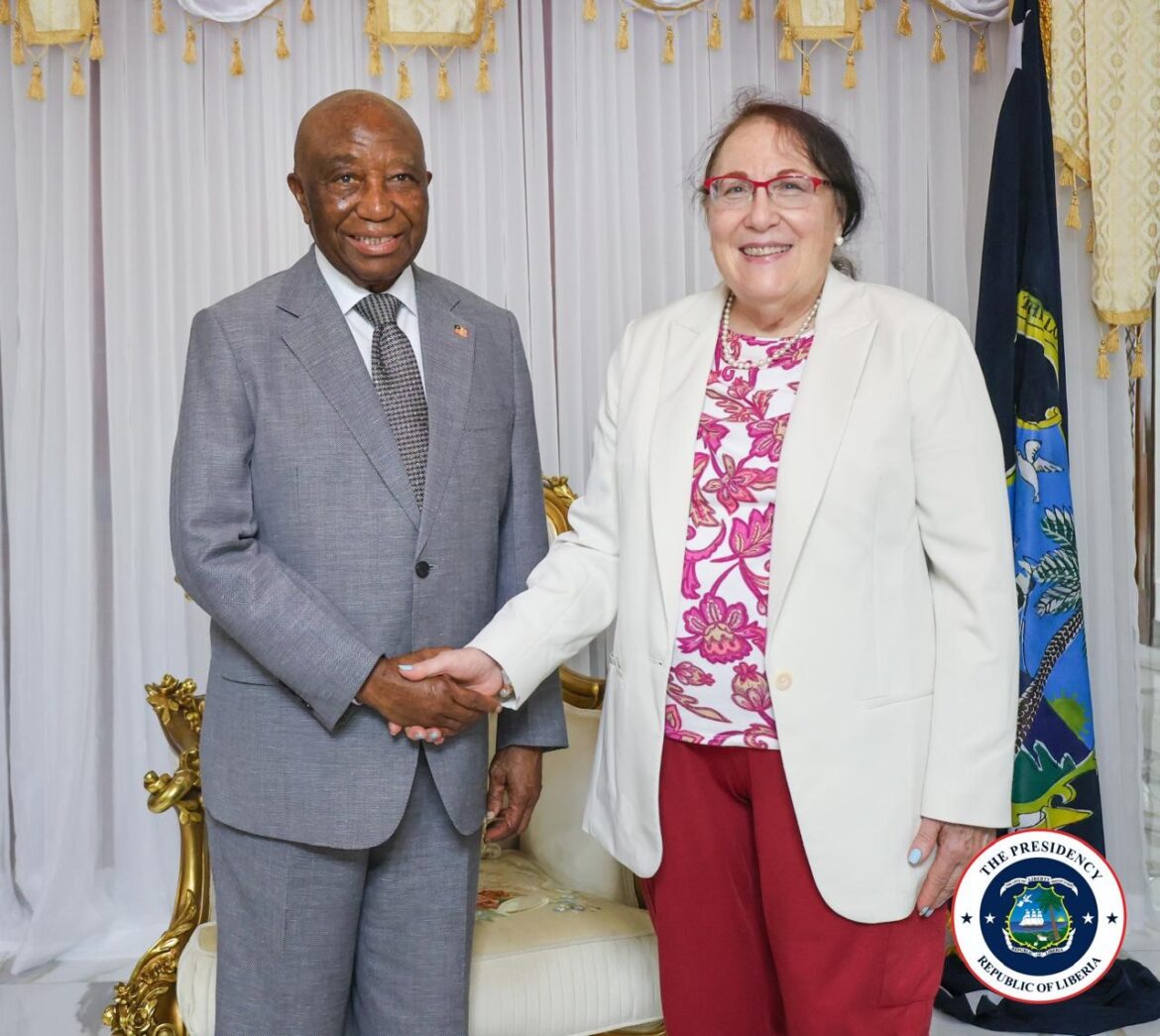
MONROVIA – Liberia’s pursuit of education reform and digital transformation received renewed momentum this week as President Joseph Nyuma Boakai, Sr. welcomed a high-level delegation from the United Methodist University and the Helping Africa Foundation at the Executive Mansion. The visit, anchored by renowned philanthropist and global epidemiologist Dr. Deborah Rose, signals a convergence of international goodwill, institutional ambition, and national development priorities. Beyond ceremonial exchanges, the engagement underscored deeper questions about how Liberia can leverage global partnerships to bridge educational gaps, modernize learning systems, and inspire a new generation of leaders. As THE ANALYST reports, the visit also reflects growing expectations on universities to drive innovation beyond classrooms, into national transformation.
In what is increasingly being interpreted as a strategic convergence of education, philanthropy, and national development priorities, President Joseph Nyuma Boakai, Sr. on Wednesday, April 1, 2026, received in audience a high-level delegation from the United Methodist University (UMU), led by its Interim President, Cllr. Medina A. Wesseh, at the Executive Mansion in Monrovia.
At the heart of the delegation was renowned philanthropist and global epidemiologist, Dr. Deborah Rose, President of the Helping Africa Foundation (HAF), whose presence in Liberia has drawn considerable attention across academic, policy, and development circles.
She was accompanied by Mr. Japhet Aryiku, Executive Director of HAF, and Mr. Jonathan Weisner, Deputy Executive Director, alongside other distinguished participants including Mr. Kofi Boateng of the W.E.B. Du Bois Foundation, Mr. Kafui Prebbie, CEO of IMPLEMENTERS, and Madam Laurin Assiamah-Yeboah, Head of Portfolio & Operations of IMPLEMENTERS.
A VISIT BEYOND CEREMONY

UMC Prexy Cllr. Wesseh, Dr. Deborah Rose and Pres. Boakai
While it was described as a courtesy visit, the engagement quickly evolved into a substantive dialogue on the future of education, innovation, and institutional collaboration in Liberia.
Cllr. Wesseh briefed President Boakai on ongoing developments at the United Methodist University, placing particular emphasis on the institution’s efforts to advance digital education models that function without reliance on conventional internet infrastructure—an innovation with potentially transformative implications for underserved and connectivity-challenged communities across Liberia.
This approach, which aligns with broader global discussions on inclusive digital learning, pundits say represents a pragmatic response to Liberia’s infrastructural constraints. It also reflects a growing recognition that the future of education in developing contexts must be both adaptive and context-sensitive.
In her remarks, Cllr. Wesseh further highlighted that Dr. Rose’s visit to Liberia was not only institutional but symbolic—anchored in her role as keynote speaker for UMU’s 2026 graduation exercises, an event expected to inspire a new generation of Liberian graduates.
DIGITAL TRANSFORMATION AS NATIONAL IMPERATIVE
Dr. Deborah Rose, widely respected for her contributions to global health and education, expressed deep appreciation for the opportunity to engage directly with the Liberian President. She used the occasion to outline her vision for digital transformation in Liberia, particularly through strategic collaboration with the United Methodist University.
Her approach is not merely technological, but philosophical—rooted in the belief that education must transcend traditional boundaries to become a tool for societal transformation. Through the Helping Africa Foundation, Dr. Rose has championed initiatives that integrate locally relevant curriculum with innovative technology, ensuring that learning remains accessible, practical, and aligned with sustainable development goals.
Her work across Sub-Saharan Africa, including partnerships in Ghana and the United States, has demonstrated the potential of computer-based learning systems to expand educational access while fostering critical thinking, technical skills, and global awareness.
PRESIDENT BOAKAI’S PERSONAL AND INSTITUTIONAL CONNECTION
President Boakai, in a moment that blended personal reflection with national vision, traced his own historical ties to Methodist education in Liberia. He recalled his formative years at the College of West Africa Secondary School, where he served as President of the Student Council Government, and his subsequent involvement in the establishment of the United Methodist University.
This recollection was more than anecdotal—it underscored the enduring role of faith-based institutions in shaping Liberia’s leadership pipeline and educational landscape. It also reinforced the President’s apparent commitment to strengthening partnerships that align with Liberia’s development priorities.
In a notable gesture, President Boakai urged Dr. Rose to actively pursue and actualize her plans for Liberia, signaling a willingness at the highest level of government to support initiatives that advance education, innovation, and social development.
DU BOIS LEGACY AND HISTORICAL MEMORY
A particularly significant dimension of the meeting was the shared reflection on the life and legacy of Dr. William Edward Burghardt Du Bois (W.E.B. Du Bois), one of the most influential African-American intellectuals and civil rights advocates of the 20th century.
Both Dr. Rose and President Boakai discussed plans to erect a monument in Liberia in honor of Du Bois—a proposal that carries both symbolic and historical weight. Du Bois, who once visited Liberia and later settled in Ghana where he died in 1963, maintained a longstanding connection to Africa and played a role in shaping Pan-African thought.
He also served as Envoy Extraordinary and Minister Plenipotentiary to Liberia under United States President Calvin Coolidge, attending the inauguration of President Charles D.B. King in the 1920s.
The proposed monument therefore represents more than a tribute—it is an effort to reclaim and institutionalize historical memory within Liberia’s national narrative, linking past intellectual heritage to contemporary development aspirations.
EDUCATION, PHILANTHROPY, AND STATE ALIGNMENT
The meeting further highlighted an emerging model of development in Liberia—one that increasingly relies on alignment between government institutions, academic entities, and philanthropic organizations.
President Boakai extended the gratitude of the Liberian nation to Dr. Rose and her partners, acknowledging the importance of individuals and institutions willing to invest time, expertise, and resources into Liberia’s development journey.
This acknowledgment reflects a broader policy reality: Liberia’s development trajectory is deeply intertwined with its ability to attract, coordinate, and effectively deploy international goodwill.
The exchange of goodwill gifts between the President and Dr. Rose symbolized not just diplomatic courtesy, but a mutual commitment to sustained engagement. Both parties pledged to remain in close contact to ensure that the initiatives proposed by the Helping Africa Foundation are translated into tangible outcomes.
A COMMENCEMENT ADDRESS THAT RESONATES
Dr. Deborah Rose’s role as commencement speaker at UMU’s 21st Convocation added further depth to her visit. Her address, delivered to the graduating class, was both reflective and forward-looking, emphasizing the transformative power of education.
Drawing from her own academic and professional journey—including experiences at Yale, Harvard, Johns Hopkins, and international engagements—Dr. Rose framed education as “the bridge” that connects individual potential to collective human advancement.
Her speech explored themes of interdisciplinary learning, global exposure, language acquisition, and the importance of adaptability in a rapidly evolving world. She highlighted her experiences with cultural immersion programs, her engagement with diverse educational systems, and her belief in learning as a lifelong, collaborative process.
Quoting both classical literature and religious scholarship, she underscored the idea that the deepest understanding often emerges through teaching and engagement with others—a philosophy she applied in her own career as an educator and researcher.
PROFILE OF A GLOBAL FIGURE
Dr. Rose’s credentials reflect a career that spans public health, education, and global development. She has served as an epidemiologist with the National Center for Health Statistics under the Centers for Disease Control and Prevention in the United States, and has held academic roles at Yale University and Johns Hopkins University.
As President of the Helping Africa Foundation, she has led initiatives focused on healthcare, education, and community development across Africa. Her work includes the development of computer-based learning centers, housing projects, and partnerships aimed at equipping students with practical skills in science, technology, engineering, arts, and mathematics (STEAM).
Her recognition with an honorary Doctorate in Education by the University of Cape Coast in 2023 further underscores her contributions to global education and development.
IMPLICATIONS FOR LIBERIA
Analysts note that the significance of the meeting extends beyond its immediate outcomes. It raises broader questions about how Liberia can institutionalize partnerships that deliver measurable impact in education and beyond.
The focus on digital education without internet dependency, for instance, could reshape access to learning in rural and underserved communities. Similarly, the proposed Du Bois monument reflects a growing emphasis on cultural and intellectual heritage as part of national identity-building.
Moreover, the alignment between government, academia, and philanthropy suggests a model that could be replicated in other sectors, including health, agriculture, and infrastructure.
LOOKING AHEAD
As Liberia continues to navigate the complexities of development in a globalized world, engagements such as this one may increasingly define the country’s trajectory.
The challenge, however, lies not in initiating partnerships, but in sustaining them—ensuring that commitments translate into programs, and that programs deliver results.
For now, the visit of Dr. Deborah Rose and her delegation stands as a moment of possibility—a convergence of vision, leadership, and opportunity that, if effectively harnessed, could contribute meaningfully to Liberia’s future.
