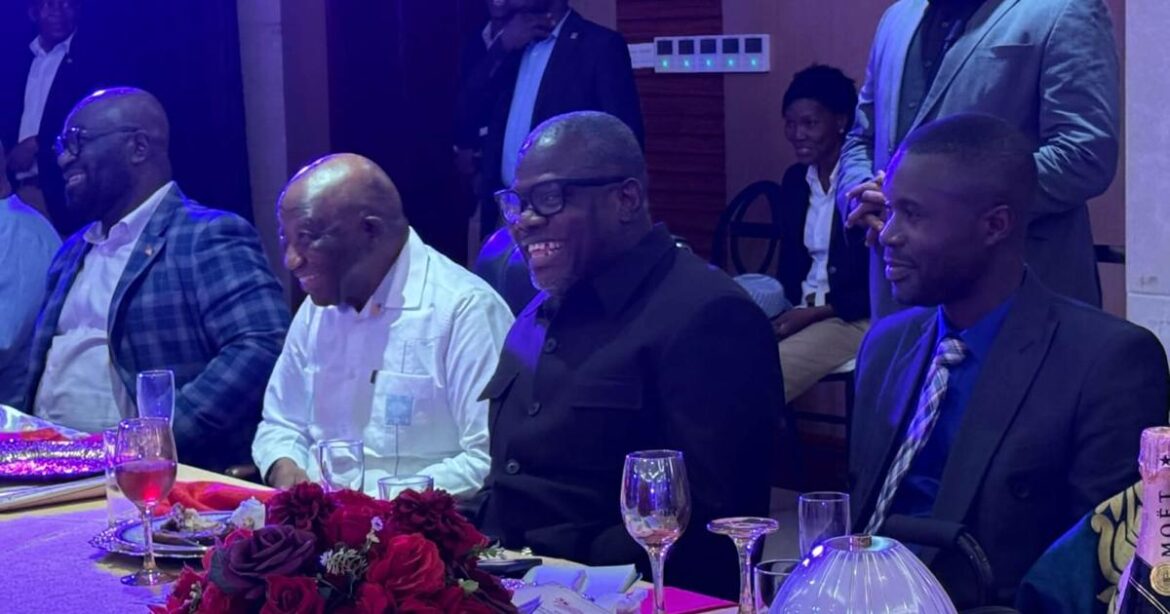
MONROVIA — President Joseph Nyuma Boakai spent Saturday evening dining, laughing and exchanging pleasantries with some of Liberia’s most senior journalists, but beneath the relaxed atmosphere of the Second Annual Presidential Media Dinner was a serious conversation about the future of the country’s struggling media industry.
Held September 12 at the EJS Ministerial Complex in Congo Town, the dinner brought together publishers, editors, broadcasters, reporters, government communicators and senior officials in an atmosphere deliberately different from the press conferences, interviews and sometimes adversarial encounters that ordinarily define relations between government and the Fourth Estate.
President Boakai set the tone by declaring that government and the media should regard each other as “partners with different responsibilities,” while making clear that partnership should neither silence journalists nor eliminate disagreement.
“We may not always agree. And in a democracy, we should not always agree,” Boakai said. “That is not abnormal. But even when we disagree, we must never lose sight of the country we all serve.”
The President also urged journalists to remain positive about Liberia without abandoning their watchdog responsibilities.
“Being positive does not mean ignoring our challenges,” he said. “It does not mean abandoning your responsibility to stand upright and question, investigate, criticize, or hold Government accountable.” Rather, he said, the media should report what is wrong while also telling the world about Liberia’s resilience, progress and possibilities.
But representatives of the media industry used the friendly setting to remind the President that journalism cannot survive on goodwill alone.
Publishers Association of Liberia President Alphonso Toweh and Infinity Corporation CEO Aaron B. Kollie, whose company operates Power FM & TV, both drew attention to the dire economic circumstances confronting Liberian media institutions amid declining advertising revenues. They urged Boakai to consider budgetary support for the sector.
Press Union of Liberia President Julius K. Kanubah went further, telling the President that many of the concerns raised at the inaugural Presidential Media Dinner in April 2025 remain unresolved.
Kanubah cited unreliable electricity, inadequate equipment, limited advertising, high operating costs and insufficient professional training among the pressures facing the industry. More than a year later, he said, there has been no significant progress toward comprehensive reform of ELBC, structured support for community radio, improved working conditions for journalists or a national media-sustainability framework.
The PUL President proposed a Liberia Media Governance and Sustainability Act to establish a transparent national framework for supporting independent, ethical and professional journalism. He also challenged Boakai to consider what his administration’s lasting contribution to the media would be, pointing to media-related initiatives under former Presidents Ellen Johnson Sirleaf and George Weah.
Female Journalists Association of Liberia President Lisa Tenneh Diasay offered another proposal: an Independent Public Interest Journalism Fund, transparently managed and protected from political interference, to support public-interest journalism as donor assistance declines.
Diasay also put gender inclusion squarely before the President.
“Inclusion is not a sentiment. It is a count,” Diasay told the President. “When a woman leaves that table, a girl in Grand Bassa loses a picture of what she is permitted to become.”
She similarly called for greater inclusion of female journalists in presidential delegations, briefings and major interviews, arguing that women journalists are present in the profession but too often absent “from the rooms where the questions get asked and the answers get given.”
Information Minister Jerolinmek Matthew Piah, meanwhile, reaffirmed government’s commitment to press freedom, pledging that journalists would not be censored, media institutions would not be arbitrarily closed because of their editorial positions and journalists would not be unlawfully detained.
“The dark days of Government crackdowns on the media are behind us,” Piah declared. He also disclosed that the government, through the Ministry of Finance and Development Planning, has begun settling legitimate debts owed by previous administrations to some media houses.
But Piah had a challenge of his own for journalists.
He warned that unverified information, particularly when amplified through online platforms, threatens public trust and could undermine government-media relations. While pledging government protection for press freedom, he urged the PUL to address ethical transgressions within the profession and called on journalists to verify information before publication.
The serious exchanges unfolded amid an evening that was anything but stiff.
Leading Liberian comedian Jah Lovett Redd, popularly known as Joseph Dean, helped steer the program as co-master of ceremonies alongside ECOWAS Radio Manager Eva Flomo. Dean repeatedly had the hall roaring as he roasted journalists, media executives, government officials — and even President Boakai himself.
Comedian Lorpu Kolu and Quincy T added to the humor, while vocalists Sundaygar Dearboy and Mr. Music performed, with DJ Master Dee providing additional entertainment.
The evening opened with an invocation by Rev. Charles Levi Martin, pastor and founder of Unity Fellowship Baptist Church in the United States. LBS Director General Eugene L. Fahngon delivered welcome remarks. Other speakers included Toweh, Kollie, Diasay, Kanubah, Piah and Minister of State for Presidential Affairs Samuel A. Stevquoah.
The dinner also carried the memory of the late Ambassador Sylvester M. Grigsby, whose stewardship as Minister of State for Presidential Affairs helped establish the inaugural event. Piah recalled Grigsby as both a distinguished public servant and former media manager whose Suntimes newspaper faced serious repression during the 1980s struggle for press freedom.
There were poignant gestures as well.
Upon entering the hall, President Boakai personally greeted two of Liberia’s most senior surviving journalists: former LBS Director General Olivia Shannon and Daily Observer founder and publisher Kenneth Y. Best.
And when the speeches were over, the formality largely disappeared.
Boakai moved around the room personally greeting attendees as the band played on. Mr. Music and Information Minister Piah took turns on the microphone, while journalists, government officials and other guests danced into the night.
It was perhaps the evening’s simplest expression of what the Presidential Media Dinner was created to achieve: not agreement between government and journalists, but enough professional respect to talk, disagree — and occasionally laugh together.
As Boakai himself put it: government must remain accessible and responsive, while the media must continue to “inform, educate, question, and hold us accountable.”
See more Liberia News Network stories in Google Search by adding LNN as one of your Preferred Sources.
★ Add LNN as a Preferred Source