
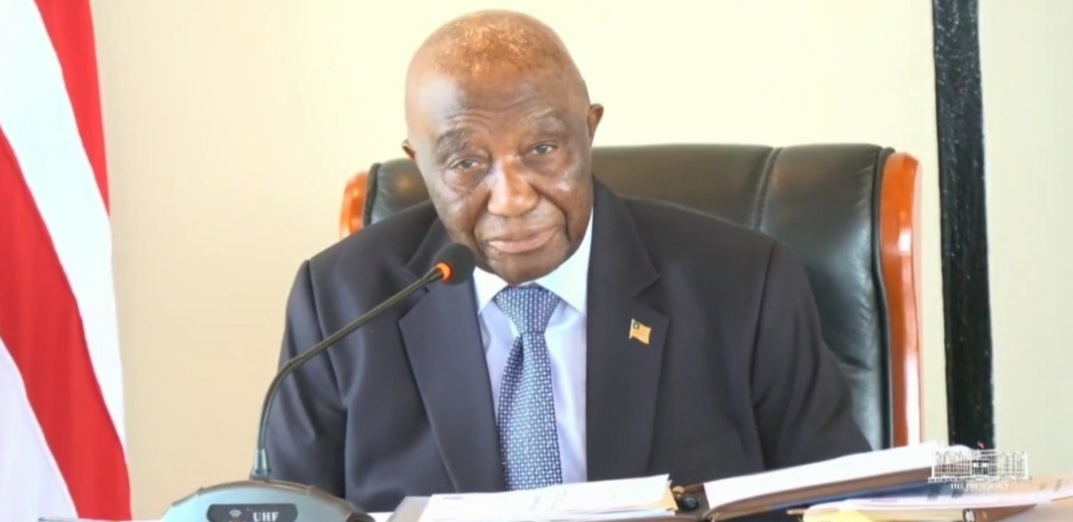
MONROVIA – President Joseph Nyuma Boakai has submitted a proposed US$1.538 billion national budget for Fiscal Year 2027 to the 55th National Legislature, outlining an ambitious spending plan that seeks to accelerate the implementation of his administration’s ARREST Agenda for Inclusive Development through increased investments in healthcare, education, public infrastructure, youth empowerment, women’s economic participation and social protection.
Finance Minister Augustine Kpehe Ngafuan, on behalf of President Joseph Nyuma Boakai, Sr., formally submits the proposed US$1.538 billion FY2027 National Budget and the President’s Budget Message to House Speaker Richard Nagbe Koon at the Capitol in Monrovia on Friday, November 6, 2026. The proposed spending plan prioritizes healthcare, education, youth empowerment, women’s economic participation and social protection under the government’s ARREST Agenda for Inclusive Development.
The draft budget, presented on Friday, November 6, 2026, by Finance Minister Augustine Kpehe Ngafuan on behalf of the President, was formally submitted to House Speaker Richard Nagbe Koon at his Capitol office, together with the President’s Budget Message, which sets out the government’s revenue expectations, spending priorities and development objectives for the next fiscal year.
Titled “A Growing Budget for Bigger Impact: Accelerating the Implementation of the ARREST Agenda for Inclusive Development,” the FY2027 budget proposal places people-centered development at the heart of the government’s fiscal priorities, with the administration seeking to convert improved domestic revenue performance into tangible improvements in the daily lives of Liberians.
A major development highlighted in the President’s Budget Message is the government’s announcement that domestic revenue collections had surpassed US$1 billion by September 2026, marking the first time in Liberia’s history that the country had reached that level of domestic revenue mobilization.
The milestone provides an important fiscal backdrop to the proposed US$1.538 billion budget, as the administration seeks to demonstrate an increased capacity to mobilize domestic resources and finance national development priorities. However, the effectiveness of the proposed spending plan will depend on how successfully the projected resources are collected, appropriated, released and translated into completed projects and improved public services. Among the most prominent priorities is healthcare, where the proposed allocation increases from US$110.9 million in FY2026 to US$135.8 million in FY2027, representing an additional US$24.9 million, or approximately 22 percent.
The proposed increase is intended to strengthen the country’s healthcare delivery system through the expansion and operationalization of medical facilities, procurement of essential medicines and equipment, recruitment of health professionals and improvements in working conditions for healthcare workers.
A major component of the health investment plan is funding for the staffing, equipping and full operationalization of the New Redemption Hospital, an intervention expected to strengthen healthcare delivery and expand access to medical services. The government has also proposed US$5.3 million for upgrading the John F. Kennedy Medical Center, including the procurement of dialysis machines and other critical medical equipment. Another US$15.3 million is earmarked for infrastructure improvements and medical equipment at the JFD Memorial Hospital.
In addition, the draft budget provides US$1 million for the Community Pharmacy Program to sustain the supply of essential medicines, particularly at government health facilities in rural communities, where access to affordable and reliable medical supplies remains an important concern.
Other proposed health investments include US$1.5 million for construction of the National Public Health Institute of Liberia headquarters, US$1.5 million to continue construction works at C.H. Rennie Hospital in Margibi County and US$800,000 in start-up funding to strengthen the country’s response to Hepatitis B. The increased allocation represents a substantial financial commitment to healthcare, although the ultimate measure of success will be whether these investments produce better-equipped hospitals, adequate medical supplies, improved staffing and more accessible services for people across the country.
Education also receives a substantial increase under the proposed FY2027 spending framework, with the allocation rising from US$143.6 million in FY2026 to US$163.5 million, representing an increase of approximately US$20 million, or 13.9 percent.
A major highlight is the proposed US$7 million allocation for the continuation of renovation and furnishing works at the University of Liberia, the country’s premier public university. The investment is intended to support the restoration and modernization of the institution while improving the learning environment for students, faculty and other members of the university community. The proposed education investments extend beyond the University of Liberia, with US$1.5 million allocated for continued renovation of schools operated by the Monrovia Consolidated School System, US$1 million for completion of the new Engineering College at William V.S. Tubman University and US$750,000 for construction of Grand Kru Technical College.
The budget also proposes US$700,000 for the ongoing transformation of the Booker Washington Institute, US$400,000 for an integrated higher education information management system and US$400,000 for renovation of Margibi University.
Additional investments in digital technology, science, technology, engineering and mathematics education, as well as improved national examination infrastructure, are intended to support the modernization of Liberia’s education system and strengthen the country’s capacity to prepare young people for an increasingly competitive employment environment. Beyond healthcare and education, the Boakai administration is placing considerable emphasis on youth empowerment, employment generation, vocational training and entrepreneurship.
The proposed budget seeks to strengthen the National Cadet and Internship Program, expand Technical and Vocational Education and Training opportunities, and provide livelihood and skills-development assistance to at-risk and out-of-school young people.
In a notable intervention targeting commercial motorcyclists, the President has proposed US$2 million to support their empowerment, including the construction of rest stops at strategic locations.
The budget also provides US$3 million to support the Lone Star National Football Team, fulfilling a commitment the President reportedly made approximately two months ago. An additional US$650,000 is proposed to support veteran Lone Star players in advancing youth sports development. Employment opportunities are also expected to expand through proposed recruitment into the Armed Forces of Liberia and the Liberia National Police. Under the plan, 800 young people would be recruited into the AFL, while another 600 would join the LNP, bringing the proposed recruitment total to 1,400.
The government further intends to increase support for youth and student organizations, including the Liberia National Student Union, Federation of Liberian Youth and Mano River Union Youth Parliament, while expanding access to small-business grants through the National Empowerment Program.
Women’s empowerment, child protection and social inclusion constitute another major component of the proposed development agenda.
President Boakai has proposed a 77 percent increase in the allocation to the Ministry of Gender, Children and Social Protection, with the additional resources intended to strengthen social protection programs, prevent and respond to sexual and gender-based violence, support safe homes and provide assistance to vulnerable populations, including abandoned children.
The proposed budget also includes US$2.5 million for small-business support, largely targeting women-led enterprises, alongside increased support for rural women’s communal farming initiatives.
Another important social investment is the proposed US$1.4 million in initial funding toward construction of a National Children’s Referral Hospital. The government has also proposed US$3 million for continuation of the national school feeding program, which is intended to support children’s nutrition and encourage school attendance. Taken together, the proposed investments reflect an effort to connect the government’s development priorities with the everyday needs of households, students, patients, women entrepreneurs and young people seeking employment.
However, the size of the proposed budget alone does not guarantee the delivery of these outcomes. The Legislature’s examination of the appropriations, the government’s implementation capacity, procurement processes and the timely release of funds will be essential in determining whether the promised investments produce measurable improvements.
The US$1 billion domestic revenue milestone also places greater responsibility on the government to demonstrate transparency, fiscal discipline and accountability in the management of public resources. Liberians will expect to see evidence of increased revenue through functioning hospitals, improved schools, completed infrastructure, accessible medicines and opportunities for young people. President Boakai, in his Budget Message, maintained that the proposed FY2027 budget is not simply bigger in financial size but also carries greater potential to improve the lives of citizens through accelerated implementation of the ARREST Agenda.
He has called for expeditious legislative action, emphasizing the importance of coordination between the Executive and Legislature in advancing the government’s national development priorities.
The proposed US$1.538 billion budget now places the national development agenda before the 55th Legislature, where lawmakers will have the responsibility to examine its revenue assumptions, spending commitments and expected public benefits before the document proceeds through the budget approval process.
For ordinary Liberians, the central question will not simply be how much money the government plans to spend in 2027, but whether the proposed investments will bring meaningful improvements to healthcare, education, employment, social protection and the quality of public services.
See more Liberia News Network stories in Google Search by adding LNN as one of your Preferred Sources.
★ Add LNN as a Preferred Source