
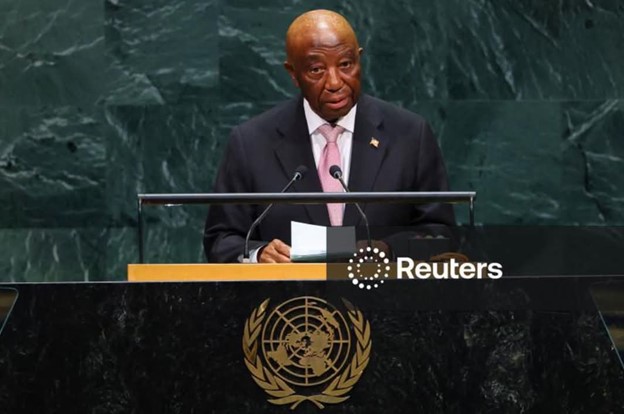
MONROVIA – President Joseph Nyuma Boakai, Sr. took Liberia’s case for fairer global rules to the United Nations (UN) on Thursday. He spoke with a double standing that sharpened his demands. Liberia helped found the UN in 1945 and now sits on the UN Security Council (UNSC). He used both to press a demand for two permanent African seats carrying the veto. He sought a louder voice for developing nations at the World Bank and the International Monetary Fund (IMF). He also asked international partners for coast guard and intelligence support against drug cartels in the Gulf of Guinea. The address staked Liberia’s influence abroad on its reform record at home. THE ANALYST reports.
Speaking at UN Headquarters in New York during the general debate of the 81st session, Boakai read the session’s theme, “Restoring Trust, Managing Transformation: A United Nations that Delivers for All,” as a description of a lingering crisis of legitimacy and relevance.
Trust in multilateralism is broken, he said, because member states have applied the principles of the UN Charter “inconsistently and selectively,” feeding global fragmentation.
The President insisted that the principles themselves remain sound. “Our answer to that fragmentation cannot be less multilateralism. It must be better multilateralism,” he told the Assembly.
Tributes and Founding Credentials
Boakai opened by congratulating Khalilur Rahman, Bangladesh’s Foreign Minister, on his election as President of the 81st session and pledged Liberia’s full support. Rahman won the post on June 2 in a rare contested ballot, defeating Cyprus’s Andreas Kakouris by 99 votes to 91.
He thanked Annalena Baerbock, the former German Foreign Minister who presided over the 80th session, for her leadership.
He also saluted Secretary-General António Guterres, whose term ends this year, for what he called principled leadership and a tireless commitment to reform.
Boakai reminded delegates that Liberia was one of only four African nations to sign the Charter that established the UN.
The country believed then, as it does now, that a peaceful world rests on international law, respect for human rights and dignity, and a commitment to development, he said.
He presented Liberia as a nation that had risen “from the ashes of conflict” to become a resilient democracy. The country, he argued, is living proof that dialogue can overcome division and that institutions can be rebuilt.
Governance Reforms at Home
The President tied that history to his administration’s domestic program. He said his government is strengthening public accountability, ensuring prudent financial management, intensifying the fight against corruption, and supporting the judiciary as it rebuilds citizens’ confidence in the institutions that serve them.
The address did not cite specific cases, prosecutions, or audit figures in support of those claims. Boakai described the effort as an expression of the same spirit of dialogue and institution-building that Liberia brings to the UN.
Peace, Prevention, Humanitarian Law
“Without peace, development is impossible, and without inclusive development, peace is an illusion,” Boakai said.
Observing that innocent civilians across the world’s conflict zones continue to pay what he called the unacceptable price of war, he renewed Liberia’s call for an immediate end to all hostilities, unhindered humanitarian access, and full respect for international humanitarian law.
He did not name any specific conflict. He argued instead that prevention must sit at the heart of international peace and security.
Investment in preventive diplomacy, mediation, and early warning, the President said, is both a moral imperative and fiscally prudent. The cost of preventing a war, he said, is small beside the cost of rebuilding a broken society.
Council Seat, Regional Threats
Speaking as a current member of the UNSC, Boakai said Liberia is putting those principles into practice while confronting evolving threats across West Africa. He listed transnational organized crime, cyber warfare, and illicit narcotics trafficking along maritime corridors in the Gulf of Guinea.
Through its Joint Security forces, he said, Liberia is “tightening the vise” on transnational drug cartels. Stating that no nation can police global criminal networks alone, he appealed to international partners for targeted support in coast guard surveillance, intelligence sharing, and port security technologies.
Debt Squeeze, Financial Architecture
Turning to the 2030 Agenda for Sustainable Development, Boakai said developing nations entering the home stretch of the agenda are being squeezed by unsustainable debt, shrinking fiscal space, and mounting external shocks. At its core, he said, this is a crisis of an international financial system designed for a different era.
Liberia is calling for urgent, structural reform of the international financial architecture, he said. Developing countries need concessional financing, debt sustainability, and predictable development capital, he argued, instead of escalating interest rates that threaten their survival.
The President placed the governance of the Bretton Woods institutions, the World Bank and the IMF, at the center of that reform. Their structures, he said, still reflect the world of 1945, and developing countries deserve a fairer voice and vote within them.
“A financial system that decides the fate of billions cannot continue to be governed by so few,” Boakai said. He described such reform as a precondition for delivering the Sustainable Development Goals (SDGs) and for restoring the trust the Assembly had convened to discuss.
ARREST Agenda on Display
Boakai presented the ARREST Agenda for Inclusive Development, his government’s national development blueprint, as the engine of transformation at home. The agenda focuses on Agriculture, Roads, Rule of Law, Education, Sanitation, and Tourism.
He said the government had made concrete strides this year in revenue administration and infrastructure, including rural roads linking farms to markets. He did not name specific road corridors or give revenue figures.
Climate Justice, Rainforest Stewardship
On climate, the President said Liberia contributes virtually nothing to global emissions, yet its communities face coastal erosion, flooding, and disrupted agricultural cycles. He told the Assembly that Liberia holds 42 percent of the remaining Upper Guinean Rainforest, which he described as a vital global carbon sink maintained on behalf of all humanity.
Climate responsibility, Boakai said, must be paired with climate justice. He called on industrial nations to honor their climate financing pledges and to operationalize loss-and-damage mechanisms.
Youth, Women, Artificial Intelligence
Calling inclusion the ultimate measure of governance, Boakai said more than 60 percent of Africa’s population is under the age of 25. He described that youthful population as the single greatest engine of innovation on Earth.
He urged investment in science, technology, engineering and mathematics (STEM) education, digital literacy, and technical training. Such skills, he said, would make young Africans co-creators in the global digital economy instead of mere consumers.
On gender equality, the President said that when women lead, peace agreements last longer, economies grow faster, and governance becomes more accountable. He reaffirmed Liberia’s commitment to full political, economic, and social equality for women and girls.
Liberia welcomes global efforts to govern new technologies, Boakai said, including the Secretary-General’s Independent International Scientific Panel on Artificial Intelligence (AI). He warned that developing nations must not be left behind as consumers of algorithms designed elsewhere and called for support in building “true digital sovereignty.”
He joined calls for binding ethical norms and greater regulation of AI, particularly in warfare. “Innovation must protect human development, not automate human destruction,” he said.
Case for Permanent African Seats
Boakai reserved his sharpest language for reform of the Security Council. “Eighty years of patience is enough,” he declared.
He welcomed the UN80 Reform Agenda, which seeks to make the organization agile, efficient, and accountable. True reform, he said, must still confront the core structural question of the Council itself.
Africa is home to 1.5 billion people and accounts for nearly one-third of UN membership, the President told delegates. Yet 80 percent of Security Council mandates concern African peace and security, he said, while the continent holds no permanent seat on the organ responsible for global peace.
He called that imbalance a historical injustice that is “no longer tenable.” Boakai then reaffirmed Liberia’s support for the Common African Position on the Proposed Reform of the United Nations Security Council.
He welcomed the presentation of the African Model during the recent Intergovernmental Negotiations. That step, he said, advances the process toward text-based negotiations.
Africa demands no fewer than two permanent seats with all accompanying rights and responsibilities, Boakai said, including the veto for as long as it exists, as well as additional non-permanent seats. Correcting the imbalance, he said, is no favor to Africa and is necessary to restore the UN’s trust, credibility, and legitimacy.
A Stark Choice
In closing, the President told the Assembly its choice is stark. It can allow multilateralism to drift toward irrelevance, he said, or change course and act boldly to restore trust, credibility, and legitimacy.
He offered Liberia’s journey from civil conflict to constitutional democracy, and from broken institutions to accountable governance, as evidence of what nations can achieve. That progress, he said, comes when countries commit deliberately and consistently to restoring trust and managing transformation.
Recalling Liberia’s role in San Francisco in 1945, Boakai said the country stands ready, with all member states, to save mankind from the scourge of war, guarantee human dignity, and leave no one behind. He urged delegates to leave the session committed to a UN that resolves crises as well as deliberates on them, restores trust through results, protects the vulnerable, honors the rights of all nations, and secures a peaceful planet for generations to come.
See more Liberia News Network stories in Google Search by adding LNN as one of your Preferred Sources.
★ Add LNN as a Preferred Source