
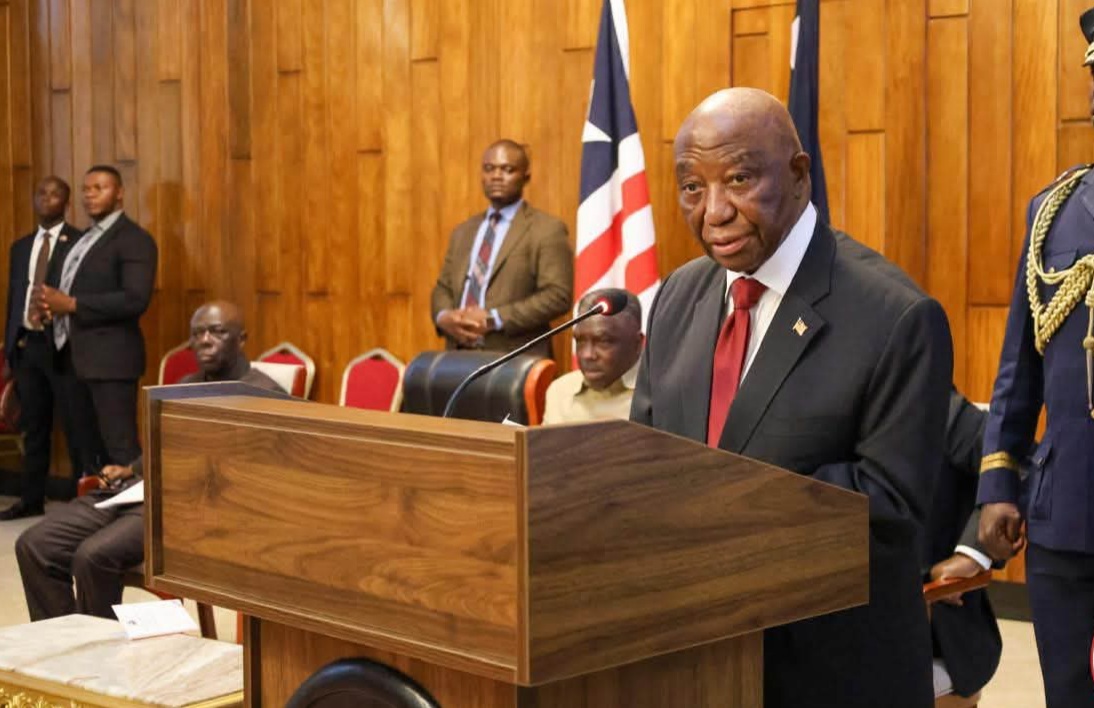
MONROVIA – President Joseph Nyuma Boakai has issued a stern warning to drug traffickers and individuals who believe wealth, political influence or public office can shield them from prosecution, declaring that his administration will pursue alleged criminals while insisting that the courts must uphold justice independently and without fear or favor.
Speaking Thursday, August 6, at the commissioning ceremony for judges and court marshals at the Executive Mansion in Monrovia, President Boakai placed Liberia’s escalating fight against narcotics, organized crime and corruption at the center of his call for a stronger justice system.
The President said illegal drugs and organized criminal activities represent more than a law enforcement challenge, warning that they threaten Liberia’s young population, legitimate businesses, national security and the country’s international reputation.
“To those who believe their position, influence, wealth, or authority places them beyond the reach of justice,” President Boakai warned, “we will identify you. We will pursue you. We will find you, and we will deal with you in accordance with the law.”
He declared that there would be “no sacred cows” under his administration, stressing that government officials, law enforcement officers, businesspeople, customs brokers and ordinary citizens must be subjected to the same law.
The President’s remarks come amid a heightened national campaign against cocaine trafficking following major drug seizures, arrests and investigations involving individuals connected to the illicit narcotics trade.
Boakai defended the government’s recent arrests, dismissals, suspensions and investigations, describing them as part of a broader effort to protect state institutions and dismantle criminal networks rather than politically motivated actions.
He also praised members of the Joint Security for what he described as their courage and commitment in disrupting narcotics trafficking and other criminal enterprises.
The President, however, acknowledged that law enforcement alone cannot win the fight against organized crime.
He told the newly commissioned judges that prosecutors and investigators can build cases, but justice ultimately depends on a judiciary capable of hearing cases promptly and applying the law fairly.
“The old saying reminds us that the wheels of justice turn slowly,” Boakai said, while cautioning that Liberia’s courts must not become “revolving doors through which criminals repeatedly pass without consequence.”
His remarks put renewed emphasis on the long-standing public debate over delays in Liberia’s justice system, particularly concerns about prolonged trials, pretrial detention and the ability of courts to deliver timely judgments.
At the same time, the President stressed that his call for tougher action against crime should not be interpreted as an attempt to interfere with judicial independence.
“This is not a call for predetermined outcomes,” he said. “It is not an invitation to compromise judicial independence.”
Instead, Boakai argued that judicial independence must be accompanied by responsibility, professionalism, integrity and diligence.
He urged judges to ensure that courtrooms become places where citizens, regardless of wealth, political affiliation or social status, can have confidence that the law will be applied equally.
The President also challenged court marshals to perform their duties with discipline and restraint while respecting the rights and dignity of individuals.
He linked the strengthening of the judiciary to the broader objectives of his administration’s ARREST Agenda for Inclusive Development, arguing that economic growth, national security, social stability and democratic governance depend on a credible justice system.
“A nation cannot prosper where the rule of law is weak,” Boakai said, warning that weak justice institutions can undermine investor confidence, erode public trust and embolden criminals.
The President further called for cooperation among the three branches of government, saying the Executive, Legislature and Judiciary each have distinct constitutional responsibilities that must be respected.
His comments come as his administration faces growing expectations to demonstrate that its aggressive response to the cocaine crisis will translate into successful investigations, credible prosecutions and convictions based on admissible evidence.
While the President promised that alleged traffickers and those involved in criminal activities would be pursued, his emphasis on judicial independence places an equally important responsibility on prosecutors and investigators to build cases capable of surviving judicial scrutiny.
For the government, the challenge now extends beyond making arrests and seizing narcotics. It is whether Liberia’s justice institutions can efficiently transform investigations into credible prosecutions while protecting constitutional rights and maintaining public confidence.
Boakai concluded by urging the newly commissioned judicial officials to approach their responsibilities with wisdom, courage, humility and integrity, saying Liberia’s future depends on institutions capable of applying the law equally.
The ceremony also provided the President an opportunity to publicly recognize First Lady Kartumu Y. Boakai, who celebrated her birthday on Thursday. Boakai described his wife of 54 years as someone “very special and dear” to him before joining well-wishers in celebrating her birthday.
He ended his address with a familiar appeal to Liberians to “Think Liberia, Love Liberia, and
together Build Liberia.”
See more Liberia News Network stories in Google Search by adding LNN as one of your Preferred Sources.
★ Add LNN as a Preferred Source