
The Executive Governor of the Central Bank of Liberia (CBL), Henry F. Saamoi, has outlined four major priorities for transforming Liberia’s digital payment system, reaffirming the country’s commitment to building a cashless economy through expanded participation, full interoperability, merchant payments, and increased financial literacy.
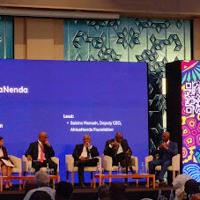
Governor Saamoi disclosed the priorities during a high-level panel discussion following the official launch of the fifth edition of the State of Inclusive Instant Payment Systems (SIIPS) in Africa 2026 report by the AfricaNenda Foundation in Mauritius on Thursday, November 19, 2026.
Speaking on the topic, “From National Rails to Continental Outcomes: Central Bank Leadership on Trust, Inclusion, Interoperability and the Policy Choices That Transform Payment Infrastructure into Shared Prosperity,” the CBL Governor explained that Liberia’s decision to introduce government-to-person (G2P) payments as the first use case for its Pay Na-Na platform was a deliberate policy choice aimed at establishing public trust, generating transaction volumes, and demonstrating the benefits of digital payments.
The panel, moderated by Sabine F. Mensah, Deputy CEO of AfricaNenda Foundation, also featured Dr. Priscillia Muthoora Thakoor, Governor of the Bank of Mauritius; Dr. Phil Mnisi, Governor of the Central Bank of Eswatini; Mr. Oscar Santos, Governor of the Central Bank of Cabo Verde; and Dr. Robert Ochola, CEO of AfricaNenda.
Responding to a question about Liberia’s decision to prioritize government payments and what would be required to bring all stakeholders onto one platform, Governor Saamoi said the government was the most strategic starting point because it is one of the largest employers and payers in developing economies.
“When the Central Bank decided to launch Pay Na-Na, ours was a deliberate policy choice that we made that would go with the government,” he said.
“At that point, we had a very clear objective in mind, which was one, to establish trust, create the transaction volume and demonstrate value for the one. As we are all aware, in developing economies, such as ours, the government is the largest employer. So, obviously, the government becomes the largest player.”
He explained that allowing citizens to receive government payments digitally would demonstrate the platform’s practical benefits and encourage wider adoption.
“So, in order for us to create that real value for people to have trust in, we decided we would do government to people first,” he stated.
Governor Saamoi also emphasized that reducing Liberia’s dependence on physical cash remains a major objective of the Central Bank, particularly because of the high costs associated with procuring and importing banknotes.
“We have a real focus that in the very short term, medium term, we will make Liberia a cash-less economy. Today, it’s driven by cash. And we see what that means for the country,” he said.
He noted that Liberia operates a dual-currency economy in which both the Liberian dollar and United States dollar are legal tender. However, the United States dollar is not printed locally and must be imported when supplies become insufficient.
According to him, the procurement and importation of physical currency are expensive and time-consuming, making digital payment systems an important alternative for reducing cash management costs.
“But if we adopt the digital means of payments, we can reduce reliance on cash and then build the confidence that is needed within the digital space,” he added.
Providing an update on Pay Na-Na, which was launched in December 2025, Governor Saamoi reported significant growth in transactions, saying the platform had recorded more than 7 billion transactions as of the end of October 2026.
“And in terms of value, we have recorded over 5 billion dollars in local currency and 40.4 billion in U.S. dollars. So, we are seeing real adoption, real use of the platform,” he disclosed.
He identified expanding participation as the first of four priorities for the next 12 months, explaining that the CBL is working to onboard more commercial banks and fintech companies following its initial engagement with mobile money operators.
“In fact, as of this morning, I just got confirmation from one of the banks that have been lagging behind and said, Governor, by the end of the week, you will see real progress from our side,” he told the panel.
He expressed optimism that a soft launch involving commercial banks and fintech companies could take place around Pay Na-Na’s anniversary, with the full instant payment system expected before the end of the first quarter.
The second priority is achieving full interoperability to enable customers to transact seamlessly across different mobile money networks and banking institutions.
Governor Saamoi recalled that before Pay Na-Na, payment services operated through fragmented networks, preventing customers from transferring money across different service providers.
He said the Central Bank wants to eliminate these restrictions and establish an integrated system where financial institutions can interact seamlessly.
“We want a situation where banks are able to interact seamlessly, money flows seamlessly by the customers themselves using the platform that we are trying to create. And we are almost there,” he said.
The third priority is promoting merchant payments and business participation by introducing practical digital payment applications that support everyday commercial transactions.
The fourth is increasing customer adoption through financial literacy, affordable transaction charges, and innovative payment services.
Governor Saamoi disclosed that the CBL is collaborating with the Ministry of Education to introduce financial literacy into the elementary-school curriculum, enabling children to acquire financial knowledge early and share it with their families.
“We have approached them. They have agreed to work with us. They see the importance of financial literacy. So, they are now developing a curriculum where financial literacy can be taught just from the elementary level,” he said.
He also stressed that affordable transaction charges are essential to preventing customers from abandoning digital platforms and returning to cash.
Referencing Cabo Verde’s removal of charges on person-to-person transactions, Governor Saamoi said Liberia intends to work toward reducing such fees.
“What I’ve told the participants is that what you need to do is, this is a volume business. And so, if you reduce your pricing, you drive volume. And once you drive volume, you drive income also,” he explained.
He pledged to engage payment service providers to reduce P2P charges while discouraging excessive cash-outs to keep money circulating within the digital ecosystem.
Concluding, Governor Saamoi stressed that financial inclusion must extend beyond technology to ensure ordinary citizens and businesses can participate in economic activities.
“Because, for us, we think that inclusion is not just merely technology. It’s about ensuring that every market would want a farmer, a student, a civil servant, and small businesses to participate in the growing economy safely and affordably,” he emphasized.
See more Liberia News Network stories in Google Search by adding LNN as one of your Preferred Sources.
★ Add LNN as a Preferred Source