
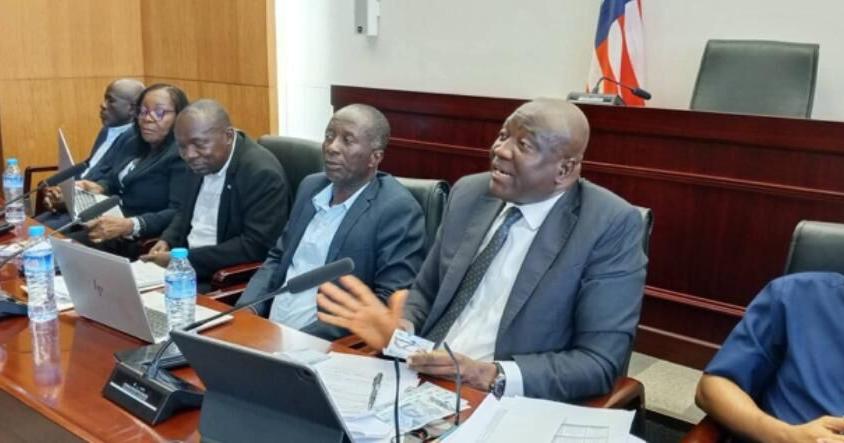
The Central Bank of Liberia, headed by its Executive Governor Henry Saamoi, yesterday informed the Liberian Senate that it intends to print additional L$79 billion in new banknotes from 2026 to 2030 and is proposing a L$2,000 denomination as part of the exercise.
Governor Saamoi told the Senate Joint committee on Banking and Currency, Ways, Means, Finance and Budget, Public Accounts and Audits that of the said amount, L$14.7 billion will be printed in 2026, with the remaining L$64.3 billion to be produced in the years that followed.
The Executive Governor told Senators the printing program is “not just to add more money into the economy.” The new notes will replace old and damaged banknotes, respond to growing cash demand, and support wider monetary objectives.
He puts the damaged notes at 7 percent annually of the L$48 billion previously printed, noting that the plan is also designed to strengthen the Liberian Dollars, and improve monetary policy operations.
Governor Saamoi asserted that the proposed L$79 billion is not the amount initially proposed as the initial proposed was far above L$79 billion.
He added that the amount proposed is an estimate from now to 2030, adding, “If we move to the ‘De-dollarization’ regime, there will be a need for additional banknotes beyond L$79 billion.”
The bank’s proposal includes a L$2,000 note, which would become Liberia’s highest denomination if approved. The current highest bill is L$1,000.
The Governor is yet to disclose the amount required to print the 79B towards the printing of the proposed banknotes.
The proposed additional banknotes printing and new denomination require legislative approval before the CBL can proceed.
The bank’s last major printing and replacement cycle was authorized in 2021.
However, Montserrado County Senator Abraham Darius Dillon has raised serious concerns over what he describes as an unreasonably short timeframe given to lawmakers to approve the printing of additional Liberian banknotes, cautioning that such a critical decision should not be rushed.
Speaking during the public hearing, Senator Dillon questioned whether the Legislature could make a sound and informed decision on monetary policy within the limited period provided.
According to Senator Dillon, the Legislature was granted ten working days to consider the authorization request for printing additional currency and the passage of a supplemental budget.
However, he noted that by the time the hearing was held, only two working days remained.
“Do you believe the two days left are sufficient for me to make that decision?” Dillon asked the CBL Governor, expressing frustration that this was the first formal hearing to justify the request.
Governor Saamoi, while acknowledging the concern, declined to directly answer the question in an open session, stating that the matter carried “executive implications” and would be better discussed behind closed doors. His response did not sit well with the Senator, who emphasized the importance of transparency in public hearings.
Dillon argued that the timing raises questions about the credibility of the process, especially given that lawmakers are expected to make decisions that will significantly impact the country’s monetary system.
During the hearing, the CBL confirmed that approximately L$48.7 billion previously printed under a past administration had been accounted for through external audits. However, the bank also disclosed an estimated 7% mutilation rate of banknotes currently in circulation, meaning the actual usable currency is lower.
The CBL is now requesting authorization to print an additional L$79 billion, a move that Dillon noted would increase the total money supply beyond what is currently accounted for.
“If I authorize the printing of L$79 billion, it will be in addition to what is left. That is a serious decision,” Dillon emphasized.
The Senator also questioned the lack of clarity regarding the cost of printing the new banknotes, noting that lawmakers were being asked to approve the measure without firm financial estimates or detailed procurement information.
In response, the CBL indicated that while estimates exist, final costs depend on legislative approval to initiate procurement processes.
The bank further explained that the proposed new notes would not introduce new security features but would instead improve durability, potentially extending their lifespan by one to two years.
Beyond policy concerns, the hearing also touched on the everyday challenges faced by ordinary Liberians. Dillon raised the issue of mutilated banknotes being rejected by commercial banks, prompting the CBL to clarify that: 1) Commercial banks must accept mutilated notes when customers deposit them into their accounts; 2) Banks must not issue mutilated notes to customers; and 3) Citizens have the right to report violations directly to the CBL.
The central bank also highlighted its ongoing “Clean Note Campaign,” aimed at educating the public on proper handling of currency and reporting mechanisms.
As the Senate reviews CBL’s proposal to print additional bank notes, Sen. Dillon reiterated that decisions of such magnitude require adequate time, transparency, and full legislative scrutiny.
“Sometimes these questions are not just for us, but to educate the public,” he said. “We must ensure the people understand and trust the decisions we make.”
