
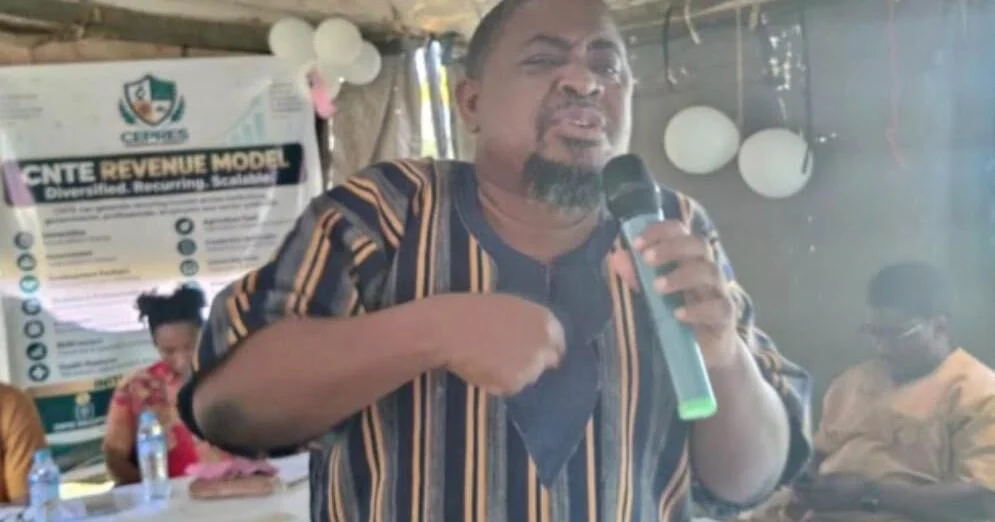
The President and Founder of CEPRES International University (CIU) Gbarnga Annex, Dr. Mogana Flomo Jr., has expressed concern over what he describes as the alleged exclusion of his institution and its students from the Madam Suakoko Scholarship programme administered by authorities in Bong County.
Dr. Flomo said CEPRES students had not benefited from the scholarship initiative, despite the program providing educational support to students attending other institutions, including vocational schools.
He raised the issue during the recent launch of the CEPRES National Transformation Engine (CNTE) in Gbarnga, where representatives from government institutions, including the National Commission on Higher Education and the Environmental Protection Agency, attended the event.
The university president said the alleged exclusion was part of broader difficulties he believes CEPRES has faced as it seeks to establish itself as a contributor to Liberia’s education and national development agenda.
He questioned why an institution attempting to prepare young Liberians for the labour market and contribute to national development would face what he described as institutional “rejection”.
Dr. Flomo did not provide documentary evidence during his remarks to substantiate the claim that CEPRES was formally removed from the Madam Suakoko Scholarship programme. However, he said the institution had observed what he regarded as a pattern in which students associated with CEPRES were encouraged to pursue their education elsewhere when seeking scholarship assistance.
He told students attending the CNTE launch that some members of their communities had allegedly discouraged them from enrolling at CEPRES.
Dr. Flomo asked students whether they had ever been told that qualifications obtained from CEPRES would not be useful. Several students raised their hands in response.
He then asked whether any students seeking scholarship assistance had been advised to attend another institution instead of CEPRES. Again, several students indicated that they had encountered such experiences.
The claims, if independently verified, could raise questions about equal access to publicly supported education opportunities and the criteria used to determine which institutions and students qualify for county-sponsored scholarships.
But without an official response from Bong County authorities or documentation outlining the scholarship programme’s eligibility requirements, it remains unclear whether CEPRES was formally excluded, whether its students failed to meet specific criteria, or whether the institution was simply not included in a particular phase of the programme.
Dr. Flomo also raised concerns about what he described as negative perceptions surrounding qualifications earned by CEPRES graduates.
He alleged that some prospective students had been told that certificates and degrees obtained from the institution would not be useful in securing employment or professional opportunities.
He said such claims could undermine the confidence of students and parents considering CEPRES as an option for higher education.
The university president further alleged that some of its graduates had experienced attempts to humiliate them because of their academic qualifications.
He cited the case of a CEPRES staff member whom he said holds a master’s degree and who, according to his account, was allegedly mistreated while seeking assistance at a government-related office.
Dr. Flomo did not identify the official or institution allegedly involved in the incident, and the allegation was not independently established during his remarks.
The claims highlight a broader issue facing private and emerging higher education institutions in Liberia: the importance of public confidence in their programmes, graduates and accreditation status.
For students, the value of a qualification is closely connected not only to the education received but also to recognition by employers, professional bodies and government institutions.
Despite his criticisms, Dr. Flomo struck a conciliatory tone toward government officials attending the CNTE launch.
He appealed to representatives of public institutions to view CEPRES as a partner in national development rather than as a competitor or opponent.
“We are not here to compete with the government,” was the substance of his appeal, as he argued that CEPRES was seeking opportunities to contribute its expertise and graduates to national programmes.
He pointed specifically to academic areas including environmental and public health, saying graduates trained in those fields could potentially contribute to institutions such as the Environmental Protection Agency.
Dr. Flomo said the university had also participated in national environmental discussions and academic activities, claiming that CEPRES had repeatedly performed strongly, finishing behind the University of Liberia in some of those activities.
He presented this as evidence that the institution was seeking to participate in national debates despite what he characterized as limited institutional support.
The presence of representatives from the National Commission on Higher Education and the Environmental Protection Agency at the CNTE launch appeared particularly significant to the university president.
Rather than treating their attendance merely as ceremonial, Dr. Flomo described it as an opportunity for CEPRES to develop stronger relationships with national institutions.
The scholarship concerns formed part of a broader presentation focused on the university’s efforts to modernize its operations through the CEPRES National Transformation Engine.
Dr. Flomo said the CNTE had taken approximately two and a half years of active work to develop.
The system, according to the university, is designed as an integrated platform connecting multiple institutional functions and using technology to improve the way the university manages academic and administrative activities.
The initiative reflects a growing push by educational institutions in Liberia to use digital systems to improve admissions, teaching, administration, student management and engagement with employers and government institutions.
Dr. Flomo argued that such investments demonstrate CEPRES’s intention to build an institution capable of contributing to Liberia’s long-term development.
See more Liberia News Network stories in Google Search by adding LNN as one of your Preferred Sources.
★ Add LNN as a Preferred Source