
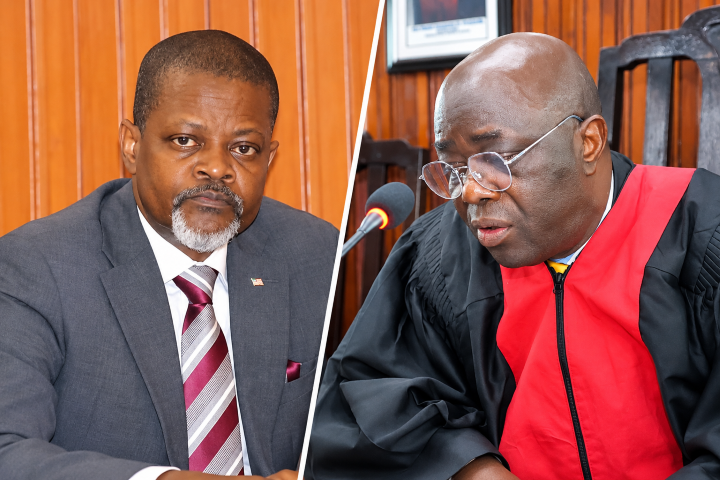
MONROVIA — Chief Justice Yarmie Quiqui Gbeisay Sr. has called for the abolition of Liberia’s trial jury system over widespread allegations of jury tampering, drawing strong opposition from Montserrado County Sen. Abraham Darius Dillon, who says the proposal threatens a fundamental constitutional right.
The chief justice made the controversial proposal during the opening of the Supreme Court’s October Term, citing reported incidents of bribery, intimidation and interference involving jurors in several judicial circuits.
Gbeisay warned that the growing allegations of jury manipulation threaten the integrity of criminal trials, undermine public confidence in the Judiciary and could make the administration of justice increasingly difficult.
“The jury system was conceived as a bulwark of liberty,” the chief justice stated, arguing that the system loses its protective purpose when jurors are compromised through bribery, threats or undue influence.
“A corrupt jury is worse than no jury at all,” he declared.
Gbeisay said the repeated allegations require a fundamental examination of Liberia’s jury system, which was established to protect citizens against arbitrary judicial decisions by ensuring that accused persons are judged by their peers.
He cited several reported incidents across the country’s judicial circuits, including cases involving rape, illicit drugs and other serious criminal offenses.
Among them was a 2022 incident in the Eighth Judicial Circuit in Nimba County, where a deputy marshal was allegedly involved in facilitating jury tampering.
The chief justice also referenced Republic of Liberia v. David Nagbe, a rape case heard during the May 2025 term in Grand Gedeh County, where alleged jury interference was identified four days after an acquittal.
Another incident involved Republic of Liberia v. George Bongar, heard during the May 2026 term in Bomi County, where jury tampering was reportedly identified 19 days after an acquittal.
In Margibi County, Gbeisay cited the drug-related case Republic of Liberia v. Quita Dolo, et al., in which suspected jury interference was reportedly detected while the trial was ongoing.
The chief justice further raised concerns about Criminal Court “C” in Montserrado County, where he said suspected jury tampering had compromised a US$100,000 drug case and contributed to its termination.
He also referenced another case in which allegations of jury misconduct surfaced seven days after an acquittal. According to Gbeisay, an investigation conducted by Judge Ousman F. Feika established that gross jury tampering had occurred.
The chief justice maintained that such incidents demonstrate the seriousness of the problem and the potential damage to the credibility of judicial verdicts.
He called on the Legislature, the Liberian National Bar Association, the Law Reform Commission and other stakeholders to examine the future of trial by jury and consider reforms aimed at protecting the administration of justice.
However, the proposal has drawn strong disagreement from Montserrado County Sen. Abraham Darius Dillon, a ranking member of the Senate Committee on Judiciary, Human Rights, Claims and Petitions.
Responding through his official Facebook page, Dillon rejected the suggestion, arguing that the Judiciary’s failure to adequately punish individuals involved in jury tampering cannot justify abolishing a constitutional protection.
“The fundamental right to #trial #by #jury is constitutionally instructive, as provided in the closing lines of Article 20 (a) of the 1986 Constitution of Liberia that ‘the parties SHALL have the RIGHT to trial by jury’,” Dillon wrote.
“To ‘dissolve’ or do away with this fundamental right guaranteed by the constitution will not require simply a ‘legislative action’; it will require a national referendum.”
Dillon maintained that the chief justice’s concerns, although serious, do not present sufficient justification for removing the constitutional guarantee of trial by jury.
“Besides, Mr. Chief Justice, your reason for suggesting ‘dissolution’ of the fundamental right to ‘trial by jury’ does not, in my view, present a strong case to even justify or warrant a referendum for said purpose,” he stated.
The Montserrado County senator argued that allegations of jury tampering instead expose weaknesses in the justice system and the failure of judicial authorities to hold perpetrators accountable.
“By suggesting that ‘jury-tampering’ hurts the intent and purpose for ‘trial by jury’, for which you are seeking ‘dissolution’ thereof, is simply exposing the weakness of our justice system and failure of the judiciary to decisively punish alleged doers of the act to serve as deterrent.”
Dillon insisted that stronger enforcement of existing laws, rather than the elimination of constitutional rights, should be the priority.
“We cannot simply seek to undo laws because of our failure to summon the courage to implement and enforce the laws. Hence, I fundamentally disagree with your suggestion to ‘dissolve’ the fundamental right to ‘trial by jury’, as guaranteed by the 1986 Constitution.”
The disagreement highlights a constitutional challenge surrounding the chief justice’s proposal.
Article 20(a) of Liberia’s 1986 Constitution guarantees due process and the right to trial by jury, while Article 21(h) provides additional protections for accused persons in criminal proceedings.
Any attempt to abolish the constitutional guarantee would require compliance with the Constitution’s amendment procedures, including approval through a national referendum.
The debate also raises questions about whether jury tampering can be addressed through stronger oversight, improved juror protection, effective investigations and stricter punishment for individuals found responsible for interfering with trials.
Although the chief justice cited several cases involving allegations of jury interference, an acquittal alone does not establish that jurors were compromised. Such allegations require appropriate investigation and supporting evidence.
Meanwhile, Gbeisay also announced that the Supreme Court would undertake a systematic review of aged and abandoned cases on its docket as part of efforts to improve judicial efficiency.
He said the exercise would target matters that parties have failed to pursue diligently, while ensuring that affected litigants receive the notice and opportunity to be heard required by law.
The chief justice emphasized that reducing case backlogs, improving case management and ensuring timely judicial decisions remain priorities of the Supreme Court.
See more Liberia News Network stories in Google Search by adding LNN as one of your Preferred Sources.
★ Add LNN as a Preferred Source