
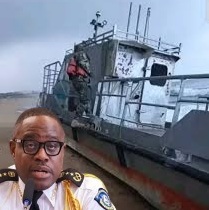
A boat arrives. An investigation begins. Then comes the silence.
There’s something profoundly unsettling about a vessel showing up on a nation’s shoreline with no crew, no clear history, and no convincing explanation of its arrival. But perhaps what’s even more concerning is what follows.
On September 10, 2026, an unidentified vessel was reported stranded along the Monrovia coastline, reportedly near South Beach, behind the Monrovia Central Prison.
Liberian authorities sprang into action. The Liberia National Police, the Armed Forces of Liberia, and other security personnel were deployed. The vessel was secured and placed in Coast Guard custody, while officials announced a joint investigation.
The message was clear: this was a situation that required serious attention. The questions were immediate and unavoidable. Where did the boat come from? Who owned it? Who had been operating it? Why was there no one aboard when it was found? How long had it been adrift? Was it carrying anything? And, perhaps most importantly, what circumstances led it to that specific part of the Monrovia coastline?
These were not just idle questions from onlookers. They were legitimate inquiries stemming from an incident that authorities deemed significant enough to warrant a coordinated security investigation.
Yet, as the days turned into weeks, the public was left in suspense. And suspense turned into frustration.
By October 13, more than a month after the discovery, the mystery remained unresolved, with no publicly verified answers available in the reporting that I or anyone I know could find.
The boat had sparked headlines, speculation, and various theories, but the fundamental questions remained unanswered in public discourse.
For a country whose coastline serves as both an economic asset and a security frontier, that silence is troubling.
The “owner” has spoken. Have the investigators answered?
The situation became more complex when a Canadian, known only as “Charlie,” reportedly claimed he owned the vessel.
He stated that he had obtained it for mineral exploration and sand-sampling in the rivers of Liberia. According to him, the boat had been left moored, lost its moorings, and eventually drifted to the Monrovia coastline.
If this account is verified, it could offer a straightforward explanation for what seems to be an unusual incident.
Howbeit, claiming ownership is just the start of the verification process, not the conclusion of an investigation. Did investigators check the registration documents? Was the ownership confirmed through independent means? Could the boat’s physical features, identifying numbers, or other records be linked to Charlie’s story? Was its supposed route traced? Were witnesses interviewed to determine when it was left unattended and how it traveled from its last known location to South Beach? These are essential questions that a thorough investigation should answer, as far as the evidence allows.
On October 5, it was reported that authorities had not independently verified the ownership claim in any publicly available findings.
Additionally, there were allegations and photographs suggesting possible ties to Riverside Resort, but these had not been officially confirmed.
Such claims should not be seen as evidence of wrongdoing by Charlie or anyone else mentioned in the reports.
Howbeit, their existence highlights the importance of independent verification. A boat’s ownership cannot be fully established just because someone claims, “It’s mine.” The public has a right to know if the evidence backs up the explanation.
Why the location matters
The location of the vessel made its discovery particularly sensitive. It was reportedly found near the Monrovia Central Prison, which houses individuals linked to Liberia’s major cocaine-trafficking investigation.
There have been previous concerns about the security of the prison and the potential for an escape attempt. This geographical coincidence is bound to draw attention.
No one, however, should be judged based on mere suspicion, proximity, or speculation. Howbeit, the location raises valid questions about whether investigators considered the possibility of a security threat and what evidence, if any, supported or dismissed that possibility.
If the vessel was merely a privately owned workboat that drifted away by accident, the evidence should clarify that.
Conversely, if it was intentionally brought to shore, investigators need to determine who was responsible, the reasons behind it, and whether any crime was committed.
If the evidence does not clarify what transpired, authorities should candidly communicate that limitation. Security investigations aim to establish facts, not to confirm rumors.
The Greater danger is the vacuum of information
In any democracy, it’s important to balance the need to protect an investigation with the public’s right to be informed. Authorities don’t have to share every witness statement, reveal sensitive intelligence, or disclose evidence that might jeopardize an ongoing inquiry. There are valid reasons for keeping certain details under wraps.
Howbeit, the public has a genuine interest in understanding the progress of an investigation. They want to know if the vessel has been identified, if its ownership is confirmed, and if any security implications have been established.
Even a brief official update could be beneficial. Authorities could inform the public that ownership has been verified, that forensic or technical examinations are ongoing, that some leads are still being pursued, or that no evidence of criminal activity has been found thus far. If there are no definitive answers yet, they could simply state that.
What is hard to justify is allowing a case that started with an official security announcement to fade from public attention without a clear update on its status.
Silence doesn’t indicate a cover-up, nor does it imply negligence, incompetence, or criminal involvement. Howbeit, it does create an information vacuum, which can quickly be filled with rumors, suspicions, and conflicting narratives.
When officials leave questions unanswered, they lose control over the public discourse, leading to speculation. This is detrimental to public trust, harmful to responsible journalism, and could undermine the credibility of the institutions tasked with safeguarding the country.
Liberia’s maritime security cannot be an afterthought
This situation brings up a broader issue: how well can Liberia detect, monitor, and investigate unusual or unexplained activities along its maritime borders?
Liberia’s coastline is more than just a sandy area where boats occasionally land; it plays a crucial role in the nation’s security landscape. Movements at sea can affect fishing, trade, environmental conservation, border security, and law enforcement.
However, not every unidentified vessel poses a danger. It means that when an unknown boat raises enough concern to warrant a joint security investigation, the public should expect a thorough and professional process to determine the facts.
Investigators should, when applicable, identify the vessel and its registration, track its movements, confirm ownership, interview individuals with relevant knowledge, and review any available evidence regarding its state and contents.
If there are tracking records, port logs, witness statements, or other technical data, their significance should be evaluated by qualified investigators.
If the evidence suggests an innocent reason, that finding should be communicated.
Conversely, if it indicates a violation, the proper legal actions should ensue.
If the investigation yields no clear answers, the public should be informed about what can be responsibly shared regarding the circumstances.
The goal should not be to create a sensational conclusion but to uncover the truth.
Five questions that still demand answers
The mystery vessel has left Liberia with a straightforward set of questions that should not lead to endless public speculation.
First: Who is the legal owner of the vessel? Has the ownership claimed by the reported party been verified through both documents and physical evidence?
Second: What is the origin of the vessel, and how did it arrive at South Beach? Has its journey been traced, and can the claim that it drifted away after losing its moorings be confirmed?
Third: Who was the last operator of the vessel? Have investigators determined when it became unmanned, who was responsible for it, and whether anyone observed its movements?
Fourth: What were the findings of the investigation? Was the boat inspected, were any identifying records retrieved, and was there any evidence of criminal activity? If the investigation found no wrongdoing, the public deserves to be informed of that as well.
Fifth: Why has there been no detailed public report? If the investigation is still ongoing, what can authorities share about its status? If it has concluded, what were the results? If it has hit a standstill, what issues remain unresolved?
These inquiries are not accusations against any person or organization. They are fundamental questions that arise from an official investigation into an unexplained maritime event. The goal should not be to create a sensational conclusion but to uncover the truth.
The government owes the public an update, not a rumor
The responsibility now lies with the Liberia National Police, the Liberia Coast Guard, and the relevant maritime authorities, along with any other agencies involved in the investigation.
A straightforward and factual public update would help clarify what is known and what remains uncertain.
If ownership has been confirmed, that should be stated clearly.
If the vessel’s movements have been tracked, the evidence should be explained.
If no criminal connections have been identified, that conclusion should be communicated clearly.
If investigators are still following leads, a status update should be provided without compromising their work.
If there is no definitive answer yet, that should be acknowledged.
The public does not require a sensational narrative; it needs a trustworthy account.
Furthermore, the government should understand that being transparent about security issues is not merely yielding to public pressure; it is essential for fostering trust in the institutions responsible for safeguarding the nation.
A final word: The boat is not the only mystery
It’s possible that the vessel was just a workboat that got loose from its moorings and floated toward the shore.
The explanation given by the person claiming ownership might eventually be backed up by evidence. That remains a possibility.
Howbeit, until the relevant facts are established and communicated responsibly, the questions will continue to linger.
A mysterious vessel appeared along the Monrovia coastline, prompting authorities to launch an investigation. Someone later claimed ownership, but even after more than a month since the discovery, the public reports still lack a thorough official resolution to the main questions.
This is the crux of the issue; it’s no longer just about whether an unidentified boat reached the shore. It’s about whether the responding institutions can provide the public with a clear account of what transpired afterward.
With every unanswered question, suspicion can grow. Each unexplained delay risks eroding public confidence. And for every security announcement that lacks a substantial public update, the credibility of official communication is put to the test.
Liberia deserves more than a cycle of alarming headlines followed by extended uncertainty. Authorities should not mistake public patience for indifference.
Citizens can wait for a thorough investigation while still expecting to know its outcome. Let the evidence be heard. Let the investigators clarify what they have found. Innocent individuals should be shielded from baseless accusations, and any wrongdoing proven by the evidence should be addressed through legal means.
Until then, the mystery vessel serves as a reminder that a nation’s security is gauged not just by how swiftly authorities react to incidents, but also by how thoroughly they seek the truth and how transparently they report the findings.
To this end, the boat may have drifted in from the sea. But the unanswered questions should not be allowed to drift away with the tide.
See more Liberia News Network stories in Google Search by adding LNN as one of your Preferred Sources.
★ Add LNN as a Preferred Source