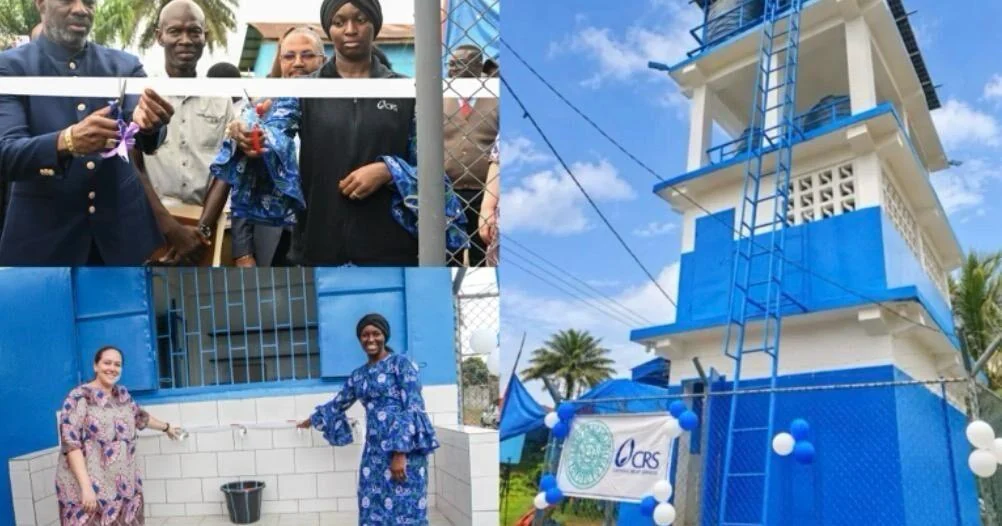
Catholic Relief Services (CRS) Liberia this week formally handed over two newly built water supply systems to community management structures, a step it says moves the facilities from construction to long-term, community-led operation.
The dedication ceremonies were held on November 17 in Jacob Town Rehab, Montserrado County, and on November 18 in Siafa Town, Weala, Margibi County. Together, the two systems are expected to serve about 20,000 residents.
The systems are part of AQUARISE (Advancing Quality Access through Resilient Infrastructure, Systems and Engagement), a CRS initiative to improve access to safe, reliable and climate-resilient water in urban and peri-urban communities in Montserrado and Margibi Counties. The project responds to unreliable access, seasonal shortages, water-quality risks and weak service-management systems.
Design was guided by hydrogeological investigations, topographic surveys, hydraulic network analysis and water-quality testing. The project delivered two mini stand-alone water supply systems, in Jacob Town Rehab and Weala, eight public water kiosks across the two systems, 51 household connections in Rehab, a community-Based Enterprises (CBEs) and Community Water Boards to manage and oversee the systems, and support to the National WASH Commission (NWASHC) to develop a national WASH Management Information System
In Siafa Town, the system includes four commercially operated kiosks, 50 household connections and a 60,000-gallon storage tank. Kiosk revenue is meant to fund community development, maintenance and sustainability.
CRS’s CWARO Deputy Regional Director for Program Quality, Caroline Agalheir, said the investment, which she attributed to private donations from individuals in the United States, goes beyond infrastructure.
“This is a significant investment, but much more importantly, it is an investment in people,” she said. She said the systems mean less time spent searching for water, more time for children in school, and reduced exposure to waterborne diseases, especially for children, women and older persons.
She cautioned that infrastructure alone does not guarantee lasting service. “The true measure of success will be determined not only by what we dedicate today but by how well this system continues to serve this community five, ten, and twenty years from now,” she said.
CRS Liberia Country Representative Glynnis Cummings-John said the handover was a moment of celebration, adding that she was confident the community would “manage the system and the water facilities around the community with care and dedication.”
CRS Program Quality Manager Emmanuel Togba said the Jacob Town system can serve more than 10,000 people. Community members were recruited and trained in small-business management and system operations, and the project has now moved from Year One into Year Two, with 15 more household connections planned.
Thirteen community members completed management, business, and operations-and-maintenance training. CBEs handle daily operations, finances and maintenance, while Community Water Boards provide oversight. Togba said a board can, for instance, question CRS’s general manager if a kiosk is closed, and is expected to work with local government, including the Representative’s and Senator’s offices, to mobilize funding to extend service to nearby communities.
“This system belongs to the people,” Togba said, conveying a message from his superior. “Treat it as your own.”
District Representative Sekou Sarafoday Kanneh described water access as a major challenge for the area and thanked CRS. He warned those managing the facility that officials would conduct oversight visits to ensure it is properly maintained and used for its intended purpose.
In Siafa Town, Water Board head John Branch said residents had long suffered from the lack of safe drinking water. “When people do not have access to safe drinking water, what happens? Diseases and sicknesses follow,” he said, adding that residents were happy to receive the keys to the facility.
Weala Clan Chief Musu Yango said, “Water is life,” and urged residents to organize to protect and maintain the facility.
Deputy Managing Director for Administration of the Liberia Water and Sewer Corporation (LWSC), T. Wilson Gaye, commended CRS for timely implementation. He reaffirmed LWSC’s commitment to providing technical support for the system’s operation, maintenance and long-term sustainability.
CRS said it remains committed to supporting the Government of Liberia and communities in advancing sustainable water, sanitation and hygiene services. The national management information system being developed with NWASHC is intended to help officials identify which communities have water access and which face challenges, in near real time.
See more Liberia News Network stories in Google Search by adding LNN as one of your Preferred Sources.
★ Add LNN as a Preferred Source