
MONROVIA – House Speaker Richard Nagbe Koon has advanced a bill guaranteeing Liberian civil society groups budget funding. The bill proposes a non-discretionary allocation of 0.1 percent of Liberia’s $1.2 billion budget. Lawmakers introduced it Thursday, June 25, then sent it to the House Governance Committee. Better Future Foundation Chief Executive Officer Augustine S. Arkoi presented the petition on June 24. He spoke for a consortium representing more than 2,500 registered Liberian CSOs. Arkoi said declining donor funding from UNMIL, USAID, and SIDA threatens grassroots programs. Former Education Minister Dr. D. Evelyn S. Kandakai backed the bill as historic. Civil society groups, including CENTAL and the Press Union of Liberia, welcomed the move. THE ANALYST reports.
In a defining milestone for domestic governance and sustainable peace, House Speaker Richard Nagbe Koon has formally accepted a landmark petition from civil society organizations and advanced it to the House Plenary.
The formal request calls for an institutionalized, non-discretionary budgetary allocation of 0.1 percent from Liberia’s US$1.2 billion (about L$218.4 billion) national budget to rescue the country’s civic space from what petitioners describe as an existential sustainability crisis.
True to his stated commitment to treating the third sector as an “indispensable partner for national development,” Speaker Koon expedited the petition immediately after its formal submission.
On Thursday, June 25, 2026, the proposed CSO bill was officially introduced on the floor during the plenary session of the 55th Legislature, where it was read, adopted, and subsequently transmitted to the House Governance Committee for review and timely reporting.
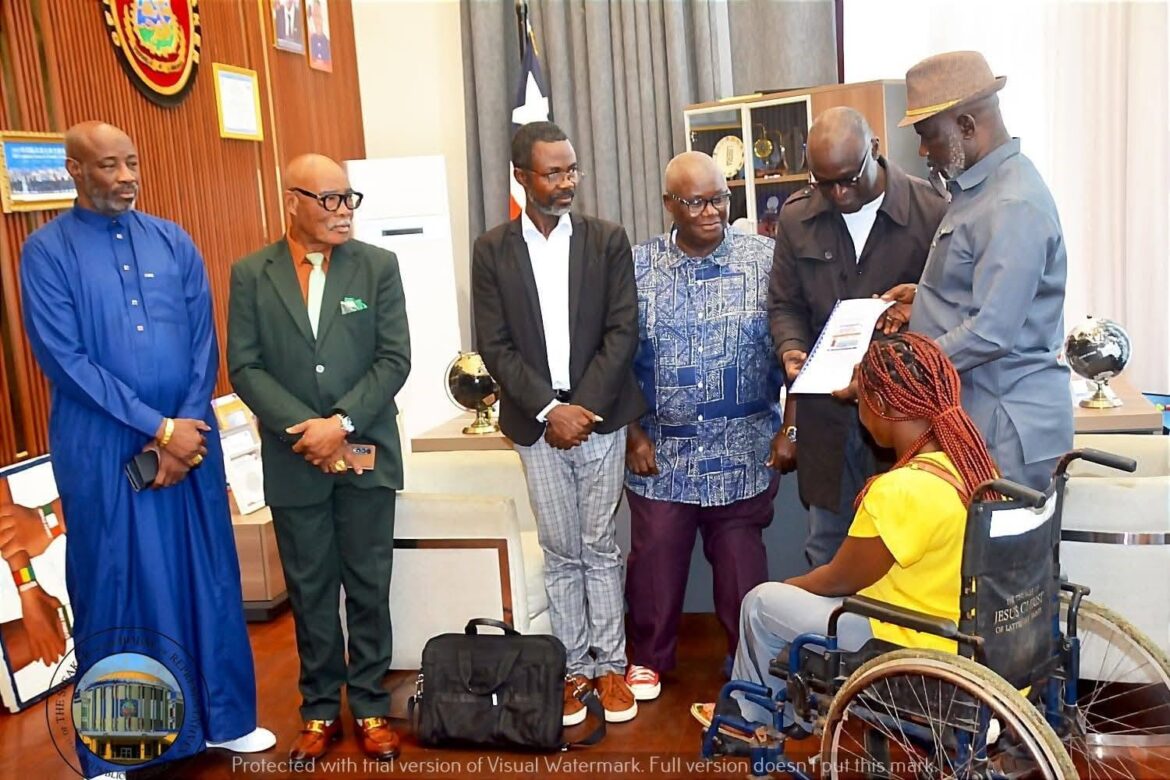
The petition was formally presented at the Capitol Building on June 24, 2026, by Augustine S. Arkoi, Founder and Chief Executive Officer of the Better Future Foundation (BFF), acting on behalf of the Consortium of CSOs-Partners for Democracy and Good Governance (PdG).
Facilitated by Representative Thomas Romeo Quioh, the presentation was witnessed by key civil society leaders, including Federation of Disabilities Organizations of Liberia President Ambassador Lionel Johnson, Vice President Sarah Wallace, and Liberia Elections Observation Network (LEON) Program Officer Mark Miller. During the presentation, Speaker Koon noted that upon successful passage of the law, it would be prudent to consider community chairmen for honoraria to incentivize localized leadership.
Shifting From External Dependency

For decades, Liberia’s third sector has been the primary vehicle for grassroots service delivery, land dispute mediation, human rights monitoring, and democratic oversight.
However, this essential architecture faces an acute funding void brought on by the withdrawal of the United Nations Mission in Liberia (UNMIL), the closure of critical international non-governmental organization programs, the dissolution of key United States Agency for International Development (USAID) projects, and the shutdown of Swedish International Development Cooperation Agency (SIDA) initiatives.
“Over-reliance on fluctuating external donor priorities compromises national ownership and threatens the continuity of vital peace consolidation initiatives,” Arkoi stated during the presentation.
He explained that the legislative push bridges the gap by enacting the long-delayed legal frameworks outlined in the 2016 GoL-CSO ACCORD and Section 7.2.1.5 of the Government of Liberia Civil Society Partnership Policy, which mandates the creation of a Civil Society Trust Fund.
Bill Cites Regional Precedents
The request for an institutionalized 0.1 percent budgetary allocation to support more than 2,500 recorded CSOs is grounded in global and regional governance frameworks. Advanced democracies and emerging economies alike recognize that state-funded independent accountability mechanisms yield significant social returns.
Across several European Union nations, for example, state budgets actively subsidize accredited CSOs through independent statutory funds to implement public service, civic education, and healthcare initiatives without compromising their independent watchdog status.
Within the Economic Community of West African States (ECOWAS) sub-region, countries are increasingly turning toward domestic asset mobilization, allocating local state resources through competitive, transparent “calls for proposals” that allow governments to maximize the access CSOs have to remote, underserved populations where formal line ministries lack reach. Petitioners argue the bill represents a paradigm shift from treating CSOs as external entities to treating them as constitutional pillars, drawing legitimacy from Article 1, Article 5, and Article 17 of the 1986 Liberian Constitution.
Safeguards Against Political Capture
To counter any risk of political co-optation, conflict of interest, or financial mismanagement, the proposed legislation builds in layers of accountability.
Funding will not be handed out as discretionary political favors; instead, disbursements will be governed through a competitive, merit-based framework evaluated by an independent, multi-stakeholder board comprised of government officials, the National Civil Society Board of Liberia, and external auditors.
To be eligible for the proposed allocation, CSOs must meet baseline criteria covering legal and financial compliance, including proof of valid incorporation, accreditation, and full compliance with Liberian tax and labor regulations.
Eligible groups must also demonstrate institutional maturity through a minimum three-year track record of active operation, fiduciary soundness through independently audited financial statements for the preceding two fiscal years prepared by a certified Liberian accounting firm, and strict non-partisanship through a binding legal affidavit verifying zero affiliation with political parties or candidates.
Lawmakers Urged To Move Swiftly
As the bill moves to the House Governance Committee, the petitioning consortium — supported by the National Adult Education Association (NARDA), the Press Union of Liberia (PUL), the Center for Transparency and Accountability in Liberia (CENTAL), and the Voices of The Elders (VOTE)-Republic of Liberia — is urging lawmakers to recognize its strategic urgency.
Petitioners argue that investing 0.1 percent of the state budget into a specialized, audited trust fund will accelerate the localization of the ARREST Agenda for Inclusive Development (AAID) and satisfy Article 5 of the Constitution by establishing a National Peace and Reconciliation Commission to institutionalize peace education, civics curriculum, and anti-drug sensitization in schools.
Former Liberian Minister of Education Dr. D. Evelyn S. Kandakai, a prominent signatory to the bill, said Liberia stands at a historic crossroads.
“The National Legislature has the profound opportunity to lead West Africa in civic sustainability. By swiftly passing this bill, lawmakers will ensure that the oversight, peace, and stable development of the Republic are funded by the state, owned by the people, and preserved for generations to come,” Kandakai said.
Key international stakeholders and rights advocates have welcomed the Legislature’s action, including Office of the UN High Commissioner for Human Rights (OHCHR) Country Representative Christian Mukosa, Independent National Commission on Human Rights (INCHR) Executive Director Urias Pour, and Liberia Council of Churches (LCC) Secretary General Rev. Dr. Christopher Toe. They emphasized that addressing the financial and operational vulnerabilities of CSOs is vital for maintaining a robust civic space, protecting human rights, and safeguarding democratic governance.
Sister Mary Laurene Browne, OSF, a veteran educator and keynote speaker during the December 2025 validation, adoption, and signing of the proposed bill, hailed the legislative intervention as an unprecedented act of statesmanship.
She noted that by taking proactive ownership of the sustainability crisis, the National Legislature has validated the grassroots efforts of peacebuilders and civic advocates while laying a foundation for enduring national development and reconciliation.
The BFF is a Liberian-based CSO dedicated to building peace, supporting democracy, promoting development, and advancing international cultural understanding and cooperation.
