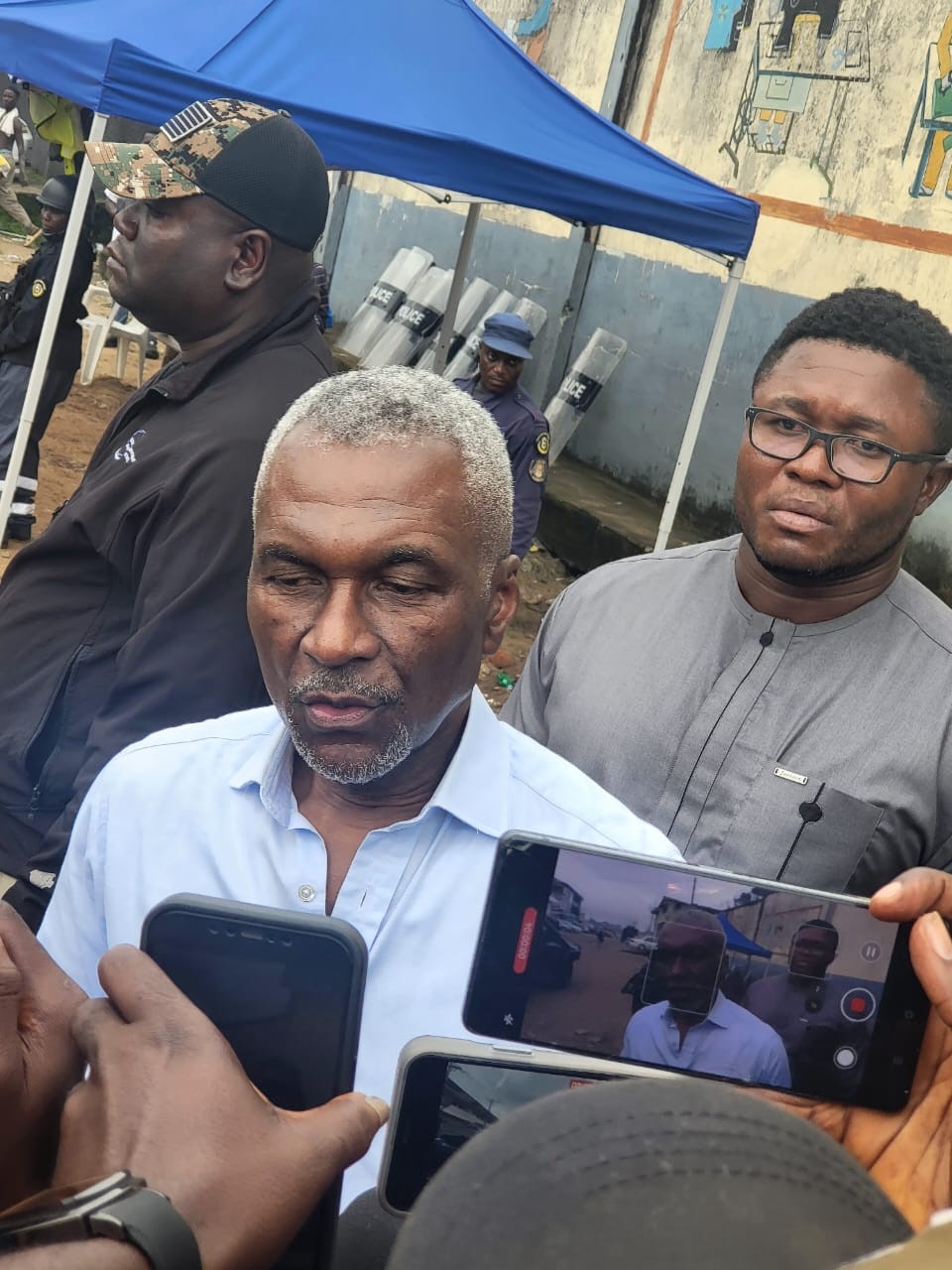
MONROVIA – A Sunday prison visit intended as a personal show of solidarity with detained former Vice President Jewel Howard Taylor has widened into a blunt political challenge to the government’s handling of Liberia’s deepening narcotics crisis. Alternative National Congress Political Leader Alexander Benedict Cummings emerged from a private meeting at the Monrovia Central Prison demanding speedy and non-selective justice, an independent investigation and the arrest of any current officials whom credible evidence may implicate. While refusing to prejudge Taylor’s case or disclose their conversation, Cummings questioned whether enforcement was being applied evenly and renewed his warning that Liberia risks becoming a “narco-state” under the government’s watch. His intervention shifts scrutiny from one detainee to the credibility of the entire anti-drug campaign. The Analyst reports.
Cummings visited the former Vice President accompanied by senior ANC officials and partisans. He described the visit as primarily personal, saying Taylor is a friend and someone he affectionately regards as his “small sister.”
But the private expression of concern quickly assumed broader political and national-security significance when Cummings addressed journalists outside the prison. He challenged the government to conduct an investigation in which evidence is followed wherever it leads and justice reaches every implicated person, regardless of political affiliation, public position or social standing.
His intervention adds another voice to the growing national debate over the government’s campaign against illicit drugs and Taylor’s detention in connection with the ongoing narcotics case. It also raises questions about whether the investigation will extend beyond opposition figures and former officials to individuals currently exercising authority within the government and national-security establishment.
‘Justice Should Not Be Selective’
Cummings said the presumption of innocence must remain the starting point in Taylor’s case, stressing that allegations alone cannot determine guilt. He insisted that investigators must establish the facts and allow the courts to decide the matter based on credible evidence.
“The evidence needs to be followed wherever it leads,” he said. He also warned against unnecessary delay in prosecuting the case, declaring: “Justice delayed is justice denied. It needs to be speedy, and justice should not be selective.”
The ANC leader said he was increasingly troubled by what he described as the appearance of unequal treatment in the government’s handling of the investigation. “It appears that justice is being selectively prescribed,” Cummings told reporters.
For Cummings, the controversy reaches far beyond Taylor’s individual circumstances. He argued that Liberia’s drug crisis has become sufficiently dangerous to require a comprehensive national response that investigates everyone credibly linked to narcotics trafficking, whether that person belongs to the government, the opposition, the security sector or the private business community.
‘Follow the Evidence’
Cummings called for an investigation capable of establishing the facts without political interference, institutional protection or preferential treatment. Anyone linked to the narcotics trade, he said, must be investigated and, where the evidence supports prosecution, arrested and taken before the law.
The opposition leader referred specifically to public comments previously attributed to Inspector General of Police Gregory O.W. Coleman suggesting that influential individuals—or “big shots”—within the government had been implicated in the wider drug investigation.
“If they are associated with this issue, if the evidence is there, they should be arrested,” Cummings said. He questioned why the identities of those individuals had not been made public and why similar enforcement actions had not been visibly taken against them.
According to the ANC leader, authorities cannot preserve public confidence by arresting some suspects while remaining silent about other people reportedly identified during the investigation. “Otherwise, the process seems unjust, it seems selective, it doesn’t seem fair,” he said.
Cummings maintained that an investigation of such national importance must demonstrate independence through its actions. The government, he argued, must show that political connections will neither protect those implicated by credible evidence nor expose others to prosecution merely because they lack influence.
Liberia Risks Becoming ‘Narco-State’
Cummings delivered one of his strongest warnings yet about the consequences of Liberia’s narcotics crisis, describing the drug trade as an immediate threat to the country’s security, institutions and future.
“This narcotic drug issue is a serious problem for our country,” he said. “Our country appears to be becoming a narco-state, and it’s happening now under this government’s watch.”
His warning reflects mounting public alarm over the reported scale of international narcotics trafficking through Liberia and the possible consequences for national security, governance, economic stability and the country’s young people. The concern has moved beyond the quantity of drugs seized to the possibility that trafficking networks could penetrate or compromise public institutions.
Cummings argued that individual arrests, however prominent, would not be enough to dismantle the trade. He called for a comprehensive investigation into the networks, financiers, facilitators, protectors and public officials who may be connected to narcotics trafficking.
Liberia, he warned, cannot afford to allow illicit drugs to become embedded within political structures or security institutions. Such a development would weaken the rule of law, undermine public confidence and place the country’s sovereignty at the mercy of criminal networks with enormous financial power.
Due Process for Taylor
Although Cummings expressed personal solidarity with Taylor, he was careful not to declare her innocent or dismiss the allegations before the evidence is presented. He said his visit was intended to empathize with her, check on her welfare and encourage her to remain strong during her detention.
“I don’t put my head on the chopping block for anybody, because you never know,” he said. The statement reflected his insistence that personal relationships must not replace evidence or the judicial process.
Cummings nevertheless acknowledged that his longstanding relationship with Taylor influenced his personal assessment of her character. “The person I know, I will be very surprised; I’d be shocked,” he said when questioned about the allegations against her.
He immediately returned to the central issue of evidence, telling reporters: “Let’s see the evidence.” Taylor, he maintained, should receive the same constitutional and due-process protections owed to anyone facing criminal allegations, including the presumption of innocence and a timely judicial hearing.
His argument was not that Taylor should be protected from investigation, but that she should neither be condemned before trial nor treated differently because of her political history. The same standard, he said, must apply to every other person whose name or conduct emerges during the investigation.
Private Conversation Remains Confidential
Cummings declined to disclose what Taylor told him during their meeting, explaining that the discussion was private. He offered only a limited description of her condition and state of mind.
“She obviously feels aggrieved,” he said, but refused to provide further details. He explained that his immediate purpose was to check on her welfare and health and offer encouragement during what he acknowledged was a difficult period.
Taylor remains at the Monrovia Central Prison as the narcotics case proceeds through the justice system. Her detention has attracted considerable political attention and intensified public arguments over due process, accountability and the possible use of state power against prominent opposition figures.
Cummings’ visit further raised the political profile of the case. What began as a private meeting between longtime political figures ended with a public demand that the government prove the integrity and impartiality of its anti-drug campaign.
Current Officials Must Answer
Cummings directly challenged the government to demonstrate that its drug campaign is not confined to opposition politicians, former officials or people without political protection. He demanded investigations into any serving government officials implicated by credible evidence.
“We want to see prosecution. We want to see arrest from current officials because it’s happening now,” he said. The ANC leader argued that concentrating attention on former officials would not answer questions about drug trafficking allegedly occurring under the present administration.
He said the government must establish whether public officials, security officers or politically connected individuals provided protection, logistical support or other assistance to narcotics networks. Where investigators uncover evidence, he said, the law must take its course without delay.
Cummings also renewed his demand for an independent investigation into the broader drug situation. Public confidence, he argued, will depend heavily on whether citizens believe the investigators are free from political pressure and willing to pursue individuals close to power.
The opposition leader said he had previously promised to engage international partners about the narcotics crisis and confirmed that he had fulfilled that commitment. He declined to disclose the details of those discussions, saying only that he had taken the steps he publicly promised to take.
His remarks come as the government has indicated that international partners are involved in efforts surrounding Liberia’s narcotics investigation. Cummings maintained that such involvement must contribute to a credible, comprehensive and impartial process capable of exposing the full trafficking network.
Pressure Extends Beyond Drug Case
Cummings said he would continue putting political pressure on the government over the drug crisis and other questions of governance and accountability. His intervention, he insisted, was not intended to take sides in Taylor’s case.
“It’s not about taking sides here or there,” he said. “It’s about let’s follow the evidence, but to everybody.”
The ANC leader said the pressure would also extend to corruption allegations and other matters affecting the Liberian public. He cited a letter his political movement had written concerning the Foyah road construction issue in Lofa County, saying the government had not responded.
“We’re going to keep the pressure on the government to do the right thing for the Liberian people,” Cummings declared. His remarks suggest that the ANC intends to place accountability, transparency and equal application of the law at the centre of its political engagement with the administration.
Drug Campaign Faces Credibility Test
Cummings’ visit has transformed what might have remained a private expression of solidarity into a broader political statement about the government’s management of Liberia’s drug emergency. His central argument is that the seriousness of the threat demands a justice process that is visibly impartial, evidence-driven and applicable to everyone.
The credibility of the government’s campaign, he said, cannot be measured solely by the quantity of narcotics seized or the number of suspects detained. It will ultimately depend on whether investigators expose and dismantle the wider networks allegedly financing, protecting and facilitating the trade.
His repeated demand that authorities “follow the evidence wherever it leads” places the burden squarely on Liberia’s institutions. Political status must not shield suspects, but neither should political vulnerability make anyone an easier target for prosecution.
As Taylor remains in detention, the case is expected to fuel continuing debate over due process, selective justice, investigative independence and the government’s response to the narcotics threat. For Cummings, the test is unmistakable: investigate every credible lead, prosecute every case supported by evidence and ensure that justice is neither delayed nor selectively imposed.
See more Liberia News Network stories in Google Search by adding LNN as one of your Preferred Sources.
★ Add LNN as a Preferred Source