
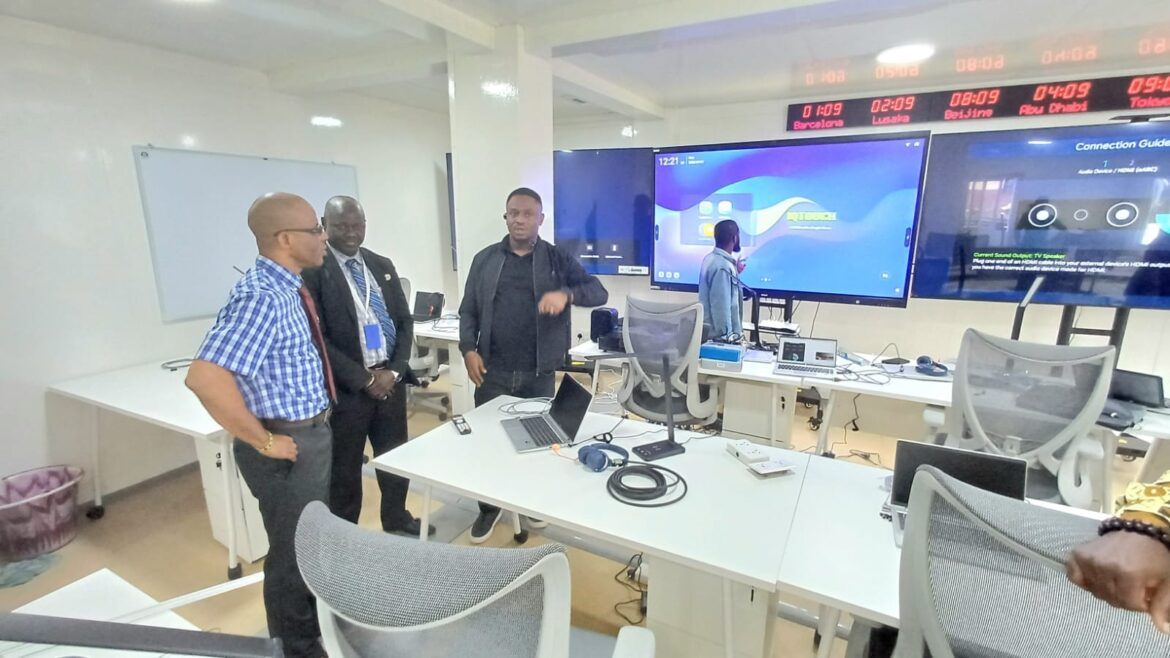
MONROVIA, Liberia — Former National Public Health Institute of Liberia (NPHIL) Director General Dr. Dougbeh Chris Nyan has challenged the current administration’s account of the origin of the institution’s new Public Health Emergency Operations Center (PHEOC), insisting that the modern facility was newly constructed through support from the Africa Centers for Disease Control and Prevention (Africa CDC) in partnership with the African Development Bank (AfDB), rather than refurbished by the United States Centers for Disease Control and Prevention (US CDC).
In a statement published on his official Facebook page on Wednesday, October 14, 2026, Nyan accused Dr. Sia Camano, Officer-in-Charge (OIC) and the NPHIL Board of providing inaccurate information about the facility during public briefings, arguing that the distinction between the two institutions’ contributions is important to the historical record, public accountability and recognition of the partners responsible for strengthening Liberia’s public health infrastructure.
The controversy centers on statements attributed to the current NPHIL leadership during briefings at the Ministry of Information, Cultural Affairs and Tourism (MICAT), where the new PHEOC was reportedly described as a refurbished facility supported by the US CDC. Nyan disputed both the description of the building and the attribution of its construction, maintaining that the facility was newly established within the NPHIL headquarters in Congo Town through an Africa CDC-led initiative.
According to the former director general, the project represented a major investment in Liberia’s capacity to coordinate responses to disease outbreaks, manage public health emergencies and improve communication among surveillance officers, laboratories and emergency response personnel.
Nyan said the Africa CDC, working with the African Development Bank, selected NPHIL to benefit from a public health programme designed to strengthen emergency operations capacity. He linked Liberia’s selection to what he described as the institution’s record in outbreak control, disease surveillance, laboratory development, One Health initiatives and biomedical research during his tenure.
He cited Mpox, Lassa fever and measles response activities as examples of the work that, in his account, strengthened NPHIL’s institutional standing and helped position Liberia to receive the support.
A central piece of evidence identified by Nyan is a communication dated November 5, 2024, which he said was sent by the Africa CDC to the NPHIL leadership. According to the wording he reproduced in his Facebook statement, the organization confirmed that, in partnership with the African Development Bank, it was supporting Liberia’s establishment of a PHEOC and had completed procurement of information and communications technology equipment valued at US$275,095.89.
The former NPHIL chief said the equipment was part of a larger package intended to establish a modern emergency coordination facility. He estimated the total Africa CDC investment in the project at approximately US$300,000, including computers, wide-screen television sets, audiovisual equipment, office equipment and other materials required for emergency management and coordination.
Nyan further stated that the equipment was shipped to Liberia and received by NPHIL around January 2025. Installation work reportedly commenced on July 14, 2025, and was completed around September of that year by a locally contracted construction firm.
He maintained that the work was carried out during his leadership and in accordance with Liberia’s public procurement laws. The account, if supported by the relevant procurement, delivery and completion records, would help establish the sequence of events behind the facility’s construction and the respective responsibilities of the institutions involved.
The former director general argued that describing the project as a refurbishment by the US CDC risks obscuring the role of the Africa CDC and the African Development Bank in delivering the new facility. He said proper attribution is especially important because the assistance was provided through an African institutional partnership intended to strengthen public health systems on the continent.
However, Nyan did not dismiss the historical contribution of the United States to Liberia’s public health infrastructure. He acknowledged that the US CDC played an important role in facilitating the construction of the existing container-type NPHIL building around 2017, following the devastating 2014 Ebola outbreak in West Africa.
He also credited the US CDC with supporting the training of field epidemiologists and providing assistance through cooperative agreements involving the Ministry of Health.
His distinction is that the earlier support for the container-type headquarters and the subsequent construction and equipping of the new PHEOC were separate interventions involving different arrangements and, according to his account, different institutional partners.
Nyan said the distinction should be clarified to protect the credibility of NPHIL and ensure that the organizations responsible for the new investment receive proper recognition. He also stressed that the Africa CDC and the African Development Bank, as well as the Liberian institutions involved, have an obligation to account for the assistance and its use.
The controversy comes at a time when public health institutions are expected to maintain accurate records of donor assistance, procurement, infrastructure development and emergency preparedness investments. Such records help governments, development partners and citizens determine whether resources have been delivered as intended and whether investments are producing lasting benefits.
A modern PHEOC is designed to provide a central point for coordinating information and operational decisions during public health emergencies. Depending on its equipment, staffing and operating arrangements, such a center can help bring together epidemiological surveillance, laboratory findings, incident management, logistics and communication during an outbreak.
For Liberia, which has experienced the consequences of major infectious disease outbreaks, investments in emergency coordination capacity are particularly important. A functioning center can help reduce delays in information sharing, improve the organization of response teams and support faster decisions when a disease threatens communities.
Nevertheless, the physical presence of a modern facility does not alone guarantee effective emergency preparedness. Its long-term value depends on reliable electricity and connectivity, trained personnel, equipment maintenance, adequate operational funding, established response protocols and regular exercises to test its readiness.
The disagreement over the PHEOC’s origins therefore raises two connected questions: whether the public has been accurately informed about the project’s history and whether the institution is maintaining the records needed to demonstrate how the investment was procured, installed and placed into operation.
Nyan said the current leadership’s account was part of a continuing pattern of inaccurate public statements. He connected the controversy to his removal from office and referred to a Supreme Court ruling dated February 16, 2025, which he said found his termination unlawful and lacking due process.
Those allegations form part of the former director general’s broader dispute with the NPHIL leadership and should be considered separately from the documentary question concerning the PHEOC. The precise scope and findings of the court decision would need to be established from the judgment itself.
The current NPHIL administration and Board have not provided a response in the material accompanying Nyan’s statement. Their explanation, together with the original project documents, would be necessary for a complete account of the disagreement.
The records relevant to resolving the matter include the Africa CDC communication of November 5, 2024, the equipment procurement and award documents, shipping and receipt records, construction contracts, procurement approvals, installation reports and official communications identifying the organizations responsible for the facility.
A comparison of those records with the statements made during the MICAT briefings would help establish whether the disputed description resulted from an error, incomplete information or a substantive disagreement over the project’s history.
For Nyan, the central issue is that Liberia’s public health development should be recorded accurately and that the institutions that contributed to the new PHEOC should receive appropriate credit.
His statement has placed the facility’s history before the public and called for a distinction between the earlier US-supported infrastructure and the new emergency operations center he attributes to the Africa CDC and African Development Bank partnership.
The matter now calls for a documented institutional explanation that establishes the project’s origin, identifies the contributions of each partner and clarifies the facility’s present operational status. Such an account would help protect public confidence in NPHIL while ensuring that the investment is recognized for what it was intended to achieve: stronger emergency preparedness and improved protection of public health in Liberia.
See more Liberia News Network stories in Google Search by adding LNN as one of your Preferred Sources.
★ Add LNN as a Preferred Source