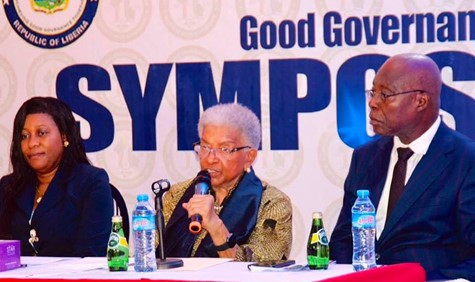
MONROVIA – Former President Ellen Johnson Sirleaf has returned to the question that defined her presidency. On Tuesday, she asked the Governance Commission symposium why accountability still needs repeating. Her answer reaches back to a Republic long governed by and for a few. She admits her government declared corruption public enemy number one and did not win. Audits were forgotten. Too few cases reached a courtroom. Her five charges fall on leaders, integrity institutions, the Legislature, the Judiciary and citizens. Her deeper argument is structural. A century of concessions, she says, gathered wealth and power in a few hands. As THE ANALYST reports, the speech is a honest confession and a challenge to those now in power.
Former President Ellen Johnson Sirleaf has conceded that the anti-corruption fight she launched in 2006 was not won, declaring that Liberia is facing the same problem today and calling for the structural transformation of the country’s economy and state. Speaking Tuesday, October 6, 2026, at the Governance Commission (GC) Symposium in Monrovia, the former President told commissioners, lawmakers, members of the Judiciary, diplomats and civil society actors that good laws and institutions alone will not end corruption.
“I wish I could tell you that with all of this effort we won the corruption fight. We did not, and we are facing the same thing today,” Sirleaf declared. “I have said so before, and I say it again today.”
The keynote, delivered under the theme “Promoting Good Governance through Accountability and Transparency in Liberia,” marked the GC’s inaugural Month of Good Governance, which is rooted in the Commission’s founding Act of October 9, 2007.
Sirleaf noted that she stood before the gathering “not as President, but as a citizen,” and set aside the guidance provided for her remarks to address what she believed was more appropriate for current challenges.
She posed what she called a hard question: “Why, after so many years, do these words still need repeating?” To answer it, Sirleaf argued, Liberians must go back to the beginnings of the Republic and the way it was governed.
Audits Published, Then Forgotten
Reflecting on her own administration, Sirleaf recalled that when she took the oath of office in January 2006, she declared corruption public enemy number one, having inherited “a nation that had been looted and a people who had lost faith in government.”
She credited some of the policies and ideas of former Interim President Dr. Amos Sawyer and noted that the GC itself grew out of the Governance Reform Commission agreed upon in the 2003 Accra Peace Accord.
She listed the reforms her government undertook, including strengthening the General Auditing Commission (GAC), creating the Liberia Anti-Corruption Commission (LACC), establishing the Public Procurement and Concessions Commission (PPCC), and reviewing and cancelling wartime concession contracts that did not serve the interest of the nation.
She also cited the National Forestry Reform Law of 2006, further strengthened by the 2009 Community Rights Law, which she said gave legal basis to community benefits.
Through the Liberia Extractive Industries Transparency Initiative (LEITI), Sirleaf noted, Liberia became the first country in Africa to meet the global standard for publishing what companies pay and what government receives.
She further pointed to the 2010 Freedom of Information Act, the first in West Africa, and to relief from nearly US$5 billion of public debt, which she said enabled the country to meet the requirements of national reconstruction.
Yet the former President was candid about the shortfalls. “Audits were published and then forgotten. Too few cases reached a courtroom, and fewer still ended in a conviction,” Sirleaf acknowledged, adding that some institutions were given mandates without budgetary allocations, “giving them responsibilities without teeth,” and that “there were times when people close to power were not held to the same standard as everyone else.”
She also disclosed that her government sought, through the effort of Dr. Elwood Dunn, new designs for the flag, the seal and other national symbols, and initiated national consultations toward constitutional reforms to align Liberia more closely with other African countries, including on citizenship. “We did not succeed,” she admitted.
Drawing lessons from that record, Sirleaf maintained that institutions are necessary but not enough. “Accountability without consequence is only a report on a shelf,” she stated. “Laws give us the tools. Only leaders, citizens and people working together can give those good governance tools the force and results achieved.” She drove the point home in Liberian vernacular: “Lemme Na Tork So! Tor So!”
Five Charges to the Nation
Sirleaf then laid out five charges, beginning with the nation’s leaders. “Accountability begins at the top, the very top, or it does not begin at all,” she declared, insisting that the Executive must set the standards and assure their implementation because “citizens believe and follow what leaders do and not what they say.”
For the GC and other integrity institutions, she demanded full budgetary allocations in accordance with the law and full independence to ensure their performance.
She urged the Legislature, as protectors of the nation’s laws and policies, to be transparent and accountable in all of its decisions and actions, and to ensure that budgetary allocations conform not only to the law but also to policies that result in a country of equity and trust in those who govern.
On the Judiciary, Sirleaf argued that court decisions must be respected and fully implemented, and that the courts must be properly staffed with people of competence and full integrity whose decisions conform to the laws and policies of the country. Her fifth and, in her words, most important charge was directed at the citizens of Liberia.
“Our Freedom of Information law belongs to you. Use it. Ask for the records,” she told Liberians. She urged journalists to keep asking the hard questions and called on those in power to protect them when they do, while encouraging the women of Liberia, “who brought this nation to peace,” to keep raising their voices.
To young people, she warned against accepting corruption as simply the way things are. “It is not. It is a choice, and you can choose the values that ensure your seat at the table of governance,” Sirleaf stated.
100 Years, Not One Tire
Beyond the charges, Sirleaf contended that good laws, good policies and good people will not be enough if the structures of the state and the economy stay as they are. “Accountability cannot take root in soil that rewards its absence,” she observed. “What Liberia needs is not minor or marginal reforms. It needs structural transformation.”
She pointed to the economy as evidence, noting that this year marks 100 years since the Firestone concession of 1926, “and not a single tire has been made.” For a century, she said, Liberia has earned its living by granting concessions and exporting raw materials such as rubber, iron ore, timber and gold, while serious questions and concerns now surround how the country’s critical minerals are taken away.
“When a nation’s wealth flows through a few contracts signed in a few offices, power and money gather in the same few hands. That is the very ground in which corruption grows,” the former President cautioned.
While applauding past and continuing efforts to restore infrastructure and strengthen institutions, Sirleaf called for continued investment in roads, power and broadband, more investment in agriculture, and greater empowerment of Liberian entities.
She further demanded real decentralization, observing that for too long every decision of consequence has flowed to Monrovia and, within Monrovia, to the Executive Mansion.
She said county officials need real resources such as the County Development Fund, and that elected local leaders must accept a duty to account to their own people, as is still done in rural villages.
Sirleaf also urged that the serious land issues restricting national development be addressed quickly and fairly, building on the basis provided by the Liberia Land Authority (LLA) and the Land Rights Law, and that civil servants be hired on merit, paid a living wage and protected from political pressure.
History Behind the Accountability Deficit
Sirleaf traced the roots of the accountability deficit to the founding of the Republic. She recalled that before 1822, the land was home to peoples with their own laws, leaders and ways of settling disputes, including the Kpelle, Bassa, Gio, Mano, Kru, Grebo, Vai, Gola, Lorma, Kissi and Mandingo, who were connected through trade and migration to the empires of Ghana, Mali and Songhai.
She noted that settlers sponsored by the American Colonization Society, a private body formed in 1816, declared the independent Republic on July 26, 1847, and modeled the Constitution, the three branches of government and the national symbols on those of the United States.
Liberia, she added, survived the Berlin Conference of 1884 and 1885 alongside Ethiopia as one of only two African nations never colonized.
“But here is the harder truth. For more than a century, the Republic was governed by and for a small minority,” Sirleaf declared. She argued that exclusion bred resentment, which fostered the violence of 1980 and then 14 years of civil war that took a reported 250,000 lives.
“There can be no accountability without inclusion,” she stated, stressing that accountability is not a foreign idea brought from outside. She cited the Palava hut tradition, in which a chief who abused his people could be challenged by the elders, insisting that “good governance is not an import. It is a return to values.”
Looking Ahead to 2047
Sirleaf cautioned that none of these changes can happen in one budget year or one election cycle, describing structural transformation as “the work of a generation.” She called for a new vision, a new factual agenda, new policies, less politics and a stronger national commitment by leaders and citizens.
Looking to 2047, when Liberia will mark 200 years of independence, the former President expressed hope that future generations would say this generation “finally made the substance match the form” and built a Republic that includes all and listens to its people.
“That work does not belong to one president, one political party, one commission or one generation. It belongs to all of us, and it could start today,” Sirleaf concluded.
See more Liberia News Network stories in Google Search by adding LNN as one of your Preferred Sources.
★ Add LNN as a Preferred Source