
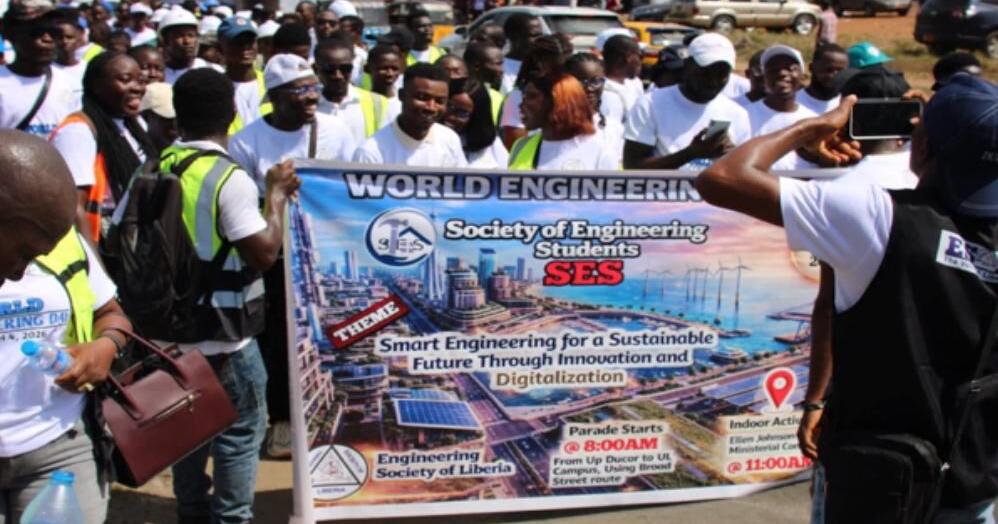
The Engineering Society of Liberia (ESOL) on March 4 joined the global community in celebrating World Engineering Day for Sustainable Development, using the occasion to call for greater institutional independence and stronger youth empowerment within Liberia’s engineering sector.
The event, held under the theme “Smart Engineering for a Sustainable Future Through Innovation and Digitalization,” was marked by a parade through the streets of Monrovia, a debate competition, keynote addresses, and forward-looking discussions focused on the future of the profession.
World Engineering Day for Sustainable Development is observed annually on March 4 and is officially recognized by UNESCO and the World Federation of Engineering Organizations (WFEO) to highlight the critical role engineers play in advancing sustainable development worldwide.
Delivering the keynote address, ESOL President David D. Wounuah laid out what he described as a bold vision for the future of the profession in Liberia, stressing that the society must assume greater responsibility in regulating engineering practice.
“First, you have to step out of your parents’ house, right?” Wounuah declared. “Originally, our office is at the Ministry of Public Works and it is like regulating the practice. We are independent and our first step is to step up.”
Wounuah argued that ESOL must break free from what he termed perceived constraints under the Ministry of Public Works, emphasizing that true independence requires self-determination and ownership of regulatory authority. He pledged to work toward the construction of a dedicated ESOL headquarters as a symbol of that autonomy.
“At the same time, we must admit that our current efforts are not enough,” he cautioned. “We are demanding that the society be permitted to take ownership. We will continue pushing to achieve our goals, and we are confident in our ability to do so.”
The ESOL president also spotlighted the critical role of young engineers in shaping the country’s future, noting that youth empowerment must be central to the society’s agenda.
“The future of engineering lies in our youth,” Wounuah said. He referenced recent initiatives aimed at improving access to internships for Liberian engineering students and announced plans to establish a formal internship program managed by ESOL to coordinate opportunities nationwide.
According to him, the initiative will connect students with practicing engineers and firms to ensure they gain practical experience and mentorship before entering the workforce.
“We want this to become the norm,” Wounuah emphasized, urging senior engineers across Liberia to actively participate in mentoring and hosting interns.
Earlier in the program, keynote speaker Eng. Thomas Z. Gwonkerwon echoed the call for modernization, challenging engineers to embrace innovation and technological advancement.
“Are we engineering smartly enough? Are we innovating boldly enough? Are we digitalizing fast enough?” Gwonkerwon asked, drawing applause from participants.
He stressed that “Smart Engineering” must be more than a slogan, urging the profession to adopt digital tools and data-driven approaches to infrastructure planning and public service delivery.
Gwonkerwon outlined practical examples of how engineering innovation can transform Liberia’s development trajectory, including the adoption of smart grids, digital procurement systems, and drone mapping technologies to improve infrastructure design and monitoring.
Highlighting the broader societal impact of engineering, he called for continuous professional development and cross-sector collaboration.
“Let us return to our institutions, project sites, classrooms, and boardrooms, determined to design smarter, build sustainably, and engineer boldly,” he urged. “Let us design and build Liberia — intelligently, responsibly, and sustainably.”
The celebration underscored ESOL’s commitment to spearheading innovation within the profession, strengthening regulatory capacity, and empowering the next generation of engineers to lead Liberia’s sustainable development agenda.
As the program concluded, participants reaffirmed their dedication to advancing digitalization, professional integrity, and inclusive growth through engineering excellence.
