
By Lincoln G. Peters
MONROVIA, May 12, 2026—The New Dawn’s Investigative Team has uncovered mounting concerns over a lagoon-side construction project linked to D’Calabash and A’La Lagoon Resort on Congo Town Back Road, a coastal wetland area residents say is increasingly vulnerable to flooding during the rainy season.
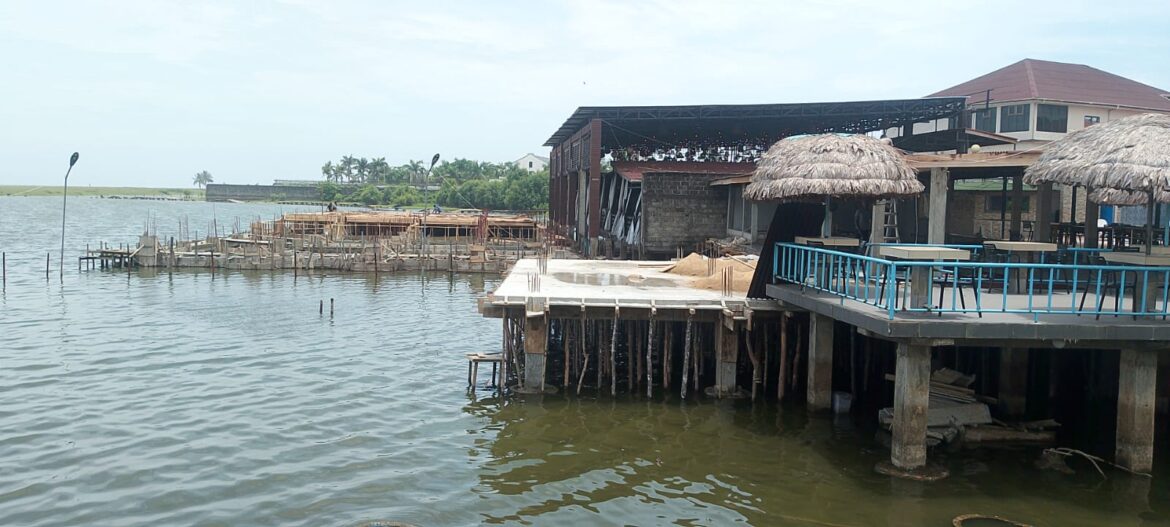
Over several weeks of site visits, the team documented ongoing work described by locals as a multipurpose building erected over the lagoon. The central question: whether the project received the required environmental authorization and whether safeguards, especially where chemicals and construction materials are used near water, are being enforced.
What the law says: Liberia’s environmental framework places strict limits on draining, filling, or building in wetlands and other coastal ecosystems. Section 75 of the Environmental Protection and Management Law (EPML) bars unauthorized draining, backfilling, or construction in wetlands, riverbanks, and lake shores.
The law also requires an Environmental Impact Assessment (EIA) and an environmental permit for projects near wetlands or water bodies to assess likely damage and set mitigation conditions. The EPA and the Ministry of Public Works have, in recent months, conducted enforcement actions, including demolition exercises, to reclaim wetlands from illegal structures.
Penalties can include fines and demolition. The draft zoning provisions referenced by residents cite Section 5.9 as allowing fines and removal of structures built in prohibited areas. Under Executive Order 143, signed by President Joseph Nyuma Boakai, the EPA says it has intensified wetland protection through a dedicated task force targeting known hotspots, including the SKD Boulevard corridor, the Police Academy area, and Jacob Town.
Environmental experts and EPA public messaging have long warned that construction in lagoons and wetlands can accelerate degradation and contribute to urban flooding. In the Congo Town Back Road case, residents fear the lagoon’s natural drainage role is being altered—raising the prospect of overflow and displacement as seasonal rains intensify.
Lagoons matter: Lagoons are high-biodiversity ecosystems—nurseries for fish and other sea life, nesting grounds for birds, and natural filters for pollutants. When construction expands into these waters, the risks often include habitat loss, reduced water quality, and weakened natural buffers against storms and sea-level rise.
Environmental risks cited by residents include sedimentation from backfilling, possible pollution from construction waste and concrete, and obstruction of natural waterways. Wetlands also serve as buffers against coastal erosion; when they are reduced or altered, nearby communities can become more exposed to storms and floods.
Another concern is fragmentation—shrinking wetland space can disrupt how wildlife moves, feeds, and breeds, especially in coastal zones where habitats are already under pressure from development.
For about a month, the New Dawn team tracked the project’s progress and sought to determine whether an environmental permit was issued in accordance with EPA guidelines governing construction in coastal wetlands and lagoon areas.
The investigation also sought to determine whether, if a permit exists, the resorts are complying with any conditions, particularly on handling chemicals and other inputs that could affect water quality and aquatic life.
Residents told the New Dawn they began raising alarm after observing what they described as “unregulated” work in the coastal zone. Several said they fear the construction could worsen flooding and force displacement during the peak of the rainy season.
They also expressed worry about biodiversity within the lagoon, alleging that certain chemicals and equipment used on site could contaminate the water. Some residents said they harvest and eat seafood from the area and are concerned about potential health implications if pollution increases.
The New Dawn sought comment from management of both establishments regarding permits, environmental safeguards, and government authorization. However, during multiple attempts, the team was unable to secure an on-the-record response.
To clarify the government’s position, the team later approached EPA Executive Director Dr. Emmanuel Urey-Yakapolowo during a regular press briefing at the Ministry of Information, where he addressed environmental issues related to concession operations and other activities across the country.
During the question-and-answer segment, the New Dawn asked whether the EPA was aware of—and had authorized—the lagoon construction linked to D’Calabash and A’La Lagoon.
In response, Dr. Urey-Yakapolowo said he could not immediately confirm whether the agency had issued an environmental permit. Still, he defended what he had observed during a visit to the site, arguing that the design appeared to rely on concrete pillars rather than on backfilling the lagoon.
“What I do know is that the construction, at least I have visited the area—they are not like blocking the waterway; they are putting big, big pillars in the water for the construction of the building. So, if you take that into consideration, it’s not necessarily like you are filling out the water or filling dirt inside the water. But it requires some set of environmental protection. Because sometimes a permit is allowed, but under certain conditions. So, we will look into that in terms of what is happening there. I don’t have the clear information to give if they have an ssenvironmental permit or not,” he said.
The EPA’s inability at the briefing to confirm the permit status has left residents and environmental advocates questioning how wetland rules are being applied in one of Monrovia’s fast-developing coastal corridors, and whether mitigation measures are adequate to prevent flooding and ecological harm.
D’Calabash—often referred to as D’Calabash Hotel, Bar & Restaurant—is a well-known hospitality and entertainment venue on Congo Town Back Road, near the Ministry of Health. The property sits along a river and lagoon corridor that residents say functions as a key drainage route during heavy rains.
A’La Lagoon is another popular resort and restaurant situated on the lagoon along Congo Town Back Road. It is known as a hotel, bar, and dining facilities overlooking the water and the nearby Atlantic coastline.
—Editing note: This story will be updated if the EPA provides documentation of any environmental permit or if management of the establishments responds to requests for comment.
