BRUSSELS / MONROVIA — Europe is tightening its response to the cocaine trade, and the implications for Liberia and other West African countries could be significant.
The European Parliament moved on September 17 toward a more coordinated European response to narcotics trafficking, calling for stronger action against criminal networks, better cooperation among customs, police and judicial authorities, enhanced maritime surveillance and port security, and tougher measures against the financial structures that sustain organized drug trafficking.
European lawmakers voted 601 in favor, four against and five abstentions, according to reporting on the vote. The European Parliament’s Legislative Observatory records September 17 as the date of the vote, although its English procedure page has not yet fully updated the procedural status.
For West Africa, the timing is significant.
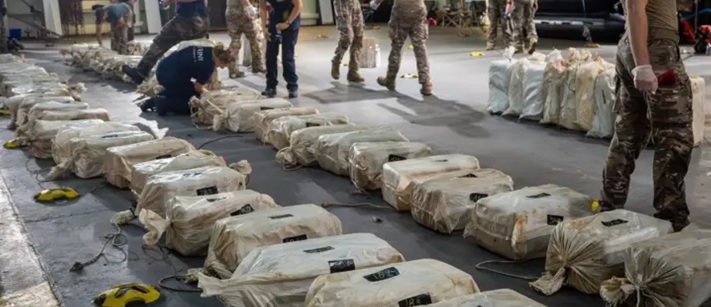
Liberia has already experienced one of the largest cocaine seizures in its history. On July 21, Liberian authorities seized approximately 3,971 kilograms of cocaine in Duazon, a shipment that police said was worth about US$317 million and was bound for Europe. Two foreign nationals were arrested, according to Reuters.
The seizure followed the interception in June of another 237.6 kilograms of cocaine at Roberts International Airport.
Taken together, the cases have placed Liberia directly inside a much larger international debate about how cocaine moves from Latin America through West Africa and ultimately into European markets.
Europe’s message is moving beyond the ports
The European response is no longer focused solely on finding drugs when they arrive in Europe.
The EU’s broader drug strategy places increasing emphasis on the maritime supply chain, ports, financial networks and cooperation with countries outside the European Union.
The EU Council has already endorsed an action plan emphasizing the “follow-the-money” approach, stronger maritime operations and greater cooperation with third countries and regions affected by drug trafficking.
The European Parliament’s own research on the EU ports strategy says the European Commission and European External Action Service are expected to conduct targeted assessments of high-risk ports in non-EU countries to address criminal infiltration before illicit shipments leave those countries. The strategy also calls for greater information exchange between customs authorities and maritime logistics companies concerning drug trafficking and illicit trade.
That development deserves serious attention in Monrovia.
If European authorities increasingly examine the security of ports and maritime departure points outside Europe, West African countries could face much greater scrutiny of their ports, logistics companies, shipping documentation, customs systems, container movements and individuals with access to maritime supply chains.
Liberia’s US$317 million seizure cannot be viewed in isolation
The Duazon seizure presents Liberia with both an opportunity and a major accountability challenge.
The question is no longer simply how Liberia managed to intercept nearly four tonnes of cocaine.
The bigger question is how nearly four tonnes of cocaine could move through an international maritime and logistics chain before reaching Liberian territory, who financed the operation, who controlled the shipment, who was supposed to receive it and where the proceeds were ultimately intended to go.
Those questions require an investigation that goes beyond the people physically arrested at the scene.
A sophisticated trafficking operation potentially involves financiers, brokers, shipping agents, companies, transporters, warehouse operators, document handlers, customs contacts and international recipients.
The arrest of individuals at one end of the chain does not necessarily identify the people financing or directing the network.
Liberian authorities have described the Duazon operation as involving an organized and well-funded trafficking network.
That characterization makes the financial investigation especially important.
Ghana provides another warning
Liberia is not alone.
On September 17, a Ghanaian court remanded four people over an alleged shipment of approximately four tonnes of cocaine from Ghana to France.
According to the Ghana News Agency, French authorities intercepted a 40-foot container at Dunkirk containing plastic waste in which about four tonnes of suspected cocaine were allegedly concealed. The shipment was reportedly connected to Ghana, and a fifth suspect, Jos Leudekkers, also known as “Bolle Jos,” remains at large. The court proceedings are ongoing and the accused have pleaded not guilty.
French customs previously reported the seizure of nearly 3.9 tonnes at Dunkirk, with an estimated street value of approximately €225 million, or about US$261 million. The shipment was reportedly destined in part for Antwerp.
That case demonstrates how a shipment originating in West Africa can become a European criminal investigation once it reaches the European port system.
It also illustrates why European authorities are increasingly concentrating on the entire supply chain.
The West African corridor
European authorities have long recognized West Africa as an important transit region for cocaine moving toward Europe.
EU documents say cocaine flows to European ports have increased and that trafficking routes can run directly from Latin America or through West Africa.
This creates a difficult situation for countries including Liberia, Ghana, Sierra Leone, Guinea and others along the West African coast.
The region is geographically positioned between major cocaine-producing areas in Latin America and lucrative European markets.
Criminal organizations therefore have an incentive to exploit legitimate maritime commerce, weak border controls, corruption vulnerabilities and gaps between national law-enforcement agencies.
But it is important not to treat every cocaine seizure in the region as evidence of one common organization.
The Liberia and Ghana cases have similarities, but publicly available evidence does not yet establish that they are part of the same criminal network.
That distinction matters.
A serious investigation must follow evidence rather than simply connect cases because the quantities or routes appear similar.
What Europe could mean for Liberia
The emerging European strategy could create several consequences for Liberia.
First, international scrutiny of Liberia’s maritime and port-security systems could increase.
Second, European law-enforcement agencies could demand stronger information-sharing involving vessels, containers, shipping companies, cargo documentation and suspicious financial transactions.
Third, Liberian authorities could face greater pressure to demonstrate that major cocaine investigations do not stop with low-level couriers or people physically found with the drugs.
Fourth, Liberia could become increasingly important to European investigators because the country has already recorded a seizure of extraordinary size.
And fifth, Liberia could benefit from greater international cooperation if its law-enforcement agencies receive additional intelligence, training, technology and investigative support.
The EU’s strategy specifically identifies partnerships with third countries and regions as one of its priorities.
The money may be more important than the cocaine
For Liberia, perhaps the most consequential part of Europe’s changing strategy is the emphasis on following the money.
A cocaine shipment worth hundreds of millions of dollars represents only one part of the criminal enterprise.
Behind the shipment is money used to purchase cocaine, arrange transportation, obtain documents, pay facilitators, move cargo and eventually launder profits.
If Liberia wants to expose the full network behind the Duazon shipment, investigators will therefore need to examine bank transfers, company ownership, property purchases, vehicle acquisitions, communications, international travel, shipping records and relationships between local and foreign business interests.
European investigators are increasingly pursuing the same approach.
The EU Council has explicitly placed financial investigations and asset tracing at the center of its anti-drug strategy.
A test for Liberia’s institutions
The enormous cocaine seizures have presented Liberia with an unusual opportunity.
The country can demonstrate that it is capable not only of seizing cocaine, but also of dismantling the financial and logistical infrastructure behind the trafficking operation.
That requires strong cooperation among the Liberia Drug Enforcement Agency, Liberia National Police, customs authorities, financial-intelligence authorities, prosecutors and the courts.
It also requires international cooperation with European governments and law-enforcement agencies.
The danger is that international attention could expose institutional weaknesses if investigations become fragmented, suspects disappear, evidence is poorly preserved or prosecutions fail to reach the people who financed and organized the trade.
The European response makes that challenge even more important.
From Monrovia to Dunkirk and Antwerp
The emerging picture is therefore larger than Liberia’s individual cocaine cases.
A shipment can begin in Latin America, pass through a West African logistical network, enter a European port and eventually reach markets elsewhere in Europe.
Liberia’s US$317 million seizure, Ghana’s nearly four-tonne shipment intercepted at Dunkirk, and Europe’s expanding maritime-security strategy all point toward the same fundamental reality:
The cocaine trade is not a collection of isolated national crimes. It is an international supply chain.
And if Europe intends to attack that supply chain from both ends, West African governments will increasingly be expected to secure their ports, strengthen customs and intelligence cooperation, investigate corruption and—most importantly—follow the money.
For Liberia, the question is no longer whether the cocaine trade is passing through the region.
The country’s own seizures have already demonstrated the scale of the threat.
The question now is whether Liberia can use international cooperation to identify who financed the shipments, who facilitated them, who expected to receive them and where the money was going.
See more Liberia News Network stories in Google Search by adding LNN as one of your Preferred Sources.
★ Add LNN as a Preferred Source