
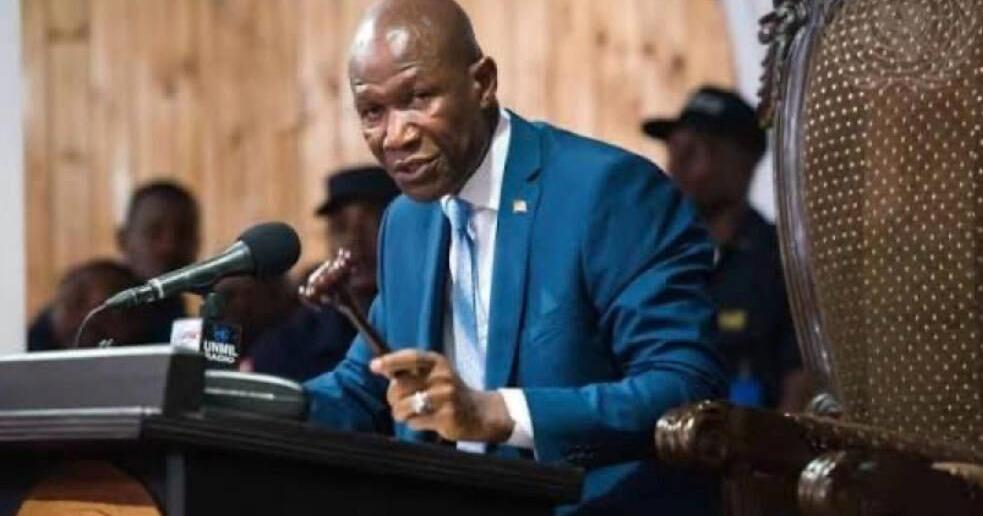
Former House Speaker Dr. Bhofal Chambers has reignited one of the country’s most sensitive legal and human rights debates by calling on the Government to begin enforcing the country’s dormant death penalty law against convicted drug traffickers and perpetrators of other capital offenses.
His remarks come at a time when Liberia is confronting an unprecedented surge in transnational narcotics trafficking, following record cocaine seizures worth nearly US$390 million within a year and growing concerns that the country is becoming an important transit corridor for international drug cartels.
Speaking during an interview in his hometown of Pleebo, Maryland County, Chambers argued that the current criminal justice system has failed to provide sufficient deterrence against organized crime.
“Liberia can no longer afford to take a soft approach to crimes that are destroying the future of our young people and undermining the security of the state,” Chambers declared.
He maintained that persons convicted through the courts of major drug trafficking and other grave offenses should face the maximum punishment permitted under Liberian law.
“Those who are involved in drug trafficking and other serious crimes that threaten the growth and development of the state, once found guilty through the legal process, should face the death penalty.”
His proposal immediately broadens the national conversation from drug enforcement to a more fundamental question—should the government revive capital punishment as a weapon against organized crime, or would doing so undermine the country’s commitment to human rights?
For Chambers and many other Liberians, the nation under siege by drugs. The former Speaker’s comments emerge against the backdrop of what many describe as the country’s most serious narcotics crisis since the end of the civil war.
Over the past several years, drug abuse—particularly the consumption of kush, cocaine, heroin, tramadol and other illicit substances—has become one of the nation’s most pressing public health and national security challenges.
Communities across Monrovia and several counties have witnessed increasing numbers of young people suffering from addiction, while schools, families and healthcare providers continue to struggle with the social consequences of widespread substance abuse.
The crisis reached a turning point in 2024, when President Joseph Nyuma Boakai declared drug abuse a national public health emergency, acknowledging that narcotics had evolved beyond a criminal justice issue into a broader threat affecting national development, education and social stability.
His administration subsequently established a multi-sectoral response involving law enforcement agencies, health authorities, community organizations and international partners.
Alongside prevention and rehabilitation efforts, Liberian authorities have intensified anti-drug enforcement operations.
The Liberia Drug Enforcement Agency (LDEA), working with international partners, has intercepted several major narcotics shipments.
Among the most significant was the seizure of 237.6 kilograms of cocaine valued at more than US$19 million at Roberts International Airport.
Authorities later confiscated nearly four metric tons of cocaine in Duazon, valued at approximately US$370 million, making it one of the largest drug seizures ever recorded in West Africa.
Those seizures transformed public perception of the country’s drug problem.
Rather than serving merely as a country confronting domestic drug abuse, Liberia increasingly appeared vulnerable to becoming a transit point for sophisticated international criminal syndicates.
Against that backdrop, Chambers argues that existing penalties may no longer match the scale of the threat.
Unlike calls for summary justice, Chambers emphasized that his proposal is rooted in constitutional due process.
He cited Article 20(a) of Liberia’s 1986 Constitution, which provides that no person shall be deprived of life except pursuant to the judgment of a court of competent jurisdiction following conviction for a capital offense.
He also referenced provisions within Liberia’s Penal Law that continue to retain the death penalty for specified capital crimes.
“Liberia’s jurisprudence is modeled after that of the United States. If the United States continues to enforce the death penalty in several of its states against those convicted of capital crimes, why should Liberia merely keep the law in its statute books without enforcing it?” Chambers asked.
He argued that maintaining a law without implementing it weakens public confidence in the justice system.
In his view, government should either enforce the law or abolish it through constitutional and legislative reforms.
Chambers’ proposal raises a question that has divided criminologists, policymakers and human rights advocates for decades.
Supporters of capital punishment argue that severe penalties send powerful deterrent signals to organized criminal networks.
Applied consistently, they contend, the death penalty demonstrates that society will impose the highest consequences on crimes threatening national survival.
Within the country’s current context—where international drug cartels appear increasingly active—supporters may argue that extraordinary threats require extraordinary responses.
Others believe the proposal reflects growing public frustration with repeat offenders, expanding drug markets and violent criminal activity.
Yet many researchers question whether the death penalty actually reduces drug trafficking.
International studies have generally found limited empirical evidence that executions deter organized criminal enterprises, whose leaders often operate across borders and treat arrested couriers as expendable.
Many legal scholars instead argue that certainty of punishment, rather than severity alone, is the stronger deterrent.
From that perspective, improving investigations, strengthening prosecutions, protecting witnesses and securing convictions may prove more effective than imposing harsher sentences that are rarely carried out.
Regional and Global Divide
Around the world, governments remain sharply divided over capital punishment for drug-related offenses.
Several Asian and Middle Eastern countries—including Singapore, Saudi Arabia, Iran and China—retain the death penalty for certain drug trafficking offenses, arguing that narcotics pose existential threats to society.
Supporters frequently point to comparatively low rates of large-scale trafficking within some of these jurisdictions as evidence of effective deterrence, although experts caution that many factors—including geography, policing capacity, border controls and governance—also influence drug crime.
In Africa, the picture is more varied.
Countries such as Botswana, Egypt, Somalia and South Sudan continue to retain and, in some instances, enforce capital punishment for certain offenses, while many others have moved toward abolition or long-standing moratoriums.
Conversely, virtually every member of the European Union has abolished the death penalty, viewing abolition as a fundamental human rights principle and a prerequisite for EU membership.
The African Commission on Human and Peoples’ Rights has likewise encouraged member states to move toward abolition, reflecting a broader continental trend favoring restraint in the use of capital punishment.
Liberia itself occupies a unique position within this debate. Although the death penalty remains in domestic law for certain capital offenses, the country has not carried out an execution since 2000, effectively making it a de facto abolitionist state.
Successive governments have retained capital punishment in legislation while refraining from implementing death sentences.
Liberia is also a party to international human rights instruments that have influenced domestic discussions about limiting or abolishing executions altogether. This legal ambiguity has created a long-standing contradiction. On paper, capital punishment exists.
In practice, it has remained dormant for more than two decades. Chambers’ proposal directly challenges that status quo.
Whether Liberia ultimately embraces or rejects Chambers’ recommendation, his intervention highlights the gravity of the country’s narcotics crisis.
Drug trafficking today is no longer viewed solely as a law enforcement problem. It affects healthcare systems, education, youth employment, family stability, national security and investor confidence.
The Boakai administration has responded through a combination of emergency declarations, intensified law enforcement operations, international cooperation and expanded public awareness campaigns.
The government has also emphasized rehabilitation alongside enforcement, recognizing addiction as both a criminal justice and public health concern.
Dr. Chambers’ proposal is almost certain to generate strong reactions from lawmakers, constitutional lawyers, religious leaders, civil society organizations and human rights advocates.
His call reflects a growing demand for tougher measures against organized crime at a time when Liberia faces increasingly sophisticated international narcotics networks.
His opponents would think reviving executions risks undermining national human rights commitments without addressing the deeper structural drivers of drug trafficking, including corruption, weak institutions, porous borders and youth unemployment.
Ultimately, the debate extends beyond the death penalty itself. It raises a broader question about how the country should respond to one of the greatest security challenges confronting the nation—whether justice is best served by imposing harsher punishments, strengthening institutions, or pursuing a balanced strategy that combines effective law enforcement, rehabilitation and long-term social investment.
As the battle against narcotics continues, Chambers has ensured that one of the country’s oldest legal provisions has once again become one of its most contentious public policy questions.
