
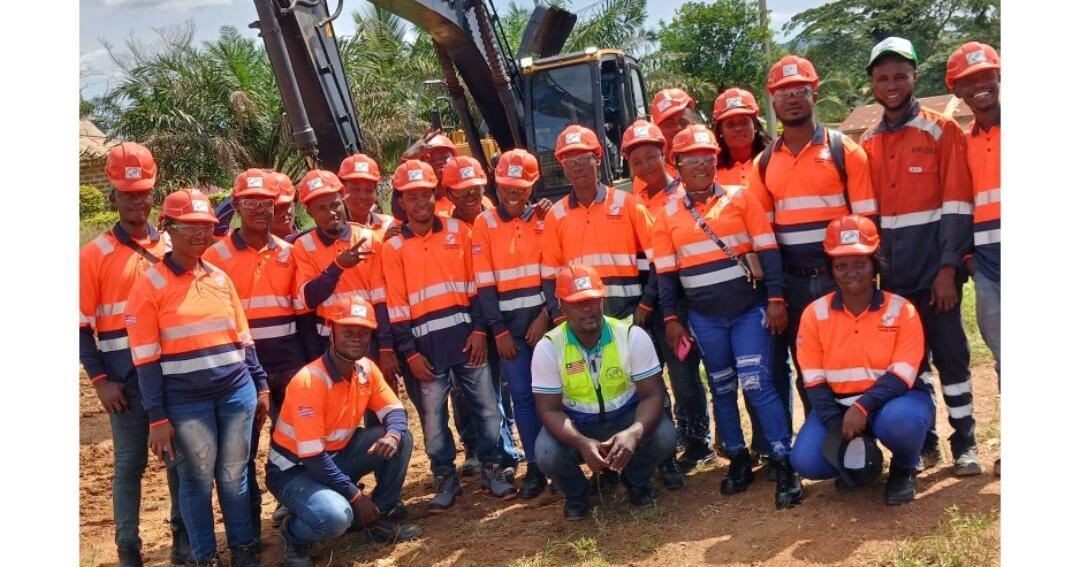
One of Nimba County’s emerging vocational institutions, the First Impression Training Center Inc. (FITCI), located in Sanniquellie City, has pledged to strengthen skills training for Liberians in heavy-duty equipment operations and other technical fields.
The newly established vocational institution is dedicated to developing technical and operational skills among Liberians, particularly young people, to meet the growing demand for skilled workers in the country’s mining, construction, and transportation sectors.
Speaking about the institution’s progress, FITCI Chief Executive Officer Darlington D. Siaway said that within its first five months of operation, the center has enrolled more than 400 students across several training programs, demonstrating strong demand for competency-based technical education.
According to Siaway, FITCI prepares equipment operators and professional drivers through a combination of classroom instruction and hands-on practical training.
“The training center contributes directly to workforce localization, youth employment, and economic development,” he said.
FITCI was founded by two professionals from Nimba County with the vision of addressing skills shortages in heavy equipment operations and professional driving.
Located in the county’s capital, Sanniquellie, the center aims to become a hub for developing skilled workers who can support companies such as ArcelorMittal Liberia (AML) and other industries. It also seeks to prepare operators capable of managing heavy equipment used in road construction and other development projects across Nimba County.
“This training center supports national priorities by promoting youth empowerment, strengthening the country’s technical workforce, and supporting Liberia’s mining and transport sectors,” Siaway said.
“It will help reduce dependence on foreign labor while increasing Liberian participation in the country’s industrial development,” he added.
According to the CEO, the institution’s mission is to transfer knowledge and practical skills while developing professional competence among trainees. Its vision is to create value through operational excellence and sustainable growth, guided by the core values of safety, integrity, excellence, accountability, and national development, consistent with international best practices.
FITCI currently offers training in Defensive Driving, Heavy-Duty Truck Operations, Excavator Operations, and Front-End Loader Operations.
Siaway said all programs are competency-based and aligned with industry standards.
“Our training methodology combines classroom instruction with extensive field practicals, supported by continuous competency assessments and structured evaluation systems,” he explained.
The institution currently has 358 students undergoing intensive theoretical and practical training, including 103 females and 255 males. The students are divided into two batches, with the first comprising 205 trainees and the second 153.
According to the institution, approximately 60 percent of the students have enrolled in the excavator operations program, reflecting strong interest in heavy equipment operation among young Liberians.
Truck driving and front-end loader operations have also attracted significant interest. One student noted that trainees must first obtain the necessary driving skills for light-duty vehicles before progressing to heavy-duty truck operations.
ArcelorMittal Liberia has previously provided specialized training for young Liberians to operate DTA haul trucks used to transport iron ore from its mining operations. However, some students believe access to those training opportunities has been limited because of selective admission processes.
Students interviewed at FITCI said the center offers a more accessible pathway for young people seeking technical skills and employment opportunities in Liberia’s growing industrial sector.
The institution believes its programs will help equip more Liberians with marketable technical skills, enhance workforce competitiveness, and expand opportunities for employment in the country’s mining, construction, and transportation industries.
