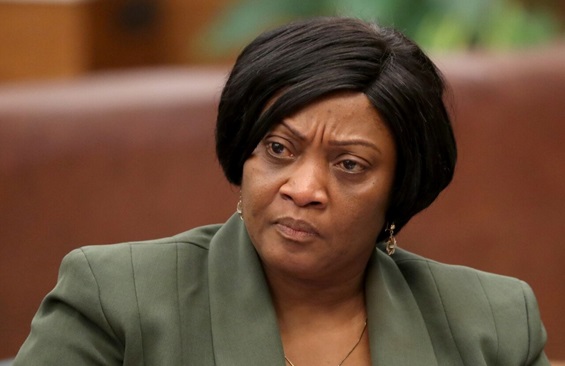
MONROVIA – Former Vice President Jewel Howard Taylor on Wednesday, August 19, 2026, headed to the Liberia National Police (LNP) headquarters with her lawyers after being stopped from leaving the country at Roberts International Airport and informed that she had been declared a person of interest in an ongoing investigation.
Taylor reportedly arrived at the airport early Wednesday to board an ASKY Airlines flight to Accra, Ghana, where she was expected to participate in a women’s leadership forum.
However, immigration officials reportedly prevented her from boarding after informing her that they had received instructions from their superiors not to allow her to leave Liberia.
According to information gathered by Smart News Liberia, Taylor subsequently attempted to contact the head of the immigration service but was unable to reach him. She later contacted LNP Inspector General Gregory O.W. Coleman, who reportedly informed her that a police investigation was ongoing and that she was considered a person of interest and needed to report to police headquarters.
Taylor is not being escorted to the police headquarters by police officers. Instead, she is proceeding voluntarily with members of her legal team.
Liberia’s Ministry of Information has confirmed that the Joint Security has designated the former vice president a person of interest, although authorities have not publicly disclosed the specific allegations or evidence linking her to the investigation.
The restriction on her movement is reportedly connected to the ongoing investigation into the seizure of approximately 3,971 kilograms of suspected cocaine in Duazon, Margibi County, valued at about US$317 million.
The massive seizure is part of a broader national drug investigation that has generated intense public debate over the alleged involvement of security personnel, the identities of individuals behind the shipment and the handling of evidence.
Taylor’s appearance before the police comes weeks after she publicly urged the government to exercise extreme caution in handling and destroying the seized narcotics.
At the time, she called for forensic evidence to be properly preserved before any destruction of the drugs, warning that failure to do so could undermine future prosecutions.
Her earlier comments are now drawing renewed attention as authorities investigate the circumstances surrounding the massive cocaine shipment.
Despite her designation as a person of interest, there has been no public indication that Taylor has been charged with a crime.
The distinction is significant, as being considered a person of interest does not, by itself, establish criminal involvement or wrongdoing.
The decision to prevent a former vice president from leaving the country and subsequently require her to report to police headquarters is nevertheless likely to intensify public interest in the government’s expanding narcotics investigation.
It also raises questions about the legal basis for the travel restriction, the nature of the information authorities are seeking from Taylor and whether the investigation will ultimately produce evidence capable of supporting criminal charges.
Taylor’s decision to appear at police headquarters with her lawyers could provide an opportunity for investigators to obtain information while ensuring that her legal rights are represented during the process.
The latest development comes against the backdrop of heightened scrutiny of Liberia’s handling of recent cocaine seizures, including the approximately 237 kilograms intercepted at Roberts International Airport and the nearly 3,971 kilograms seized in Duazon.
Together, the seizures have been valued at approximately US$336 million and have prompted demands for greater transparency, independent investigations and accountability at the highest levels of government and the security sector.
See more Liberia News Network stories in Google Search by adding LNN as one of your Preferred Sources.
★ Add LNN as a Preferred Source