Published: August 25, 2026
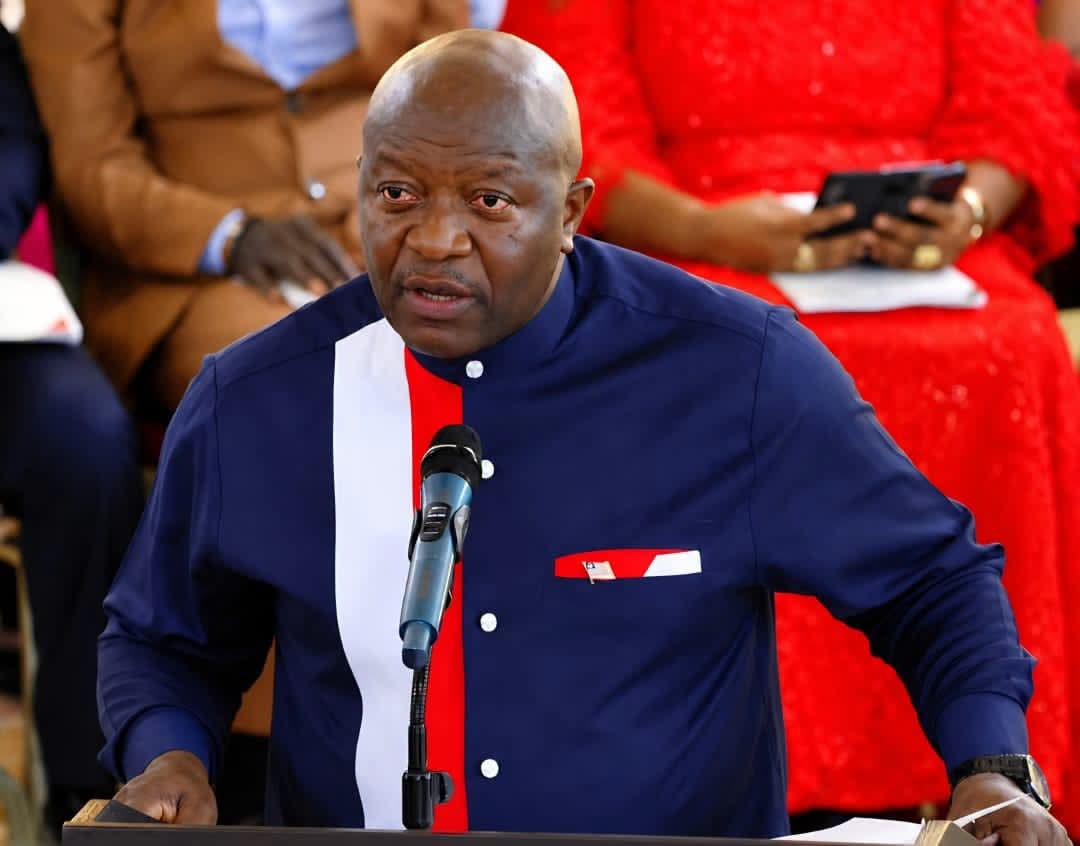
Oration delivered by
Hon. Augustine Kpehe Ngafuan
Minister of Finance and Development Planning
Republic of Liberia
On the Occasion of the 179th Anniversary of National Flag Day
August 24, 2026
His Excellency the President of the Republic of Liberia;
The Honorable Vice President of the Republic of Liberia;
The Honorable Speaker and Members of the House of Representatives;
The Honorable President Pro Tempore and Members of the Liberian Senate;
His Honor the Chief Justice and Members of the Judiciary;
Former Officials of Government,
The Dean and Members of the Cabinet and other officials of Government;
The Doyen and Members of the Diplomatic and Consular Corps;
Traditional and Religious Leaders;
Members of our Armed Forces and National Security Institutions;
Our Teachers and Students;
Members of the Fourth Estate;
Distinguished Guests;
Fellow Liberians at home and throughout the Diaspora;
Ladies and Gentlemen:
I am deeply honored to stand before you on this historic occasion as we commemorate the 179th anniversary of Liberia’s National Flag Day under the inspiring theme:
“From Heritage to Hope: The Flag That Unites Us.”
Today, we gather not merely to celebrate a national symbol. We gather to reflect upon who we are, where we have come from, what binds us together, and—perhaps most importantly—where we intend to go as one people and one Republic.
Our flag is cloth, but it is more than cloth. It is color, but it is more than color. It is history, but it must also be hope. It is a reminder of yesterday, a symbol of our common identity today, and a solemn promise to the generations of tomorrow.
FROM HERITAGE
One hundred and seventy-nine years ago, our forebears gave this Republic a flag to represent the aspirations of a newly independent African nation.
Eleven alternating red and white stripes and a lone white star resting upon a field of blue became the emblem under which generations of Liberians would live, struggle, celebrate, mourn, disagree, reconcile, rebuild, and dream.
That flag has witnessed our finest hours. It has also witnessed our darkest days.
It has flown in times of peace and conflict. It has been raised at inaugurations and lowered in mourning. It has accompanied our men and women in uniform and flown above our schools, public buildings, diplomatic missions, and international gatherings.
Through political transitions; through a brutal civil war that destroyed infrastructure and took countless lives; through public-health emergencies such as Ebola and COVID; through economic downturns and the difficult work of national reconstruction, the Lone Star has continued to fly high over land and over sea.
Distinguished Ladies and Gentlemen:
As I mount this hallowed podium on this National Flag Day, my mind’s eye races back through time, capturing vivid scenes from my distant past.
I see myself on August 24, 1978, a first grader at Bolahun Public School in Wawoma Clan, Kolahun District, Lofa County, proudly dressed in my school uniform—a white shirt and green short trousers—marching alongside my fellow first graders behind the students in the higher classes. Hundreds of students from village schools across the Clan have also converged on Bolahun for the grand Flag Day parade.
The entire clan has practically descended upon the town. Parents, relatives, friends, and well-wishers throng the streets, or more precisely paths, to witness the beautiful spectacle of schoolchildren marching proudly toward the designated point to salute our red, white, and blue flag.
I can still hear the cheers.
As each drill commander approaches the designated line and gives the salute, the crowd erupts in applause and laughter.
Those moments brought the entire town alive.
For us as children, National Flag Day was never merely a day to salute the flag. It was a day of celebration and fun—a day when students felt especially proud to be in school and parents experienced the joy of watching their children march with excitement and confidence.
Nearly five decades later, those memories remain vivid.
That little first grader marching through Bolahun in 1978—the little boy who would later return to Monrovia and continue his schooling in Logan Town, Jamaica Road, Kakata, and other places—could not have imagined that one day he would stand before his country as National Flag Day Orator, called upon to reflect on the meaning of the very flag he once marched so proudly to salute.
But that possibility should never be unique to one person.
It should be part of the Liberian promise available to every child.
Every Liberian child should be able to look at the Lone Star and say:
My country sees me. The circumstances of my birth do not determine the boundaries of my possibilities.
My dreams matter.
That is the Liberia we must build.
THE FLAG THAT UNITES US
My fellow Liberians:
If the flag belongs to all of us, then loyalty to that flag requires us to seek the common good.
But unity does not mean uniformity.
Indeed, look at what we witnessed during today’s parade: students dressed in different uniforms, coming from different schools, marching in different formations—but all saluting one flag.
There is a lesson for Liberia in that image.
We too may wear different political uniforms. We may come from different counties. We may belong to different tribes, religions, professions, associations, and social groups. We may disagree passionately about policies, personalities, and the direction of our country.
But above all those uniforms flies one flag.
We can disagree and still be Liberians.
And as I said in 2010 at the induction of officers of the Federation of Lofa Associations in the Americas (FLAA):
“Our individual counties exist within a country called Liberia, and while we have our individual county flags that belong to some of us, we have a single national flag that belongs to all of us. So, our county-centricity must never conflict with or undermine our country-centricity.”
Today I would add:
Our party-centricity must never undermine our country-centricity.
There must always be something above everything else.
That something is Liberia.
LET US INDIVIDUATE
We must resist the temptation to stereotype one another negatively because of political, county, tribal, religious, or other associations.
There is nothing wrong with loving the group to which we belong. But while loving our own group, we must recognize that other Liberians have an equal right to love theirs.
Our membership in one group does not make everyone in our group good.
Membership in another group does not automatically make someone else bad.
Every county, tribe, religion, or political party has its good, its bad, its ugly.
Every government has its good, its bad, its ugly.
The media has its good, its bad, its ugly.
The same is true of civil society, religious institutions, the business community, and every other human institution.
Why?
Because institutions are populated by imperfect human beings.
So let us individuate.
Let us assess each Liberian primarily by who that person is, what that person does, the values that person demonstrates, and what that person contributes to the common good.
Being outside government does not automatically confer sainthood on anyone, except if we fall for that feeble argument that the environment outside government is a paradise populated only by angels and cherubim.
Conversely, being in government does not automatically make a person bad, except again if we surrender to the warped argument that government by nature is an evil construct populated only by demons.
There are Liberians outside government who protect the flag every day through their service to country. And there are legions of Liberians in government working diligently and patriotically for the forward march of our nation.
The location of a person matters less than the character and patriotism of the person.
PATRIOTISM MUST BECOME PRACTICE
Distinguished Ladies and Gentlemen:
In recent years, the celebration of our nation’s Independence Day has taken on a remarkable new momentum. Liberians at home and across the Diaspora are increasingly adorning themselves in our national colors and celebrating Liberia with a passion, pride, and enthusiasm perhaps greater than we have witnessed in generations.
It is as though Liberians are falling in love with their country all over again—renewing their marital vows to our beloved Liberia in symbolic ceremonies of national recommitment taking place across the world every Independence Day.
This growing spirit of patriotism is a beautiful and encouraging phenomenon. It must be nurtured and sustained. Whatever we have done—as a people and as a government—to inspire this renewed affection for Liberia, we must continue to do, and do even better.
But it is easy to dress in national colors.
It is easy to sing the national anthem.
It is easy to wave the flag.
The harder task is to live by what the flag demands of us.
The raising of the flag and the singing of the national anthem should not merely make us teary-eyed. They should extract from us a commitment to take practical actions in the interest of our country.
Patriotism is not only what we say about Liberia. Patriotism is what we do for Liberia.
A public official who protects public resources is raising the flag.
A teacher who enters the classroom prepared to educate the next generation is raising the flag.
A nurse or doctor who faithfully cares for patients is raising the flag.
A member of our joint security forces who resists the tempting overtures of drug cartels and enforces the law regardless of name, status, wealth, or connections is raising the flag.
A businessperson who pays legitimate taxes and treats workers fairly is raising the flag.
A journalist who pursues truth responsibly is raising the flag.
A citizen who refuses corruption even when nobody is watching is raising the flag.
A young Liberian who chooses education, hard work, creativity, entrepreneurship, and service over despair is raising the flag.
The flag, therefore, should inspire more than emotion.
It should inspire responsibility.
Because love of country without responsibility to country is incomplete.
THE FLAG IN THE OFFICE
This responsibility has particular meaning for those entrusted with public office.
When the President, Vice President and other public officials assume office, they take an oath solemnly pledging allegiance to the Republic and undertaking to uphold its Constitution and laws.
That is why the flag is hoisted on all public buildings. That is why the flag is in the offices of public officials.
It is not merely decoration.
The flag represents millions of Liberians at home and throughout the Diaspora. Its presence should remind every public official that a government office is not a private space for advancing personal interests at the expense of the common good.
In a sense, every day that flag in a public office speaks silently to the official seated beside it, saying:
Liberia and Liberians are right here with you.
Liberia is watching you. Liberia is counting on you.
So, think Liberia. Love Liberia. Build Liberia.
THE LIBERIAN ENTERPRISE AND THE RESPONSIBILITY OF LEADERSHIP
Distinguished Ladies and Gentlemen:
Our country is like a common enterprise in which every citizen is a shareholder.
Those privileged to occupy public office do not possess a greater ownership share in Liberia. On election day, the President in the Executive Mansion or a fisherman in West Point, is entitled to one ballot—not two, not three—one.
Public office therefore does not increase one’s ownership of Liberia. It increases one’s responsibility to Liberia.
And leadership itself extends far beyond public office. Responsibility for country rests on the shoulders of every Liberian, especially those who can rightly be called Liberian leaders. And I use the phrase “Liberian leaders” broadly.
A Liberian leader is anyone whose position or influence can shape the thinking, behavior, and direction of other Liberians—for better or for worse.
Pastors and imams are Liberian leaders because congregations look to them for moral direction.
Principals and teachers are Liberian leaders because they shape impressionable minds.
Political party leaders are Liberian leaders because thousands take cues from their words and actions.
Talk-show hosts, panelists, editors, reporters, bloggers, and influencers are Liberian leaders because they influence what citizens believe to be true or false.
Business leaders, market association leaders, motorcyclist union leaders, trade union leaders, health professionals, sports leaders, community leaders—all exercise influence.
And influence creates responsibility.
A microphone creates responsibility.
A pulpit creates responsibility.
A classroom creates responsibility.
A political platform creates responsibility.
A social-media following creates responsibility.
Wherever influence exists, responsibility follows.
THE TRAGEDY OF THE COMMONS
There is, however, a danger that comes with common ownership.
Sometimes, because Liberia belongs to all of us, we behave as though Liberia belongs to none of us.
Economists describe a related phenomenon as the “tragedy of the commons”—when individuals pursue narrow private interests in ways that ultimately undermine the collective interest.
We say we want clean cities, yet some of us throw garbage from a moving vehicle.
We say Liberia needs a bigger national budget, yet some of us deliberately evade legitimate taxes.
We say we want a crime-free society, but when a friend or relative is lawfully apprehended, some of us demand that the police abandon the law.
We demand accountability from public officials, but excuse wrongdoing when the wrongdoer belongs to our party, county, tribe, church, family, or circle of friends.
That is how the common good is weakened.
Protecting the flag means understanding that what belongs to all of us must be protected by each of us.
FROM HERITAGE TO HOPE
My fellow Liberians:
The theme of today’s celebration does not stop at heritage.
It calls us from heritage to hope.
Heritage tells us where we came from.
Hope tells us where we can go.
But hope cannot simply be a wish.
National hope must be constructed.
It must be planned.
It must be financed.
It must be protected by strong institutions.
It must be powered by discipline, sacrifice, hard work, innovation, and what I call our thinking equity.
Our national development agenda—the ARREST Agenda for Inclusive Development—is therefore an instrument of hope.
Not empty hope.
Not wishful hope.
But hope translated into plans; plans translated into projects; and projects translated into measurable improvements in the lives of our people.
DEVELOPMENT AS A NATIONAL UNITER
Distinguished Ladies and Gentlemen:
The Government of President Joseph Nyuma Boakai inherited enormous challenges. But we are not content merely to curse the darkness.
We are lighting candles. We are lifting the flag.
And based on what we are doing, I can now confidently say that this generation of Liberians will in few years be able to drive on paved roads from Monrovia to Harper and from Gbarnga through Zorzor, Voinjama, Kolahun, and Foya toward Mendikorma on the Sierra Leone border, things that previous generations of Liberians since the nation’s founding could only dream of.
We are working to expand reliable electricity, improve schools and healthcare, strengthen institutions, create jobs and opportunities, and connect communities that for too long have remained isolated from the full promise of national development.
Why?
Because one of the most effective ways to unite a country is to develop the country.
The roads we are paving do not ask the political party of the persons travelling on them.
The electricity we are expanding in Monrovia, in Buchanan, in Voinjama and across the country does not ask the tribe of the child studying beneath its light.
The hospitals we are improving or the ones we are building will not ask the county of the patient seeking treatment.
The schools we are equipping, rehabilitating or constructing, including the more than 100 schools for foundational learning that we are about to rehabilitate or construct, will not ask whether a child’s parents voted for the government or the opposition.
Development, when it is inclusive, is one of the most powerful expressions of national unity.
A road connecting two counties connects more than geography—it connects people, markets, opportunities, and hopes.
Electricity reaching a community does more than illuminate houses—it expands possibilities.
A functioning school does more than educate a child—it strengthens the future of the Republic.
This is how we move from heritage to hope.
Under the leadership of President Joseph Nyuma Boakai, our government is working with urgency to expand the fiscal space necessary to finance the ever-growing ambitions of our people.
When some critics and cynics considered a billion-dollar national budget a distant and unrealistic aspiration, we chose to pursue the difficult work of expanding domestic revenue and strengthening fiscal capacity. And sometime in September this, we shall hit the historic billion-dollar mark, the first time since the founding of our country.
But a bigger budget is not an end in itself.
Its meaning lies in what it makes possible:
- More roads.
- More electricity.
- Better schools.
- Stronger healthcare.
- More jobs and opportunities.
- Stronger institutions.
- And measurable improvements in the lives of our people.
That is the standard by which development must ultimately be judged.
COMPETITION WITHOUT HATRED
But development alone cannot unite a nation if our politics continually tears it apart.
We can compete politically without hating one another.
We can disagree without becoming enemies.
We can seek victory without requiring another Liberian’s destruction.
There is a dangerous form of politics that treats national life as a zero-sum game: for me to live, you must die; for me to rise, you must fall; for me to succeed, you must fail.
We must reject that mindset.
Some may consider such a position naïve or non-Machiavellian.
But we should never become comfortable acquiring our joy through the pain of others or celebrating our advancement through the destruction of others.
We can be competitive without being cruel.
We can succeed without destroying.
We can win without hatred.
A person’s political opponent is not a person’s political enemy. After all, the position or office in contention is not the personal property of political contenders. It is for the Liberian people.
When hatred becomes the organizing principle of politics, eventually everybody loses.
OUR SHARED PATRIOTIC COVENANT
Perhaps one of the challenges of our national life is that we have become very clear about what separates us but insufficiently clear about the minimum values that must unite us.
Liberia needs a minimum Patriotic Covenant—a set of irreducible national values to which government and opposition, Christian and Muslim, young and old, rich and poor can subscribe.
Let that covenant affirm:
- That Liberia comes first.
- That political power must be pursued peacefully.
- That public resources belong to the people.
- That corruption is wrong regardless of who commits it.
- That truth matters.
- That our differences must never justify hatred.
- That the Constitution and the rule of law must prevail over personalities.
- That no political victory is worth destroying Liberia.
- And that every generation, in the spirit of intergenerational equity, has a duty to leave the Republic stronger than it inherited it.
These should not be government values or opposition values.
They should be Liberian values.
PEACE MUST NEVER BE TAKEN FOR GRANTED
Distinguished Ladies and Gentlemen:
Our history has taught us a costly lesson:
Division can destroy in a few years what generations labor to build.
Peace, therefore, must never be taken for granted.
We must guard it.
We must nurture our democracy.
We must strengthen the rule of law.
And we must ensure that our words—whether spoken from political platforms, radio stations, pulpits, community meetings, or posted online—do not reopen wounds that our nation has struggled so hard to heal.
Words matter.
A microphone can educate or inflame.
A radio program can inform or divide.
A political platform can inspire or incite.
A social-media post can build bridges or deepen fractures.
Our children deserve to inherit our progress.
Not our divisions.
Not our hatred.
Not our anger.
WHAT SHOULD THE FLAG SEE?
We often ask what do we see when we look at the flag.
Today, let us reverse the question.
If the flag could look back at us, what would it see?
Would it see citizens committed to building their country?
Would it see leaders placing national interest above personal interest?
Would it see young people equipped with knowledge, skills, and opportunity?
Would it see political opponents who disagree without hatred?
Would it see communities living peacefully despite their differences?
Would it see public resources being transformed into roads, schools, hospitals, electricity, jobs, and opportunity?
Would it see integrity becoming stronger day by day?
Would it see hope becoming stronger than despair?
Those questions cannot be answered by this speech.
They will be answered by our actions.
CONCLUSION: THE FLAG WE MUST LIVE
My fellow Liberians:
The flag we celebrate today came to us from history.
The Liberia beneath which it will fly tomorrow is ours to build.
That is the journey from heritage to hope.
And wherever the Lone Star flies, let every Liberian remember:
This is our heritage.
This is our hope.
This is our home.
This is our Liberia.
But let us also remember:
The flag cannot raise itself.
We raise the flag when we raise our standards.
We raise the flag when we raise our integrity.
We raise the flag when we raise our children with knowledge, discipline, and hope.
We raise the flag when we raise one another.
And we raise the flag highest when we put country above self.
So let us leave this celebration determined not merely to wave the flag, but to live the flag.
Not merely to salute Liberia, but to serve Liberia.
Not merely to hope for a better Liberia, but to build one.
May the Lone Star forever unite us.
May peace remain within our borders.
May hope rise in every Liberian heart.
And may Almighty God continue to bless the Republic of Liberia and save the State.
Happy 179th National Flag Day!
Long live the Lone Star!
Long live the Republic of Liberia!
I thank you.
See more Liberia News Network stories in Google Search by adding LNN as one of your Preferred Sources.
★ Add LNN as a Preferred Source