
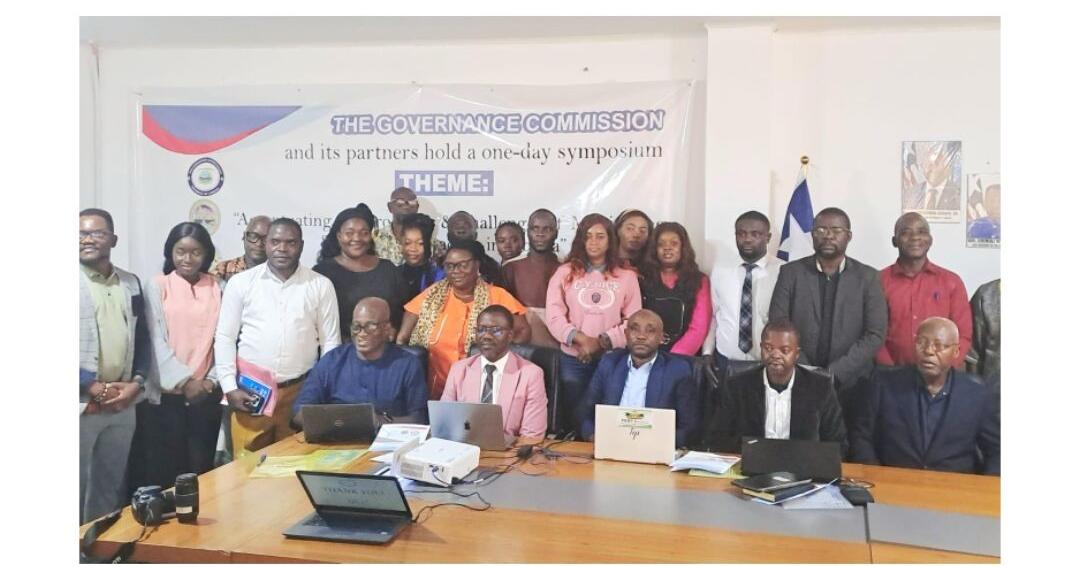
The Governance Commission (GC) has intensified efforts to establish a unified national Monitoring and Evaluation (M&E) framework, bringing together government institutions, development partners, and governance stakeholders to identify opportunities and address longstanding challenges affecting Liberia’s monitoring and evaluation system.
The one-day national symposium, held on wednesday, june 23, 2026, under the theme, “Accentuating the Prospects and Challenges of M&E Practice in Liberia,” focused on strengthening institutional coordination, improving data quality, promoting accountability, and ensuring that public resources deliver measurable results for citizens.
The symposium comes amid growing concerns over fragmented monitoring systems, weak institutional coordination, and increasing pressure to demonstrate the impact of government programs in an era of limited financial resources and declining donor support.
Delivering the special statement, Acting Chairman of the Governance Commission, Prof. Alaric K. Tokpa, called on participants to provide practical recommendations that would guide the development of a single national Monitoring and Evaluation framework capable of serving successive governments and development partners.
“We need one national M&E framework that we all can validate and subscribe to,” Prof. Tokpa said, noting that the Commission has already engaged the Ministry of Finance and Development Planning, the Legislature, and other key stakeholders in advancing the initiative.
According to him, an effective national M&E system is essential for measuring transparency, efficiency, accountability, and the real impact of government interventions on citizens’ lives.
“When we engage in governance processes, particularly in an era of decentralization, we want to monitor and evaluate effectiveness, transparency, efficiency, and accountability. But beyond that, we also want to see the degree of change and the impact interventions are making in the lives of our people,” he stated.
Prof. Tokpa warned that without proper coordination among public institutions, Liberia risks duplicating efforts and wasting scarce resources on overlapping activities.
He stressed that the proposed framework should become a national development tool that transcends political administrations while remaining flexible enough to evolve through periodic reviews and improvements.
Also speaking at the symposium, Liberia Anti-Corruption Commission (LACC) Commissioner for Monitoring and Evaluation, Dr. Miatta Jeh, described Monitoring and Evaluation as a cornerstone of good governance and effective public service delivery.
She said strong M&E systems enable institutions to measure results, identify implementation challenges, and make evidence-based decisions that improve governance outcomes.
“Monitoring and Evaluation plays a vital role in strengthening governance, improving public service delivery, and ensuring that public resources are used responsibly,” Dr. Jeh said.
While acknowledging Liberia’s progress in promoting accountability and results-based management, she observed that significant challenges remain, including weak institutional capacity, inadequate data systems, and poor coordination among stakeholders.
She emphasized that strengthening coordination, improving the reliability of national data, and fostering a culture where performance and results matter are critical to improving transparency and reducing corruption risks.
“For the LACC, effective M&E is a tool for enhancing transparency, identifying corruption risks, and supporting evidence-based decision-making. Strong systems ultimately help build public trust and improve governance outcomes,” she added.
Representing the United Nations Development Programme (UNDP), Monitoring and Evaluation Specialist Amara N.M. Kanneh underscored the growing importance of evidence-based planning at a time when development financing has become increasingly constrained.
Amara N.M. Kanneh on behalf of the UNDP Resident Representative, Mr. Aliou Mamadou Diak, Kanneh praised the Governance Commission for leading what he described as one of Liberia’s most significant initiatives toward strengthening national development planning.
He observed that although governments and development partners continue to invest significant resources in development programs, Liberia has often struggled to adequately measure and demonstrate the impact of those investments.
“We have made investments in development activities, but it remains a challenge to account for the overall impact of the resources invested,” Kanneh noted.
He said dwindling donor funding and increasing demands for accountability make it imperative for Liberia to maximize every available resource through effective monitoring and evaluation.
“It is no longer about implementing activities. It is about the results those activities produce. Monitoring and Evaluation should never be an afterthought. Once you fail to plan, you plan to fail, and anything that is not reported is not done,” he emphasized.
Kanneh further advocated for a transition from traditional activity-based monitoring to results- and evidence-based Monitoring and Evaluation capable of demonstrating measurable development outcomes.
Earlier, Governance Commission Program Manager for Monitoring, Evaluation, Research and Publication (MERP), McNeil Mani Wilson, presented an overview of the draft National Monitoring and Evaluation Policy, explaining that the proposed framework seeks to consolidate Liberia’s currently fragmented M&E practices into a coordinated national system.
Wilson explained that the draft policy, developed in collaboration with the Ministry of Finance and Development Planning and other stakeholders, is currently undergoing stakeholder validation before its official launch.
According to him, the policy is intended to ensure that all government institutions and development partners operate under one coordinated Monitoring and Evaluation framework, thereby enhancing accountability, improving planning, and promoting value for money.
He noted that under the proposed arrangement, the Ministry of Finance and Development Planning will continue monitoring project inputs, outputs, and outcomes, while the Governance Commission will focus on assessing long-term governance impacts and policy effectiveness.
“The Governance Commission looks at the impact of change. We want to know whether government interventions are improving the lives of Liberian citizens in the way they desire. If not, we can recommend policy changes to achieve those desired outcomes,” Wilson explained.
The symposium concluded with renewed calls for stronger collaboration among government institutions, development partners, civil society organizations, and policy experts to finalize and operationalize Liberia’s National Monitoring and Evaluation Policy.
Participants expressed optimism that a unified national M&E framework would strengthen evidence-based governance, improve accountability, enhance resource utilization, and ultimately ensure that development interventions produce tangible improvements in the lives of Liberians.
