
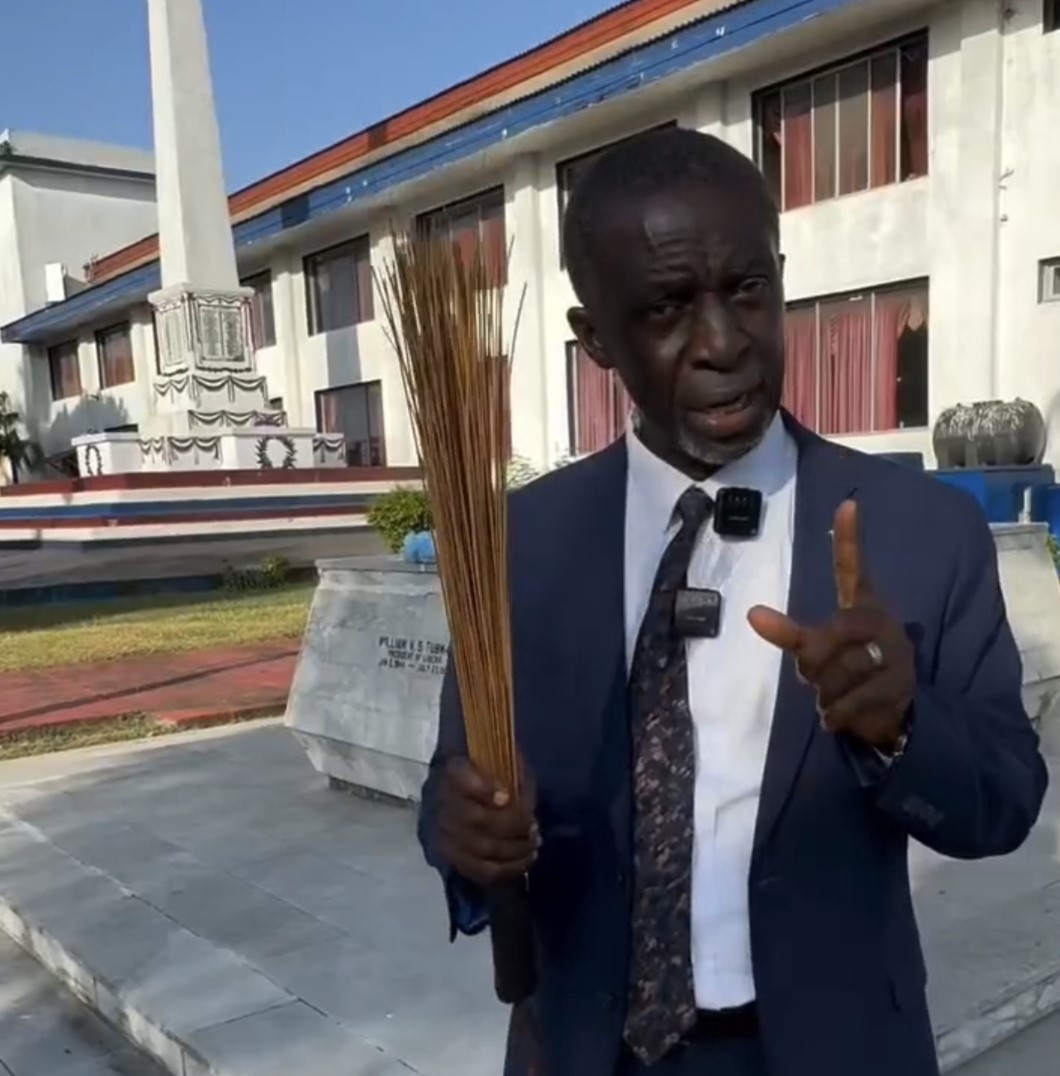
MONROVIA – The Political Leader of the Liberian People’s Party (LPP), Tiawan Saye Gongloe, has issued a sweeping and strongly worded ultimatum to President Joseph Nyuma Boakai, warning that he will mobilize a campaign for the President’s impeachment if decisive steps are not taken to investigate and resolve the growing border tensions between Liberia and Guinea.
Gongloe delivered the ultimatum when he spoke on a podcast last week at the historic Centennial Pavilion and the Providence Baptist Church, carried both symbolic and political weight as he invoked Liberia’s founding legacy while sounding the alarm over what he described as a potentially dangerous dispute along the Makona River that borders Liberia and Guinea.
“Today I have chosen this shrine of Liberia, the sanctity of the Centennial Pavilion and the Providence Baptist Church where the Constitution of Liberia was drafted and adopted, to speak to the Liberian people, but more to speak to President Joseph Nyuma Boakai,” Gongloe declared at the outset of his statement.
Impeachment Warning and Call for Investigation
At the heart of Gongloe’s statement was a direct challenge to the President to act swiftly and transparently.
“And so, I am calling upon President Boakai, standing in this shrine of Liberia, the Centennial Pavilion, the grave of President Tubman, and the Providence Baptist Church where our Constitution was drafted and adopted, for him to launch a serious investigation,” he said.
Gongloe insisted that any individuals found culpable—regardless of rank—must face the full weight of the law.
“Anybody who is found to have violated this international law that brought Guinea and Liberia nearly to war, to be held accountable. If it is a minister in his government, that minister should be dismissed. If it is someone in the other branch of government, that person should be prosecuted.”
He did not mince words in characterizing the alleged actions that may have triggered the dispute:
“It was an act of treason, something that will undermine the sovereignty of Liberia.”
The LPPP political leader escalated his warning further, tying presidential inaction directly to political consequences.
“If President Boakai does not do it, then he’s complicit, and I will launch a campaign for his impeachment. I am very serious about it.”
He continued: “We will not allow anybody to undermine the stability of Liberia. We have not even recovered from the effects of the war. We are still trying to rebuild our country, and for greed of some people, they want to put us in trouble for no other reason but for their pockets.”
Allegations of Illegal Mining
Gongloe pointed to what he described as unofficial but troubling reports suggesting that illicit mining activities in the border area may have sparked the confrontation.
“But I hear some Liberians saying that the way Guinea came to the border, yes, Guinea may have overreacted. But what was the cause? The cause that we have heard unofficially is that some people in this government were mining gold and diamonds in that water.”
He stressed that such actions would violate international norms governing shared natural resources.
“It’s a violation of international law. When there is a river, stream, any water between two states, for you to carry on that kind of mining operation, it has to meet the consent of the other country. It is a violation of our law.”
Historical Reflection and Warning Against Conflict
In a significant portion of his address, Gongloe drew on Liberia’s diplomatic history, particularly the leadership of former President William V. S. Tubman, to underscore the importance of peace with Guinea.
“I am standing by the grave of President Tubman, the man who prevented war between Liberia and Guinea right at the beginning of the independence of Guinea,” he said.
He recounted a detailed historical narrative involving France’s post-colonial tensions with Guinea under Ahmed Sékou Touré.
“President Tubman was influenced by the French. The French offered air support, naval support, and their military hardware for President Tubman to fight for territories that were lost to French Guinea during the colonial period after independence.”
“They came to President Tubman and said, ‘We can help you to acquire all of your land that we took from you in Guinea because President Sekou Toure has driven us from Guinea.’”
Gongloe further emphasized Tubman’s refusal to engage in war. “President Tubman said, ‘You have given it to our brother, and I can tell you that I, as President of Liberia, will not allow one ounce of any African blood, Guinean blood, or Liberian blood to be wasted for the land that you took away from us.”
He further recounted how Liberia supported Guinea during a period of economic blockade. “Since there is a naval blockade on you, you can get all of your goods through the Freeport of Monrovia.”
Gongloe explained that this history was relayed to him during a diplomatic mission in 1992. “I heard this story from Foreign Minister Sylla in 1992 when I was sent to see President Conteh as a Special Envoy of President Amos C. Sawyer.”
“He said, ‘Mr. Gongloe, go and tell President Sawyer not to worry. Even if all of the ECOMOG troops leave Liberia, Guinea can never leave Liberia because Guinea owes a debt of gratitude to Liberia that Guinea will never be able to pay.’”
Based on this shared history, Gongloe expressed confidence that outright war should be avoidable.
“So, I strongly believe that Guinea and Liberia will never fight.”
Criticism of Governance and Renewed Threat
Despite that optimism, Gongloe warned that internal misconduct could jeopardize peace.
“Government is meant for service to the people. It is not meant to fill pockets. I have always said that government is a place to serve, not to steal.”
He reiterated his readiness to support any credible inquiry. “Even if he wants to put me on that special commission to investigate, I am prepared to reach to the bottom of this. It’s a national duty.”
However, he ended with a stark warning to the Boakai administration. “He had better not fail. If he fails, then he’s part of the deal. We will hold him accountable, and then we will launch a campaign for his impeachment.”
“This is my message to President Boakai, seeking the support of the Liberian people.”
Gongloe also stressed that Liberia’s history has not been marked by border conflicts, making the current situation particularly troubling.
“We have never had conflict with any of our borders. It did not happen under Doe, it did not happen under Taylor, and it did not happen even with the rebel factions during the war.”
“It cannot happen under the government that the Liberian people expected to display the highest degree of maturity in governance.”
Ongoing Diplomatic Efforts
The Liberian government, through diplomatic channels and security agencies, has reportedly initiated engagements with Guinean authorities aimed at de-escalating tensions. These efforts include bilateral discussions and confidence-building measures to prevent further military posturing along the border.
Regional mechanisms, including ECOWAS protocols on conflict prevention, are also expected to play a role in mediation, although no formal intervention has yet been publicly confirmed.
Government officials have reiterated Liberia’s commitment to peaceful resolution and respect for international law while urging citizens to remain calm.
As the situation unfolds, Gongloe’s forceful intervention has amplified national attention on the crisis, placing pressure squarely on the Boakai administration to act swiftly, transparently, and decisively to prevent a dispute that many fear could spiral into a broader conflict if left unresolved.
