
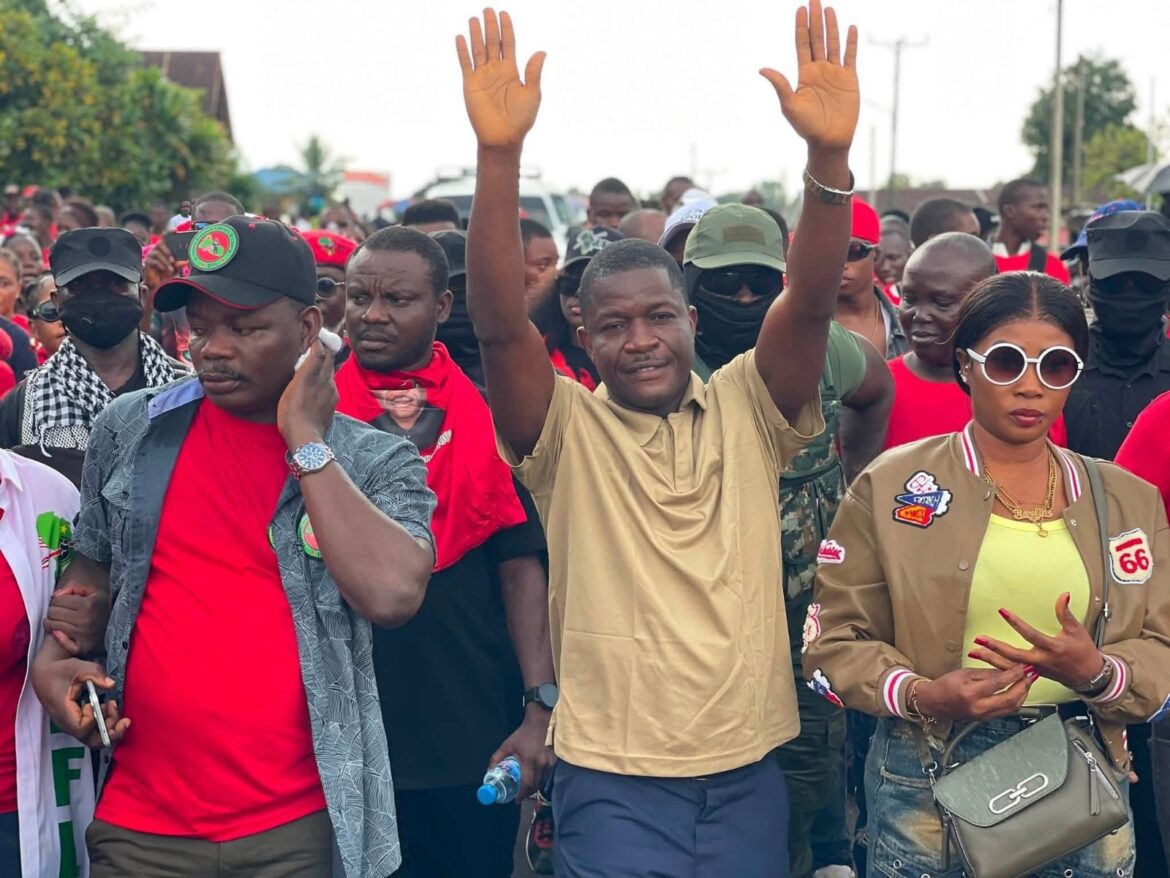
KAKATA, MARGIBI COUNTY — The political landscape in Liberia is shifting dramatically as Emmanuel D. Gonquoi, the political leader of the Economic Freedom Fighters of Liberia (EFFL), has declared his intention to run in the 2029 general elections.
This announcement raises major questions about the future of his long-standing alliance with President Joseph Nyuma Boakai and the ruling Unity Party.
During a youth dance competition hosted by the EFFL in Kakata, Margibi County on Saturday, Gonquoi made a bold statement about his plans for the upcoming elections.
Howbeit, one important detail was notably missing from his announcement: Gonquoi did not specify which position he aims to contest.
This omission has left many Liberians wondering whether he is gearing up for a presidential run, a legislative seat, or another political role.
His official Facebook post following the event hinted that his declaration was serious and far from casual.
“Thank you, Margibi County, and yes! I will be on the ballot,” Gonquoi wrote, acknowledging the potential controversy his announcement might stir.
“I knew very well that by saying I will be on the ballot, the take away from our historic arrival would have been huge and controversial,” he continued.
He then shared a message that could have lasting implications beyond the event in Kakata: “Keep talking, but we are moving forward. We want to build a powerful political organization that will live with our people forever!”
He then added with an unmistakable statement of ambitions: “Hate or like us, but certainly we will govern Liberia.”
For a political leader whose movement played a significant role in Boakai’s rise to the presidency in 2023, these words imply much more than just the EFFL’s meeting in Margibi.
They indicate that Gonquoi desires his party to be evaluated not just on its capacity to rally supporters for another candidate, but on its willingness to pursue governing authority independently.
In Liberia’s ever more competitive political landscape, this distinction could prove to be crucial.
From political ally to potential contender
Gonquoi’s announcement comes amid a political relationship that has already faced significant challenges.
In August 2023, the EFFL publicly backed Boakai’s presidential bid under the Unity Party’s “Rescue Mission,” opting to support the former vice president rather than fielding its own candidate in that election.
This endorsement was part of a broader opposition initiative that ultimately helped Boakai gain power.
Howbeit, this decision also left the EFFL without its own presidential mandate, making its ongoing relationship with the ruling establishment a crucial test of its political autonomy.
Since Boakai took office, Gonquoi has increasingly expressed frustration over what he sees as the sidelining of the political forces that aided the president’s ascent.
In June 2025, he accused the Unity Party of not meeting expectations and cautioned that the political movement that helped elevate the governing party could also be instrumental in its downfall.
By August 2026, the EFFL leader was openly lamenting that the avenues for consultation between the Unity Party Alliance and the presidency had vanished post-election.
He also cautioned against the assumption that Boakai’s political allies would automatically back a second term.
Given this context, Gonquoi’s recent announcement signifies more than just a commitment to participate in elections; it suggests that the EFFL is eager to carve out a political identity that isn’t solely reliant on the Unity Party’s fortunes.
Whether this marks a clear break with Boakai, a strategic move to renegotiate the terms of their alliance, or the start of an independent electoral campaign, remains uncertain.
Gonquoi hasn’t stated that he is leaving the governing alliance, nor has he clearly announced his candidacy for president.
However, his strong assertion that the EFFL will lead Liberia brings the issue of political independence back into the spotlight on the national agenda.
‘We are not going to stop at the grasscutter’
The emotional impact of Gonquoi’s appearance at Kakata was rooted not just in his electoral announcement but also in the personal journey he shared with his audience.
Speaking to supporters, young people, traditional leaders, religious figures, and members of his party, he aimed to link his political aspirations to a narrative of struggle, resilience, and progress.
He reminded the crowd of his days as a rubber tapper at the Firestone plantation, detailing how he faced challenges in covering basic educational costs and relied on the generosity of others to pursue his studies.
He reminisced about a time at the Booker Washington Institute when he couldn’t afford a meal that cost only 25 Liberian dollars.
He also shared stories of doing manual labor, like hauling planks, to earn money for school.
For Gonquoi, these experiences were more than just memories of hardship; they formed the basis of a political narrative where personal challenges illustrate the potential for national change.
“Your today condition should not determine your future,” he told the youth, emphasizing that they should not give in to poverty or let tough circumstances undermine their self-belief.
“A few years ago, I was a tapper in the Firestone plantation. Today, I am a national political leader to be reckoned with in the future,” he declared.
Thus, his speech blended two powerful messages: an uplifting call to young Liberians facing poverty and a political assertion that the existing leadership should pave the way for a new generation.
Gonquoi showcased himself as proof that leadership can arise from communities that have often been sidelined from power.
He then broadened this personal narrative into a larger assertion regarding the political future of Margibi County and the national aspirations of the EFFL, arguing that the movement should not be evaluated solely based on its past electoral failures.
“Because we went to the forest to hunt and we missed the grasscutter, it does not stop me and the EFFL from pursuing a bigger dream and mission,” he stated.
Gonquoi’s use of the metaphor was clear: past challenges, regardless of their form, would not dissuade the party from aiming for a more ambitious goal.
For a movement that backed another party’s presidential candidate in 2023, this statement could be seen as a commitment that its next major electoral effort will yield different results.
The presidential question hanging over Kakata
One of the most captivating aspects of Gonquoi’s speech was how he recognized public expectations without explicitly naming the office he plans to run for.
He informed the audience that many had expected his visit to Margibi to end with a declaration of his political ambitions.
“Today, we are here not to declare our intention for any public office. We are here to say thank you, Margibi,” he initially stated.
Howbeit, later in his address, he added, “I will be on the ballot in 2029.” He went on to reveal that he would announce the specific office he intends to pursue at a future event at the Antoinette Tubman Stadium in Monrovia.
“Next year, the position I will be declaring for, I will do that at the Antoinette Tubman Stadium. We are going to the ATS to declare our intention for the position we want,” he said.
This announcement creates a clear distinction between intention and declaration. Gonquoi has committed to being on the ballot, yet he has not specified the contest through which he aims to fulfill his political goals.
A presidential run would be the most significant interpretation of his comments, placing him directly in the race to lead the country and potentially positioning the EFFL as a viable alternative to both the ruling Unity Party and other established political entities.
A legislative bid, on the other hand, could enable Gonquoi to seek a seat in the Legislature while simultaneously strengthening his party’s national organization in preparation for upcoming presidential elections. At this point, neither option can be considered certain.
Howbeit, his commitment to reveal his intended office at a prominent venue in Monrovia, along with his self-description as a leader whose presence in Kakata seemed “much more presidential,” is likely to heighten speculation regarding his ultimate ambitions.
The political importance lies not in an unannounced presidential run, but in the intentional buildup of anticipation surrounding a future electoral choice.
Margibi’s grievances and a warning to the establishment
Gonquoi took the opportunity at the Kakata gathering to send a strong message to the political leaders of Margibi County, highlighting the broader implications for the nation.
He raised concerns about the county’s representation in the Boakai administration, pointing out that Margibi had provided significant electoral support to the president yet felt it had not received adequate representation in key government roles.
“Margibi gave Boakai nearly 70 percent of the total vote,” he stated, questioning how many individuals from the county hold positions as ministers, directors, or heads of government agencies.
His main point was that ordinary citizens should not be left behind while local political elites vie for power and influence.
He criticized some long-standing politicians for prioritizing their personal ambitions over the collective good of the county and called for an end to divisive politics.
“Margibi, think bigger. You cannot continue to fight yourself,” he urged.
He also highlighted the county’s ethnic diversity, mentioning various communities in Liberia as he advocated for unity and denounced what he termed tribal politics.
The comments aimed to elevate a local issue into a wider political statement: counties should not just provide votes during national elections; they should also have a meaningful voice in decisions about governance and representation.
For the Unity Party, this message poses a potentially tricky challenge. Margibi was part of the electoral coalition that contributed to Boakai’s victory, and concerns about political inclusion could open doors for other parties trying to convince voters that their backing of the ruling establishment hasn’t resulted in sufficient influence.
Gonquoi’s appeal to the county may thus serve two purposes at once: galvanizing local support and positioning the EFFL as a means for communities to advocate for a larger role in national decision-making.
A party seeking to be more than a kingmaker
The key question arising from Kakata is what direction the EFFL intends to take.
In 2023, the party opted to back Boakai rather than put forward its own presidential candidate. While this strategy aligned the movement with a larger political goal, it also meant that the EFFL missed the chance to independently assess its ability to secure the nation’s highest office.
Gonquoi’s recent statement suggests that the party may now be looking to evolve beyond this supportive role.
In his Facebook post, he clearly expressed a desire to create an organization that can endure beyond individual election cycles.
“We want to build a powerful political organization that will live with our people forever!” he wrote.
He characterized the EFFL as a movement dedicated to restoring the dignity of Liberians through progressive governance and confidently predicted that the party would one day lead the country.
“Next County is Nimba, Bassa, Bong and Lofa!” He declared, indicating a plan to carry the political momentum gained in Margibi to other regions of Liberia.
These upcoming visits could serve as a crucial test of whether the EFFL can turn a highly visible gathering into a lasting national organization.
Political excitement at a rally doesn’t automatically translate into votes, legislative representation, or the necessary infrastructure for a competitive nationwide campaign.
The party must prove that it can establish lasting structures across counties, recruit credible candidates, articulate a compelling national agenda, and convince voters that it can offer more than just strong rhetoric.
If Gonquoi ultimately aims for the presidency, he will face formidable challenges, which will require him needing to create a clear policy platform, building a wide-ranging electoral coalition, and showing that the EFFL can compete on a national level without depending on an established party’s presidential machinery.
If he opts for a different office, that same declaration might serve as the basis for a more extensive strategy aimed at solidifying political power ahead of a future presidential election.
Regardless of the outcome, this announcement increases the pressure on Gonquoi and his party to clarify what their commitment to progressive governance entails in real-world terms.
What happens to the Boakai alliance?
For President Boakai and the Unity Party, the implications are quite enormous, even though the relationship hasn’t officially broken down.
The support from the EFFL was part of the broader political alignment that helped the Unity Party gain power.
Now, the leader of the EFFL has stated that his party plans to run in the next general election independently, while also publicly criticizing certain aspects of the current governing arrangement.
This situation creates a strategic dilemma. If the EFFL decides to enter the 2029 election on its own, it could attract voters who supported Boakai in 2023, especially those drawn to its messages of economic freedom, social justice, and generational change.
The actual impact on the election would depend on the position Gonquoi aims for, the candidates other parties put forward, and how strong the EFFL’s organization is.
An independent campaign by the EFFL wouldn’t automatically mean that the party has turned against the Unity Party. Political parties can work together on some issues while still competing in elections.
However, it would require both sides to clarify their relationship. Would the EFFL continue to work with the president while running its own candidates? Would it negotiate a new agreement with the Unity Party Alliance? Or would it try to position itself as an independent opposition force?
Gonquoi’s announcement doesn’t provide clear answers to these questions. Still, it indicates that the previous assumption—that the EFFL would definitely stay aligned with the Unity Party in the upcoming national election—can no longer be taken for granted.
For Boakai, the challenge may lie in maintaining the trust of former political allies by addressing their concerns regarding consultation, representation, and governance.
For Gonquoi, the challenge lies in proving that the EFFL’s political independence stems from a genuine governing vision, rather than just a sense of discontent with its position in the current alliance.
As the 2029 elections draw nearer, both questions will become increasingly hard to sidestep.
‘The coming revolution’
Gonquoi concluded his Facebook statement with three words that capture the sentiment he aimed to convey: “The coming revolution!” While the language is quite dramatic, its immediate implication seems more political than a call for violence.
Within the context of his speech and public message, Gonquoi is positioning the EFFL as a movement intent on broadening its influence, challenging the existing political framework, and ultimately governing Liberia.
The crucial test will be whether this ambition can evolve into an electoral strategy that garners widespread public support.
For now, the EFFL leader has left the most important detail unaddressed.
He has committed to participating in elections but has not specified which office he aims for.
He has announced a forthcoming declaration at the Antoinette Tubman Stadium but has yet to disclose the specific campaign he plans to initiate.
This uncertainty might actually serve a political purpose. It enables the party to spark national dialogue, rally supporters, and create anticipation without prematurely locking into a specific contest.
Howbeit this strategy also comes with its own set of risks. The longer Gonquoi keeps his intentions vague, the more space there will be for various interpretations of his message—and the greater the pressure he will face to prove that his announcement signifies a tangible political strategy.
What is evident is that the EFFL does not wish its role in Liberian politics to be solely defined by the support it extended to Boakai in 2023.
In Kakata, Gonquoi reflected on his journey from the Firestone plantation to the national political arena, urged established leaders to look beyond their immediate goals, and assured that his party would one day govern Liberia.
Whether this promise leads to a presidential campaign, a legislative effort, or another electoral pursuit remains uncertain.
Yet one political reality has surfaced from Margibi: the man who once helped rally support for Boakai is gearing up to present himself—and the future of the EFFL—directly to Liberian voters in 2029.
Ultimately, when he steps onto the stage at the Antoinette Tubman Stadium to announce the office he aims to pursue, the question will shift from whether Emmanuel Gonquoi wants to be on the ballot to whether Liberia is prepared to accept the political future he claims to be creating.
See more Liberia News Network stories in Google Search by adding LNN as one of your Preferred Sources.
★ Add LNN as a Preferred Source